
Ayahuasca Purging: Pharmacology, Stages, and Recovery
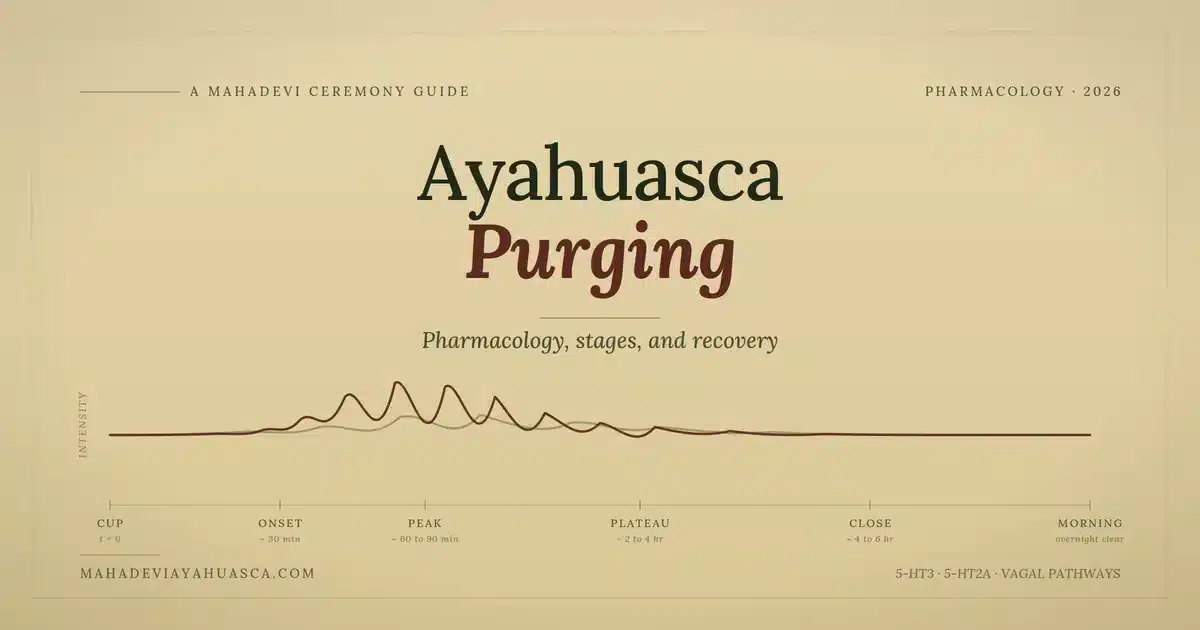
| Form of Purging | What Is Happening | Typical Window | Frequency |
|---|---|---|---|
| Top purge (vomiting) | 5-HT3 and 5-HT2A activation in gut and brainstem | 20 to 90 minutes after dose | Most common; ~70% of participants |
| Bottom purge (loose stool) | Gut serotonin flooding, peristaltic acceleration | Can occur anytime in ceremony | Less common but normal |
| Sweating, yawning, shaking | Autonomic activation; somatic release | Throughout ceremony | Very common; often unnoticed |
| Crying, laughing, sounds | Emotional discharge tracking the medicine | Throughout ceremony | Common; varies by person |
| No visible purge | Internal release without somatic event | Whole ceremony | A real outcome, not a failure |
The purge is the part of the ayahuasca experience most participants worry about before their first ceremony, and the part most stop worrying about after. Mechanism is specific, forms are plural, duration is short. What follows is the pharmacology of why it happens, the spectrum of how it shows up, the traditional reading of what it is for, and the practical work of preparing so the body can do its job cleanly.
Why the Ayahuasca Purge Happens
The body is not malfunctioning. It is responding accurately to the pharmacology of the brew.
Ayahuasca is two plants doing two jobs. Banisteriopsis caapi, the vine, contributes β-carboline alkaloids that inhibit monoamine oxidase A, the enzyme the gut uses to degrade DMT and other monoamines on contact. Psychotria viridis, the chacruna leaf, contributes the DMT itself. For the broader picture of the brew, the lineages, and the chemistry, see our complete ayahuasca guide.
With MAO-A blocked, DMT reaches the bloodstream and the brain. With MAO-A blocked, serotonin also accumulates throughout the body, especially in the gut, where more than ninety percent of the body’s serotonin lives (Egger et al., 2024).
This is where purging starts. Serotonin floods the 5-HT3 receptors in the gut wall and the chemoreceptor trigger zone in the brainstem. β-carbolines and DMT bind 5-HT2A receptors centrally and peripherally. Vagal pathways carry the signal upward, and the body reads the convergence as a need to expel (Politi et al., 2022).
The same receptor family is what chemotherapy anti-nausea drugs target when they block emesis. Ayahuasca is doing the inverse, and doing it on purpose.
The Many Forms a Purge Takes
Vomiting is the most visible form. It is not the only form, and it is not the measure of anything.
The Spanish-speaking traditions call vomiting the top purge and loose stool the bottom purge. Both are common. Neither is required. Sweating, yawning, shaking, crying, laughing, and waves of heat or cold all count as purging in the curandera vocabulary, because the underlying meaning is the same: something is being moved out of the body.
Some ceremony participants vomit forcefully and cleanly, surprised by how little discomfort there is. Others vomit in small, repeated waves through the night. Others have a single bottom purge and otherwise sit quietly. A meaningful number of participants experience full ayahuasca ceremonies without any visible purge at all, and report afterward that something nonetheless moved.
The pattern that holds across forms: the purge is intermittent, not continuous. It comes in waves, with stretches of stillness between. The bucket is there, and then it is not needed for an hour, and then it is needed again. This is normal.
How Long Ayahuasca Purging Lasts
The acute purge takes minutes. The pharmacology window is hours. The recovery is overnight.
Each individual episode of vomiting or bottom purge usually lasts seconds to a minute or two. Across the ceremony, episodes cluster in the first ninety minutes after dosing, when DMT and β-carboline blood levels are climbing toward peak. The full ayahuasca ceremony runs four to six hours from cup to closure. Most participants are not purging for most of that time.
The medicine clears the system overnight. By the morning after, the gut signal has settled. By a typical five-night retreat’s third or fourth ceremony, most participants are purging less, not more, as the body learns the territory and the deeper releases shift from physical to emotional. The reverse pattern, with purging escalating night after night, is uncommon and worth flagging to the facilitator.
What Tradition Says the Purge Is For
Indigenous and mestizo traditions across the Western Amazon read the purge as the medicine working, not the medicine misfiring.
The phrase la purga belongs to Spanish-speaking curanderos in the Putumayo and the Peruvian Amazon, where the work has been done in unbroken transmission for generations. The vegetalista tradition documented by Luis Eduardo Luna in the early 1980s names ayahuasca itself as la purga, and uses the saying la purga misma te enseña, the purge itself teaches you, to convey that the medicine and the release are not separate phenomena (Luna, 1984).
This traditional reading sits inside an older cosmology. In that vocabulary, the body holds what the body has been carrying, and negative energy is not a metaphor; it is a way of naming the residue of what has not been digested in the larger sense. The purge becomes the body returning what is not its own. A reader who does not share the cosmology can still notice that the experience matches the language.
A 2023 review in the psychotherapeutic literature reaches the same conclusion in different vocabulary, naming purging as one of five core psychotherapeutic processes of ayahuasca, mediated by harmala effects on stomach enzymes and DMT activation of gut serotonin receptors, and consistently experienced by participants as emotional and psychological release rather than illness (Perkins et al., 2023).
One sentence carries this section. What the body releases, the body knew it was holding.
How to Prepare So the Purge Lands Cleanly
The pre-ceremony work is mostly subtractive. Stop adding things the medicine will then have to fight.
The traditional dieta is more than a list of restrictions. In Amazonian medicine it is a therapeutic system in its own right, designed to clear the body’s pharmacological and energetic load before the brew arrives (O’Shaughnessy & Berlowitz, 2021). For a ceremony participant, the practical version reduces to a short list.
The non-negotiable medication washouts. SSRIs, SNRIs, tricyclics, pharmaceutical MAOIs, lithium, tramadol, and other serotonergic agents are contraindicated. The combination with ayahuasca’s β-carbolines can produce serotonin syndrome, a documented and potentially fatal medical emergency.
The first published case linked fluoxetine and ayahuasca, and remains the reference standard nearly thirty years later (Callaway & Grob, 1998). Washout periods are medication-specific and require supervision by a prescribing physician. For the full breakdown of agents and washouts, see our SSRI and MAOI interaction guide.
The dietary work in the days before. Avoid tyramine-heavy foods: aged cheeses, cured meats, fermented foods. Avoid alcohol, recreational drugs, and stimulants in the seventy-two hours before ceremony. Eat lightly the day of, and stop eating four to six hours before the cup is poured. Hydrate.
What the body needs at the level of mindset. Resistance to vomiting tightens the diaphragm and prolongs the wave. Surrender shortens it. Almost every participant who has been through several ayahuasca experiences will say the same thing: the purge is easier than the resistance to it.
After the Purge: Recovery and the Day After
The hours after the ceremony are quieter than most participants expect, and more important than most retreats explain.
Vomiting and sweating cost fluid and electrolytes. The post-ceremony window calls for water, mineral replacement, and rest. Light, easily digested food the next morning, with a focus on whole grains, fruit, and clear protein, helps the gut settle. Heavy meals or alcohol on the day after a purge undo the work the body just did.
The longer arc matters more than the meal. A 2025 study measuring gut microbiome composition before and after ayahuasca ceremonies found measurable reductions in pro-inflammatory bacterial taxa and matching reductions in depression scores (Follestad et al., 2025). The findings suggest the purge is not only an acute event but the visible edge of a deeper recalibration of the gut-brain axis.
This is one mechanism among several, and the research is early. The point is that the body keeps working after the bucket is put away.
Integration support, professional or peer, is what carries the work past the retreat. The purge is the visible part of the release. The integration is the part that decides whether the release becomes a change.
When the Purge Becomes a Warning Sign
Most purges resolve. A small set of presentations should not be waited out.
The largest survey of ayahuasca use to date, with 10,836 participants in more than fifty countries, reported physical adverse effects in 69.9 percent of participants and only 2.3 percent requiring medical attention (Bouso et al., 2022). Those percentages are the right shape. A careful retreat’s work is to keep its participants out of the 2.3 percent.
Signs that a purge has crossed into a medical event include:
- Sustained vomiting beyond the ceremony’s pharmacology window
- Severe muscle rigidity or sustained tremor
- Body temperature climbing past 38.5°C
- Agitation that does not settle
- Confusion that deepens rather than clears
These are the signs of serotonin syndrome, of cardiovascular strain, or of the rare psychiatric decompensation. A trained facilitator recognizes them (White et al., 2024). A trained facilitator also screens for the medication and condition combinations that make these events likelier, before ceremony, in writing.
If any of the above occur and persist, the response is to go to a hospital and tell the physician what was taken. The medical staff will not judge. They will help.
Feel deeply.
Show up fully.

Frequently Asked Questions
Will I throw up during my first ayahuasca ceremony?
Probably, though not certainly. Around seventy percent of ayahuasca ceremony participants vomit in some form. The rest purge through sweating, yawning, crying, shaking, or simply through internal release without a visible event. The first ceremony tends to carry the most physical purging. Subsequent nights typically lighten.
How long does ayahuasca purging last?
Each episode of vomiting or loose stool usually takes seconds to a minute or two. Episodes cluster in the first ninety minutes after dosing and come in waves with stillness between. The full ceremony runs four to six hours, and the medicine clears the system by morning. The acute purge is brief, even when the ceremony is long.
Why does ayahuasca cause diarrhea in some people?
The same serotonin flooding that causes vomiting accelerates peristalsis in the lower gut. Ninety percent of the body’s serotonin lives in the gastrointestinal tract, and ayahuasca’s MAO-A inhibition raises serotonin throughout it. For some bodies the strongest signal is in the upper gut. For others it is in the lower gut. Both are normal expressions of the same underlying mechanism.
Is it bad if I do not purge during an ayahuasca ceremony?
No. Not purging visibly does not mean nothing happened. The medicine works at a depth that does not require a bucket. Curanderos consistently note that participants who do not vomit can still receive the full benefit of the ceremony. The purge is a feature of the experience for many, not a measure of efficacy for any.
Can I take anti-nausea medication to stop the purging?
No. Anti-nausea drugs that block 5-HT3 receptors directly oppose the medicine’s mechanism, and many anti-emetics carry their own interaction risk with MAO-A inhibitors. Beyond the pharmacology, suppressing the purge defeats the purpose for which most ceremony participants drink. The bucket is part of the work, not an obstacle to it.
What should I avoid mixing with ayahuasca before a ceremony?
SSRIs, SNRIs, tricyclic antidepressants, pharmaceutical MAOIs, lithium, tramadol, dextromethorphan, St John’s wort, 5-HTP, and triptans are the highest-risk combinations and require supervised washout. Alcohol, recreational stimulants, MDMA, and tyramine-heavy foods like aged cheese and cured meats should be avoided in the days before. A reputable ayahuasca retreat will screen for all of these in writing.
How is ayahuasca purging different from being sick?
Ordinary vomiting from illness is forceful, prolonged, and leaves the body drained. Ayahuasca purging usually arrives without prolonged nausea, resolves quickly, and is most often followed by a sense of lightness rather than depletion. The pharmacology is different. The body’s experience of it is different. Most ceremony participants describe the difference clearly after their first night.
What should I eat after an ayahuasca ceremony to recover?
Light, easily digested food. Whole grains, fruit, broth, clear protein. Hydrate aggressively, with electrolytes if available. Avoid alcohol, heavy fats, and processed foods on the day after. Most retreats provide an integration-friendly menu the morning after a ceremony, designed to settle the gut and support the deeper recalibration the medicine has begun.
What if I am embarrassed about vomiting in front of other people?
The ceremony space is dark. Each participant has their own bucket. Other people are usually purging at the same time, or doing their own internal work and not paying attention. Facilitators have seen every form of purging across thousands of nights and treat it as the work, not as a scene. After the first night the embarrassment usually disappears entirely.
Is ayahuasca hard on the body?
In a screened, supervised setting, ayahuasca is generally safe. The largest global survey to date found that 2.3 percent of users required medical attention for an adverse event. The risk concentrates in unsupervised contexts and in participants with unscreened cardiovascular conditions, psychiatric histories, or contraindicated medications. The body works hard during the ceremony. With proper preparation, it recovers cleanly.
Conclusion
The purge is the part of ayahuasca that most participants dread before their first cup, and the part most stop dreading after.
The mechanism is specific. Two plants, one enzyme blockade, a flood of serotonin in the gut, a signal traveling the vagus nerve to the brainstem, and the body doing what the body does when the receptors say to. The forms it takes are plural. The duration is short. The traditional reading and the pharmacological reading agree more than the surface vocabulary suggests.
What carries through the night is not what the bucket holds. What carries through is what the body decides to release because the body finally had the medicine to release it.
The medicine is wild. The release is honest.
