Ayahuasca and DMT: The Sacred Relationship Between the Vine and the Spirit Molecule
| Aspect | Ayahuasca | N,N-DMT (smoked) |
|---|---|---|
| What it is | A brew of two plants | A single isolated molecule |
| Active component | DMT made orally active by harmala alkaloids in the vine | DMT alone |
| Onset | 30 to 60 minutes | Under 30 seconds |
| Duration | 4 to 6 hours | 15 minutes |
| Setting | Ceremony with dieta, intention, maestra or maestro | Variable, often unguided |
| Lineage | Indigenous Amazonian, centuries deep | Modern Western, mostly post-1960s |
Most popular writing collapses ayahuasca and DMT into one word. The collapse is convenient and wrong. DMT is one of the brew’s two essential components. The vine is the other. What changes when you put them together is not just chemistry. It is the difference between a fifteen-minute fireworks show and a night’s worth of teaching.
What Are Ayahuasca and DMT?
The molecule is old. The brew is older.
Swallow DMT and nothing happens. Smoke it and you are gone for fifteen minutes. The same molecule, two outcomes. That is pharmacology.
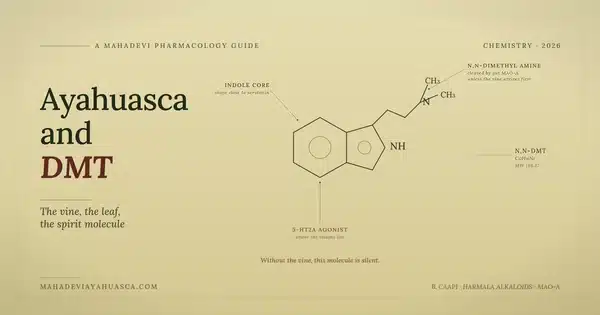
DMT is dimethyltryptamine, a serotonergic compound that occurs naturally in dozens of plants, in some animals, and in trace amounts in mammalian tissue. Its molecular shape is close to serotonin’s. Smoked or vaporized, it crosses the blood-brain barrier in seconds and produces an intense, short altered state. Swallowed alone, it produces nothing. The gut’s monoamine oxidase enzyme breaks it down before any of it reaches the brain.
Ayahuasca is the Amazonian preparation that solves that problem. The Quechua name, often translated as “vine of the soul,” refers specifically to Banisteriopsis caapi, the woody liana whose harmala alkaloids reversibly inhibit the same enzyme that would otherwise destroy oral DMT (Egger et al., 2024). The brew pairs the vine with a DMT-containing leaf. In Peru and most of the eastern Amazon, that leaf is chacruna, Psychotria viridis. In Colombia’s Putumayo and across Ecuador, where the brew is more often called yagé, the leaf is chaliponga, Diplopterys cabrerana (Brito-da-Costa et al., 2020).
Two plants. One brew. Without both, nothing happens. For the broader picture of the brew, the lineages, and the ceremony, see our complete ayahuasca guide; for where DMT-containing plants sit alongside iboga, San Pedro, and other ceremonial medicines, see our plant medicine overview.
The Sacred Pairing: How DMT and the Vine Become Ayahuasca
The pairing is precise. It is also old.
The pharmacology is not complicated, but it is elegant. The β-carboline alkaloids in the vine, harmine, harmaline, and tetrahydroharmine, are reversible inhibitors of monoamine oxidase A, the enzyme responsible for deaminating DMT in the digestive tract (Ruffell et al., 2020). Inhibit MAO-A and the DMT in the leaf survives the gut, reaches the bloodstream, and crosses into the brain, where it acts primarily at the 5-HT2A serotonin receptor.
Tetrahydroharmine, the third major β-carboline, also acts as a weak serotonin reuptake inhibitor, contributing to ayahuasca’s longer, more contoured arc (Ruffell et al., 2020). Whether the molecules act synergistically or additively remains an open question in the published literature, which is the kind of honest detail most articles leave out.
The vines and leaves are not interchangeable across regions. Phytochemical analysis confirms variability in DMT content between leaf species and even within batches of the same species (Callaway, Brito & Neves, 2005). Chaliponga leaves contain meaningfully more DMT per gram than chacruna, which is one reason brews from Colombia and Ecuador can hit differently than those from Peru (Chambers et al., 2020).
| Plant | Role | Active Compound | Region |
|---|---|---|---|
| Banisteriopsis caapi (the vine) | MAO-A inhibitor; “the spirit of the brew” in Indigenous cosmology | Harmine, harmaline, tetrahydroharmine (β-carbolines) | Throughout the Amazon basin |
| Psychotria viridis (chacruna) | DMT-containing admixture in most Peruvian brews | N,N-DMT | Peru, eastern Amazon, Brazilian churches |
| Diplopterys cabrerana (chaliponga) | DMT-containing admixture in most yagé brews | N,N-DMT (higher concentration than chacruna) | Colombia, Ecuador, parts of Peru |
| Mimosa hostilis (jurema) | Used in non-Amazonian preparations called analogues | N,N-DMT (in root bark) | Brazilian northeast; not traditional in classical ayahuasca |
The Amazonian brew is two plants in conversation. Western analogues that substitute Syrian rue for the vine and Mimosa for the leaf reproduce the chemistry without the lineage. They work pharmacologically. They are not ayahuasca.
Ayahuasca vs DMT: Six Differences That Matter
The differences are not academic. They change what the experience is.
Most of the “is ayahuasca stronger than DMT” question dissolves when you look at the actual experience rather than the molecule. Smoked DMT and ayahuasca share an active compound and almost nothing else. They are different journeys, different containers, and different invitations.
| Dimension | Ayahuasca (drunk) | N,N-DMT (smoked) |
|---|---|---|
| Onset | 30 to 60 minutes after drinking | Under 30 seconds after inhalation |
| Duration | 4 to 6 hours of full experience, 1 to 2 hours of comedown | 15 minutes total, peak in 5 |
| Route | Oral, with the body’s full digestive participation | Inhaled, bypassing the gut entirely |
| Setting | Traditionally a ceremony with maestra, icaros, dieta | Variable; often a single room, often unguided |
| Character | Slow build, embodied, narrative arc, often emotional | Sudden, geometric, often described as breakthrough |
| Integration | Days to months of ongoing work expected | Often treated as discrete; integration framework less established |
The sustained arc is what makes ayahuasca a teaching rather than a fireworks show. The brew’s active interaction is not just DMT plus MAOI. The synergy with tetrahydroharmine likely shapes the affective texture as well, though the literature has not fully resolved this (Ruffell et al., 2020).
Smoked DMT is a fast event. Ayahuasca is a long teaching. The sustained four-to-six-hour arc is not a longer version of the same experience. It is a different one entirely (Reckweg et al., 2022). The body has time to participate. Memories surface in sequence. The visions, when they come, are stitched into a story that has a beginning, a middle, and an end.
Ayahuasca also includes the body. The purga, the vomiting and other physical clearing, is a physiological feature, not a side effect. Smoked DMT bypasses all of that. Which one is more useful depends on what you are after.
Where 5-MeO-DMT Fits, and Where It Doesn’t
A different molecule. A different journey. A different lineage.
5-MeO-DMT is often confused with N,N-DMT and with ayahuasca, sometimes by people who should know better. It is a different compound. Its receptor profile, its effects, and its origin all diverge from what is in the brew.
5-MeO-DMT is found in the venom of the Sonoran Desert toad and in some plants outside the Amazon. It is also synthesized. Its primary affinity is for the 5-HT1A receptor, not the 5-HT2A receptor that ayahuasca’s DMT preferentially binds (Reckweg et al., 2022). The experience is reported as a near-complete dissolution of self with little of the visual, narrative, or geometric character that ayahuasca brings. Smoked or vaporized, it lasts 15 to 30 minutes.
5-MeO-DMT is not in ayahuasca. The Amazonian brew contains N,N-DMT, a different molecule with a different action (Callaway, Brito & Neves, 2005). The traditions that work with each are different too. Ayahuasca belongs to the Amazon. 5-MeO-DMT, in its modern ceremonial use, is mostly a recent Western practice that took shape in the last few decades.
If you are choosing between them, you are choosing between two unrelated medicines that happen to share three letters in their names. They are not the same path.
What the Ceremony Holds: Vine, Leaf, Song, and Maestra
The chemistry is necessary. The ceremony is what makes it medicine.
The pharmacology of ayahuasca explains why the brew works. It does not explain why it has been used the way it has been used. For that, you have to look at the room.
The Indigenous Amazonian traditions that hold ayahuasca are plural. The Shipibo-Konibo of the Peruvian Ucayali work with personalized icaros, sacred medicine songs received from plants during years of dieta and used as diagnostic and therapeutic instruments by trained onanyabo (Gonzalez et al., 2021). The Inga, Kamëntsá, Cofán, and Siona peoples of Colombia’s Putumayo work with yagé, often led by taitas whose lineage extends through generations of apprenticeship (Suárez Álvarez & ICEERS, 2023). The Brazilian ayahuasca religions, Santo Daime, União do Vegetal, and Barquinha, emerged in the 1930s through 1960s, synthesizing Amazonian vegetalismo with Catholic and Afro-Brazilian elements (Labate & MacRae, 2010).
The dieta is central to all of this. It is not a cleanse and it is not a wellness practice. The dieta is a long-form discipline of restriction and isolation in which a healer-in-training learns from specific plants over weeks or months, often years. It is the primary method by which the knowledge in this tradition is passed (O’Shaughnessy & Berlowitz, 2021).
The ceremony itself usually unfolds at night, in a maloca or ceremony space, with the maestra or maestro leading. Mapacho, sacred tobacco, is used to clear the space. The icaros structure the experience. The participant drinks. The medicine begins. What happens next is held by everything around it.
This is where the difference between drinking ayahuasca in ceremony and ingesting DMT outside one becomes most visible. The chemistry is the same. The container is not. Decades of ethnobotanical work have documented the depth of Amazonian botanical knowledge that informs the ceremony, the dieta, and the relationship between healer and plant (Schultes & Raffauf, 1992).
The medicine is wild. The container is what makes it usable.
Safety, Screening, and Who Should Not Drink
Most who sit with ayahuasca are fine. Some absolutely should not.
The largest survey of ayahuasca use to date, with 10,836 participants across more than fifty countries, found that 69.9 percent of participants experienced acute physical effects, mostly vomiting, but only 2.3 percent required medical attention (Bouso et al., 2022). That is a meaningful number in absolute terms and a small one in relative terms. The brew is not benign, and most who drink it under proper guidance come through.
The most serious risks are pharmacological. Ayahuasca’s β-carbolines are MAO inhibitors, and combining them with serotonergic medications can produce serotonin syndrome, a potentially life-threatening condition that has been documented since the late 1990s (Callaway & Grob, 1998). The list of contraindicated medications is longer than most weekend retreats let on. For washout windows by drug class, see our SSRI and MAOI interaction guide.
Medications that are contraindicated or require careful washout
- SSRIs (sertraline, escitalopram, fluoxetine, others)
- SNRIs (venlafaxine, duloxetine)
- Tricyclic antidepressants and MAOIs
- Tramadol and certain opioids
- Triptans for migraine
- Dextromethorphan
- Lithium
- St. John’s wort
- Stimulants and ADHD medications, case by case
Conditions that warrant exclusion or caution
- Cardiovascular disease and uncontrolled hypertension; ayahuasca raises blood pressure and heart rate measurably (Riba et al., 2003)
- Personal or first-degree family history of psychotic or bipolar disorders (dos Santos et al., 2017)
- Active epilepsy
- Pregnancy and breastfeeding
- Severe liver or kidney disease
Substances to clear before ceremony
- Alcohol, in the days before
- MDMA, stimulants, and other serotonergic recreational substances
- Cannabis use should be discussed with the facilitator
The screening conversation is the place where all of this is sorted. A retreat that does not ask careful questions before accepting you is not a retreat that should be trusted with your nervous system. ICEERS has published a thorough guide for participants and organizers that lays out best practices in detail (ICEERS, 2019).
Legality: Where the Plants Stand and Where Ceremony Lives
DMT is scheduled. The plants, in most places, are not.
The legal landscape around ayahuasca turns on a single distinction. DMT, as an isolated molecule, is a Schedule I controlled substance under the 1971 Convention on Psychotropic Substances and under most national laws derived from it (UNODC, 1971). The plants that contain DMT are not, with very few exceptions, subject to international control. Neither is the brew itself (Rebollo & Sánchez Avilés, ICEERS, 2019).
This is why the legal situation is patchwork. In the United States, DMT is Schedule I under the Controlled Substances Act (DEA Diversion Control Division, 2024). The Supreme Court’s unanimous 2006 ruling in Gonzales v. UDV established a religious-use exemption for the União do Vegetal church under the Religious Freedom Restoration Act (Gonzales v. UDV, 2006). Colorado decriminalized personal possession and use of DMT and several other natural psychedelics under Proposition 122 in 2022 (Colorado Proposition 122, 2022). Federal scheduling stays in place.
In Peru, the traditional uses of ayahuasca were declared National Cultural Heritage in 2008, protecting Indigenous ceremonial practice (INC Peru, 2008). In Brazil, religious use by Santo Daime, UDV, and Barquinha was formally regulated by CONAD in 2010 (Labate & Feeney, 2012). In Colombia, yagé has long-standing cultural recognition without specific prohibition, and Indigenous Amazonian communities have continued ceremony throughout (Suárez Álvarez & ICEERS, 2023).
The practical effect: most people who want to drink ayahuasca in a serious lineage travel to a country where the brew is permitted and ceremony is held within recognized practice. That is the path most retreats are built around.
Beginning Your Path: Preparation and Integration
The ceremony is the easy part. The before and after are the work.
If you are reading this seriously, you are probably in some version of the question of whether to drink. The decision is yours. What follows is what most people do not realize until they are already in it.
Before ceremony
- Set an honest intention. Not a wish list. The actual question you have not been able to answer in any other way.
- Get medically screened. A facilitator should ask about every medication, every condition, every history. If they don’t, find another one.
- Wash out medications and substances on the timeline your prescriber gives you. Some require longer than others.
- Do the dieta if it is offered. No salt, no sugar, no pork, no alcohol, no recreational substances, no sexual activity, often for days or weeks. The point is not virtue. It is preparation of the body and the field.
- Tell someone you trust where you are going. Plant medicine is not a vacation.
After ceremony
- Plan for integration. The work that comes after the ceremony is often more important than the ceremony itself. Real change requires landing what was shown.
- Find a practitioner who knows this territory. Therapists, integration coaches, somatic practitioners; many but not all are familiar with plant medicine. Ask before you book.
- Be slow with big decisions. The first weeks after a strong experience are not the time to quit your job or end your marriage.
- Re-engage the dieta gradually. The body is open. What you feed it matters.
The ceremony is one night. The path is the rest of your life. People who treat the medicine as a single event tend to leave most of what was offered on the floor.
Feel deeply.
Show up fully.
Frequently Asked Questions
Is DMT the active ingredient in ayahuasca?
Yes, with a caveat. DMT is the primary visionary compound, but it does nothing on its own when swallowed. The β-carbolines from the Banisteriopsis caapi vine are what make the DMT orally active by inhibiting the gut’s MAO-A enzyme. Calling DMT the active ingredient without naming the vine misses half the medicine.
How much DMT is in ayahuasca?
It varies considerably. Mass spectrometry of ayahuasca brews has measured DMT concentrations ranging from roughly 30 to 155 milligrams per liter, with chaliponga-based yagé brews on the higher end of that range and chacruna-based Peruvian brews lower (Chambers et al., 2020). A standard ceremonial cup is typically 50 to 150 milliliters. Concentration depends on plant variety, brewing method, and lineage tradition.
Is ayahuasca stronger than DMT?
“Stronger” is the wrong frame. Smoked DMT is more intense moment to moment, with peak effects unlike anything else in the psychedelic family. Ayahuasca is far longer, more embodied, and structured by the vine’s β-carbolines into an arc with a beginning, middle, and end. They are different journeys, not different doses of the same one.
Can ayahuasca be made without DMT?
A brew of just Banisteriopsis caapi without a DMT-containing leaf is sometimes called caapi-only, vine-only, or “ayahuasca without chacruna.” It is psychoactive and traditional in some lineages, but the visionary character is markedly different. Most people use the word “ayahuasca” to mean the full pairing of vine and leaf. Without the leaf, you are drinking the vine, which is a different practice.
What type of DMT is in ayahuasca?
N,N-dimethyltryptamine, often written as N,N-DMT. This is the same molecule that is smoked or vaporized as freebase DMT in non-Amazonian use. It is distinct from 5-MeO-DMT, a related but pharmacologically different compound found in toad venom and some plants outside the Amazon. Ayahuasca contains N,N-DMT only.
Why does ayahuasca last longer than smoked DMT?
The body metabolizes DMT continuously over the course of digestion rather than receiving a single fast bolus through the lungs. The vine’s MAO inhibitors slow DMT breakdown so a steady level reaches the brain over hours. Tetrahydroharmine in the vine also acts as a weak serotonin reuptake inhibitor, which contributes to ayahuasca’s longer affective tail (Ruffell et al., 2020).
Is 5-MeO-DMT found in ayahuasca?
No. Ayahuasca contains N,N-DMT only. 5-MeO-DMT is a different compound, found primarily in the venom of the Sonoran Desert toad and in some plants outside the Amazon. Its receptor profile favors 5-HT1A over 5-HT2A, and the experience it produces is reported as fundamentally different from ayahuasca’s (Reckweg et al., 2022). Confusing the two is common and worth correcting.
What is an “ayahuasca analogue” or anahuasca?
An ayahuasca analogue, sometimes called anahuasca, is a non-Amazonian preparation that uses different plants to reproduce ayahuasca’s pharmacology. The MAO inhibitor often comes from Syrian rue (Peganum harmala) and the DMT often from Mimosa hostilis root bark. The chemistry works. The lineage, the ceremony, and the cultural container that give ayahuasca its meaning are absent. They are a related but distinct practice.
Conclusion
DMT is the molecule. Patience belongs to the vine, the slow chemistry that lets the molecule do its work. The ceremony holds them both.
None of them is the whole thing. Calling ayahuasca “just DMT” misses the vine, the dieta, the icaros, the maestra, and several centuries of accumulated knowledge about what to do when the medicine arrives. Calling it “spiritual” without naming the chemistry misses the actual mechanism.
Both are true at once. The brew is pharmacology and lineage at the same time. The work is to honor both.
The vine has been holding the molecule for a long time. What science is now describing, the Amazon never forgot.
References
Rebollo N, Sánchez Avilés C. (2019). Ayahuasca and the law. ICEERS.
Labate BC, MacRae E (Eds.). (2010). Ayahuasca, Ritual and Religion in Brazil. Routledge.
United Nations Office on Drugs and Crime. (1971). Convention on Psychotropic Substances, 1971.
