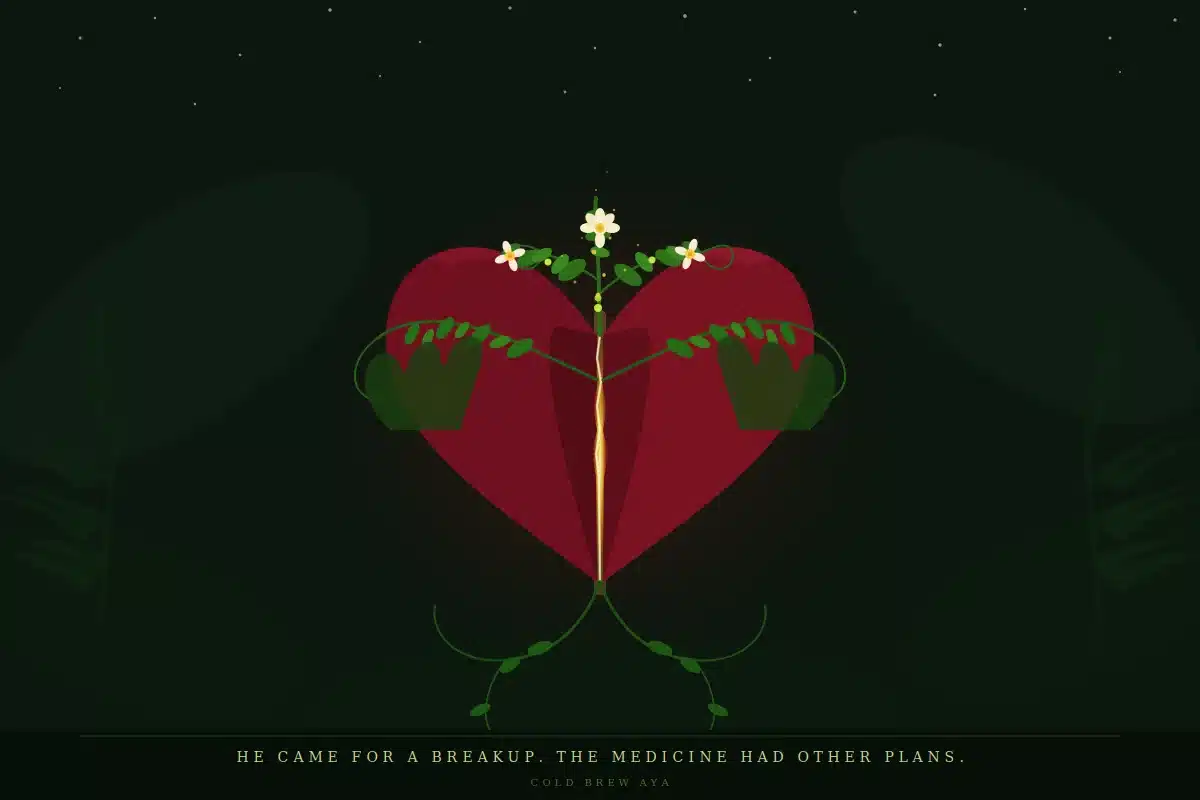
He Came for a Breakup. The Medicine Had Other Plans.
There’s a particular kind of suffering that doesn’t show on the outside.
You look fine. You sound fine. You make it to the dinner, cancel the next three, apologize, make plans again. People assume you’re flaky, or antisocial, or going through something temporary. They don’t see the exhaustion underneath. The brain fog that makes a normal conversation feel like running uphill. The aches that don’t have a clean explanation. The way your body uses every resource just to stay functional, leaving nothing left for anything else.
This is the daily reality of living with a chronic autoimmune disease. And for a long time, it was Fabian’s.
I met Fabian at one of my first retreats in Colombia. He had a quiet energy, slightly nerdy, the kind of person who made you feel immediately at ease without really trying. We became friends afterward, mostly because we both lived in Medellín and found ourselves in similar circles.
Making plans with Fabian was an exercise in patience. He’d confirm something, then cancel the morning of. Not once or twice. Consistently. I could have taken it personally. But the more time I spent around him, the more I understood it wasn’t about me at all. He was managing something that I couldn’t see from the outside, and on the days his body decided not to cooperate, there was no negotiating with it.
He had been diagnosed with an autoimmune disease some years before we met. Chronic, systemic, and mostly invisible to anyone who wasn’t living inside it. He’d tried what his doctors offered. Multiple treatments, multiple approaches, multiple practitioners. Nothing had resolved it. Some things helped temporarily. Nothing held. And beyond the physical symptoms there was the secondary damage that chronic illness does to a life, the isolation, the inability to commit, the way it quietly shrinks your world until you’re managing instead of living.
The Wrong Door Opened the Right One
Fabian came to ayahuasca for a reason that had nothing to do with his autoimmune disease.
He had just come out of a painful breakup. That was the presenting wound, the one he could name and point to. He wasn’t arriving with a healing protocol or a list of intentions around his physical health. He was arriving the way most people arrive, with the thing that was hurting most in the foreground, not necessarily knowing what was waiting underneath it.
His first few ceremonies were oriented around that grief. Breakups carry their own particular weight. They’re not just about the person. They’re about the version of yourself you built around that relationship, the future you imagined, the identity you constructed. Ayahuasca tends to go past the surface story into the architecture underneath it. And for Fabian, that architecture turned out to be more complicated than a relationship ending.
He kept coming back. Week after week, ceremony after ceremony, he showed up. From the outside this puzzled me, because Fabian would tell me he didn’t have time for friends, didn’t have energy for social events, but he always found a way to make it to the next ceremony. I didn’t question him on it. People have their reasons, and who was I to rank his priorities. Over time it became clear that these weren’t just a therapeutic escape for him. They had become a lifeline, a consistent thread back to something he couldn’t quite access in everyday life.
The medicine was giving him something.
The Ceremony That Changed the Conversation
Several months in, after a particularly deep ceremony, Fabian and I sat by the fire in the quiet hours that follow the ceremony space. There’s a quality to those hours that’s hard to describe. The night is very still. People are more raw than they usually allow themselves to be. Conversations that would take weeks to arrive at in ordinary life happen in ten minutes.
Fabian started talking about his autoimmune disease. Not as background context. As the center of what he’d experienced that night.
He told me that during the ceremony, he had seen his disease. Not symbolically. Not as a metaphor he was constructing afterward. He had encountered it directly, the way the medicine sometimes takes you into the interior of something and shows you what is actually there, stripped of everything you’ve been layering on top of it.
What he saw was the root. Where the condition had started. What had originally triggered the immune system into this sustained misfiring. And it was not what any of his doctors had been looking for. It wasn’t purely physical in origin. What the medicine showed him was connected to stress, specifically to a chronic, unrelenting stress response that had been running in the background of his life for years. His inability to release certain things from his past. Patterns of self-pressure and emotional suppression that had never been addressed because they didn’t look like medical symptoms. They just looked like personality.
“It wasn’t just about the physical symptoms. It was about my mindset, my stress, my inability to let go of things from my past.”
The medicine had taken his breakup, which was what he thought he’d come to heal, and used it as a doorway into something much older and much deeper.
What Ayahuasca Actually Did
This is the part that gets collapsed in most ayahuasca storytelling, and the collapsing is where the damage happens.
Fabian did not drink the medicine and get well. That is not the story. The story is that the medicine gave him information he had not been able to access any other way, and then he went home and used that information to change his life.
He adjusted his diet, significantly. He incorporated mindfulness practices and kept them. He changed how he managed stress. He looked honestly at the emotional patterns the medicine had identified and worked on them, not in ceremony but in the mundane texture of his daily choices. Most importantly, he shifted his fundamental relationship with his own body. He had been fighting the disease, treating his immune system as a malfunction to be corrected, an enemy to be suppressed. After what the medicine showed him, he stopped fighting it. He started working with it. His body as a partner, not an opponent.
That shift sounds simple stated plainly. It is not simple to actually make. It requires dismantling a relationship with your own suffering that has been calcifying for years. Most people can’t do that work alone, and most people can’t do it quickly. Fabian didn’t do it quickly either. It was a process that unfolded over months.
Two years after his first ceremony, his autoimmune disease was gone.
When I asked him about it, he was precise with his words in a way I respected.
“Ayahuasca didn’t cure me. It showed me what I needed to see to help myself heal.”
That’s not modesty. That’s accuracy. And it matters, because if you conflate the two, you go into the ceremony expecting a cure and you skip the work. If you skip the work, the insight fades. The clarity that comes through in ceremony has a shelf life. What you do with it in the weeks and months after is what determines whether it becomes transformation or just a very intense memory.
What Modern Medicine Gets Wrong About Invisible Illness
I want to be careful here because this is not an anti-medicine argument. Fabian’s doctors were not incompetent. They were working within the diagnostic framework available to them, which is oriented toward identifying and suppressing biological dysfunction. That framework is genuinely useful for many things.
What it is not designed to do is look for the emotional and psychological architecture underneath a physical condition. It is not designed to ask what chronic stress has done to an immune system over fifteen years, or what unprocessed grief looks like when it manifests in the body, or how a person’s relationship with their own past might be maintaining a state of physiological alarm. These are not questions that fit neatly into a lab panel or a pharmaceutical protocol.
Ayahuasca asked those questions directly. That’s what it does, when it works and when the person is genuinely ready to hear the answers.
For Fabian, those were the right questions at the right time. His body had been trying to communicate something for years through symptoms. The medicine translated.
The Part No One Talks About
What strikes me most about Fabian’s story is not the healing itself. It’s the discipline of what came after.
He did not leave the ceremony and coast. He left the ceremony with a map and then he walked the territory the map described, day after day, making small adjustments that didn’t feel dramatic in any individual moment but accumulated over time into a different life. Different body. Different relationship to stress, to the past, to himself.
That kind of integration is unglamorous. It doesn’t make for a good before-and-after. There’s no single moment of transformation to point to. There’s just a person making different choices consistently, because the medicine showed him what was underneath his old ones, and he couldn’t unsee it.
He lives fully now. He has the energy to show up for people. He cancels plans a lot less. He pursues things that matter to him without the constant background drain of a body in crisis. The autoimmune disease is not something he manages anymore. It resolved.
He came to work on a breakup. The medicine noticed what actually needed attention and went there instead.
That’s not magic. That’s the medicine doing what it does when the conditions are right and the person is willing to follow where it leads.
Cold Brew Aya is an independent editorial brand exploring what ayahuasca actually is, how it works, and what it asks of the people who sit with it.
Feel deeply.
Show up fully.
About the Author
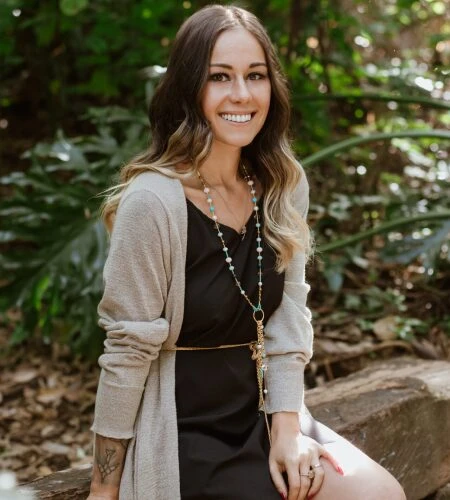
Ania Halama is the co-founder of MahaDevi Ayahuasca and Lead Facilitator and Head of Integration at the retreat center in Putumayo, Colombia. A holistic mentor, plant medicine facilitator, and two-time bestselling author, she is certified in EFT, Breathwork, Ho’oponopono, and Akashic Records. Ania has trained within plant medicine traditions, including dietas with Chullachaqui and Niwe Rao under indigenous guidance. Her work bridges ancient wisdom and modern integration tools to support participants in translating ceremony into grounded change in their lives.
