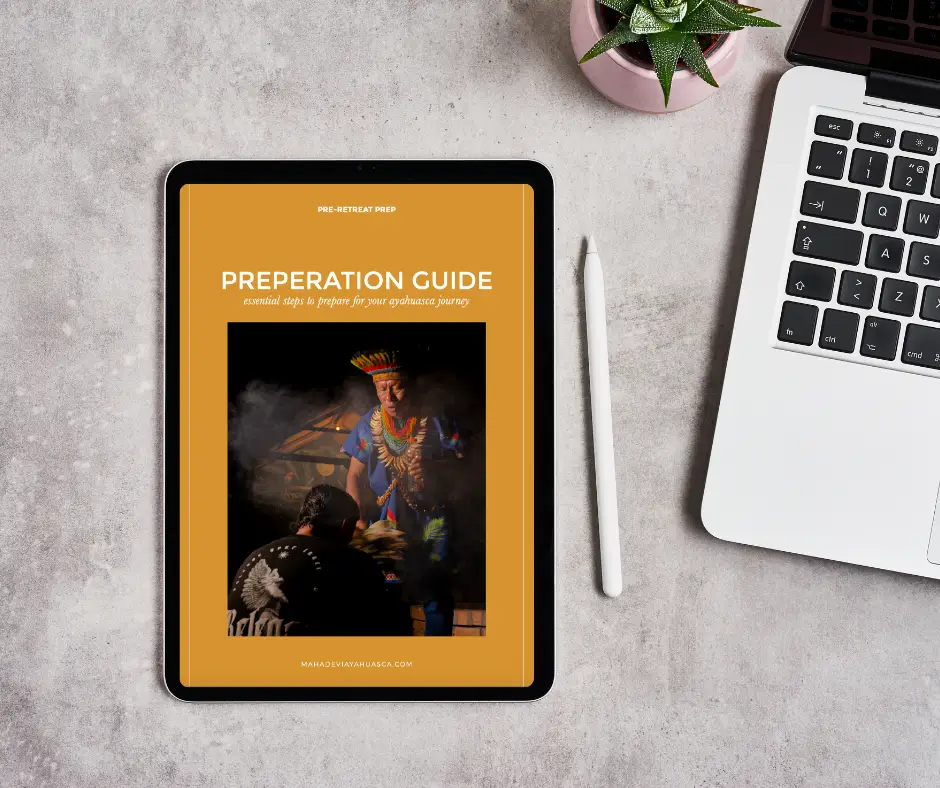
How to Prepare for Ayahuasca: The Complete Guide
| Ayahuasca Preparation | Key Facts | |
|---|---|---|
| Most important step | Stop serotonergic medications – washout required, not optional | Malcolm and Thomas, 2022 |
| Minimum food prep | 7 days of strict diet for those already eating cleanly | Berlowitz et al., 2018 |
| Cannabis | Stop at least 1 month before ceremony | ICEERS, 2019 |
| Intention | Set a direction; do not demand a specific outcome | Bourzat and Hunter, 2019 |
| Over-preparation risk | Attachment to expectations is one of the most common pitfalls | Watts and Luoma, 2020 |
| Level | Who It Applies To | Preparation Intensity |
|---|---|---|
| General ceremony | First-timers, occasional participants | Standard diet, medication check, basic intention |
| Deep healing work | Those working with specific trauma or addiction | More committed diet, closer facilitator communication |
| Master plant dieta | Initiates in extended plant work | Strict isolation, full dieta, extended timeline |
Why How You Prepare Is Already Part of the Medicine
The ceremony doesn’t begin when you drink. It begins the moment you decide to come.
That is not a poetic observation. It is a practical one. Every choice you make from the moment you commit to ceremony – what you eat, what you watch, who you spend time with, what you put into your nervous system – is already shaping the container you will bring to the circle. The medicine works with what is there. This is how both the Amazonian tradition and the clinical research on psychedelic outcomes describe it. Set and setting – the internal and external conditions around the experience – are among the strongest predictors of outcome (Perkins et al., 2021). The preparation is the first part of the set. In indigenous contexts, the relationship with the medicine often begins before the ceremony itself. Coming to ayahuasca is understood as a decision with weight, one that calls for a response in how you live in the days leading up to it (Bourzat and Hunter, 2019). You do not have to be perfect. You have to be present to the fact that something is already beginning.Ayahuasca Is Kind and Forgiving: The First Thing to Understand
The most widespread misconception about preparation is that ayahuasca punishes.
Most of what circulates about ayahuasca preparation is framed in fear. Break the rules and something will go wrong. Arrive imperfectly and the medicine will turn on you. Eat the wrong thing and you will have a terrible night. This is not an accurate picture of the medicine. Ayahuasca is kind. The medicine meets you where you are. It responds to what you bring with intelligence, not punishment. People have had deeply meaningful ceremonies after imperfect preparation. People have had difficult ceremonies despite following every rule precisely. Preparation matters because it creates the conditions that allow the medicine to work more easily – not because the medicine is keeping score (Luna, 1984; Gearin, 2024). What matters most is honesty and openness. Arrive knowing why you are there. Arrive having told your facilitator the truth about your health and your medications. Arrive with enough internal space that the medicine has room to move. That is the real preparation.Depth, Intention, and Why Preparation Is Not One-Size-Fits-All
Someone sitting in ceremony for general purposes needs significantly less preparation than someone working through deep trauma with a master plant.
Preparation is not uniform because the work is not uniform. The depth of what you are entering determines what the preparation should look like. For general ceremony purposes – someone attending for the first time or returning for personal growth or healing – solid basic preparation is sufficient. The dietary restrictions, the medication check, a clear intention, and a rested body. For deep healing work – someone working with specific trauma, grief, addiction, or a significant psychological pattern – a more committed preparation and closer communication with the facilitator is warranted. The medicine will likely go deeper. Arriving cleaner matters more. For those entering a master plant dieta – an extended initiation practice involving prolonged isolation, strict dietary restriction, and sustained plant work – the preparation timeline is a different conversation entirely (O’Shaughnessy and Berlowitz, 2019; Berlowitz et al., 2018). The personal variables that shape your preparation: your current medications, your health history, your experience with the medicine, and what you are working with. All of these shift the appropriate protocol. The best approach is always working directly with your facilitator, your healer, and your own healthcare provider.Medication Washout: The Non-Negotiable Starting Point
Washout from serotonergic medications is not a recommendation. It is a safety requirement.
Ayahuasca’s beta-carboline alkaloids inhibit monoamine oxidase A (MAO-A), the enzyme that normally breaks down serotonin and related compounds in the body. With MAO-A inhibited, serotonergic medications cannot be processed safely. The result can be a dangerous accumulation of serotonin, known as serotonin syndrome (Ruffell et al., 2020; Malcolm and Thomas, 2022). The medications that require complete washout before ceremony include SSRIs (fluoxetine, sertraline, escitalopram), SNRIs (venlafaxine, duloxetine), MAOIs, tricyclic antidepressants, trazodone, triptans, lithium, linezolid, dextromethorphan, and St. John’s Wort (ICEERS, 2019; Malcolm and Thomas, 2022). The washout timeline varies by drug. Most SSRIs require four to six weeks. Fluoxetine, because of its long half-life, requires longer. MAOIs require complete washout and the timeline should be determined with the prescribing doctor. This is not something to estimate based on what you have read online. If you are currently taking any serotonergic medication, the right action is to consult your prescribing doctor before making any changes and before committing to a ceremony date. Do not stop a medication without medical guidance. Do not assume a shorter timeline is sufficient. If stopping the medication is not currently possible, the honest answer is that this may not be the right moment to attend ceremony. The right moment will come. Attending while serotonergic medications are in your system is a serious risk that no ceremony experience justifies.The Dietary and Lifestyle Preparation Timeline
The timeline of what you stop, when you stop it, and why is the practical backbone of preparation.
The dietary preparation for ceremony is covered in full depth in the Ayahuasca Diet and Dieta guide. What follows is the consolidated timeline for participants preparing for ceremony at MahaDevi.| What to Stop | When to Stop It |
|---|---|
| Marijuana and recreational substances | 1 month before ceremony |
| Pornography | 1 month before – shapes the mental landscape the medicine moves through |
| Pork | 2 weeks before ceremony |
| Alcohol | 1 to 2 weeks before ceremony |
| Commercial cigarettes | 2 weeks before (recommended) |
| Red meat | 1 week before ceremony |
| Fermented foods and dairy | 1 week before ceremony |
| Caffeine | 1 week before ceremony |
| Sugary and processed foods | 1 week before ceremony |
| Heavy media, violent or sexual content | Begin reducing 2 weeks before |
| Serotonergic medications | Consult prescribing doctor – 4 to 6 weeks or longer |
Intention Setting: A Direction, Not a Demand
Setting an intention is powerful. Attaching to a specific outcome is a trap.
An intention is a direction you give to yourself and to the medicine. It tells the experience where your attention is, what you are open to, what you are willing to look at. It is not a request for a specific vision. It is not a demand that the medicine deliver a particular insight or healing. The medicine does not negotiate with your preparation itinerary. People who arrive holding a fixed idea of what their ceremony must deliver often find that the medicine goes somewhere else entirely. That somewhere else is usually where they actually needed to go. The rigidity of the expectation becomes the obstacle (Bourzat and Hunter, 2019; Watts and Luoma, 2020). A useful intention is honest and directional. Something like: I am open to seeing what I need to see about this relationship. Or: I want to understand why I keep returning to this pattern. Or simply: I am here to heal. I am open to what comes. Write your intention down. Sit with it for several days before ceremony. Let it settle. Bring it with you, lightly. At MahaDevi, a one-on-one discovery call is available before arrival for those who want support clarifying their intention. Arriving with clarity – even partial clarity – is better than arriving with a shopping list.Mental and Emotional Preparation: The Dimension Most Guides Skip
What you consume with your mind in the weeks before ceremony is as important as what you eat.
Most preparation guides cover the food list and stop there. They leave out the dimension that is equally shaping the container you bring. In the two to three weeks before ceremony, pay attention to what you are feeding your mind. Avoid films and television with graphic violence, sexual violence, or heavy trauma content. Not because these things are forbidden, but because they lodge in the nervous system and become part of the landscape the medicine moves through. Distance yourself from politics and news to the extent possible. Unnecessary stress narrows the internal space that ceremony requires. You can return to all of it afterward. Limit social media. The constant switching of attention, the comparison, the low-grade anxiety of feeds – all of it works against the quality of presence that ceremony benefits from. Do not spend hours on Reddit reading other people’s ceremony reports before your own. Other people’s experiences will create expectations and filters that have nothing to do with what the medicine has for you. False expectations are the most common preparation failure mode. MahaDevi provides curated preparation resources: a recommended list of books, films, and documentaries available on request, and materials included in your pre-retreat pack. Use those. They were selected to prepare rather than to alarm.Physical Preparation: What the Body Needs
A body that arrives rested, hydrated, and physically open is a body the medicine can work with more easily.
Physical preparation is often the most straightforward dimension, and also one of the most neglected. Sleep is the foundation. Arrive at the retreat rested, not depleted from travel or a rushed final week. If you are flying to Colombia, we strongly recommend arriving at least one to two days before the first ceremony. Jet lag, travel fatigue, and the physical stress of a long journey put the body under a strain that is not neutral to ceremony. A daily yoga practice in the weeks before ceremony is a meaningful preparation. Surya Namaskar – the Sun Salutation sequence – builds heat, moves energy, and opens the body. The physical openness you bring to ceremony is not separate from the experience. The body is where the medicine lands. Massage in the days before ceremony releases physical holding patterns that would otherwise be carried into the circle. If you have access to it, a session one to three days before arrival is worthwhile. Hydration matters. In the days before ceremony, drink clean water. Avoid dehydrating yourself with excess caffeine or alcohol in the countdown period. Light exercise throughout the preparation period keeps the body’s systems moving. Heavy exercise in the final two to three days before ceremony is not advisable. You want to arrive with energy available, not spent.Sexual Abstinence and Energetic Exchange
Sexual abstinence before ceremony is a traditional practice recognised across Amazonian traditions, and the reasoning is energetic as much as physical.
If you are in a committed relationship, sexual abstinence for one to two weeks before ceremony is the recommendation. This is not a medical requirement. It is an energetic one. The conservation of vital energy and the focus that comes with it create a particular internal container for the ceremony. If you are not in a committed relationship and are sexually active with multiple partners, the guidance is more explicit. Sexual exchange creates energetic connection. Arriving to ceremony carrying the energetic field of recent encounters with multiple people is arriving less contained. Abstinence for at least thirty days before ceremony is the recommendation in that case. Pornography belongs in the same conversation. Its consumption in the weeks before ceremony is strongly discouraged. It shapes the mind’s landscape in ways that are not neutral to the ceremonial space. Thirty days before ceremony is the guidance here as well. For those entering a traditional dieta, sexual abstinence is a fixed component of the practice – not optional, sometimes extending for the full duration of the plant work (Berlowitz et al., 2018). The underlying principle is consistent throughout preparation. What you put into your mind shapes the container you bring to ceremony, exactly as what you put into your body does.Other Plant Medicines: What to Stop and When
Cannabis, tobacco, rapé, and other plant medicines all affect how you arrive at ceremony.
The most important: stop marijuana at least one month before ceremony. Cannabis significantly affects the way perception and consciousness are processed. It is not a neutral substance in the context of ayahuasca preparation, and using it close to ceremony reliably changes the experience in ways that are not always beneficial (ICEERS, 2019). Recreational psychedelics should also be stopped at least one month before. This includes psilocybin, MDMA, LSD, and analogues. The nervous system benefits from a clean period before ayahuasca ceremony. Tobacco is worth distinguishing carefully. Commercial cigarettes are recommended to stop at least two weeks before ceremony. Sacred tobacco and rapé – the traditional tobacco preparations used in some Amazonian lineages – occupy a different category. These are plant medicines in their own right, and their use in ceremony is a decision for you and your facilitator to discuss in advance. If you are microdosing or using any other plant medicines, disclose this to your facilitator before arrival. The interaction profile of some combinations is not well understood, and your facilitator needs to know the full picture to hold you properly. Communicate honestly. That is the rule that covers everything else.Women, the Moon Cycle, and Ceremony
Menstruation is not a contraindication. In most Amazonian traditions it is understood as a time that calls for extra protection and care, not exclusion.
Across Amazonian traditions, practices around menstruation and ceremony vary considerably. In some lineages, menstruating women are asked to sit at a distance. In others, they participate fully with specific accommodations. The framing varies: some traditions frame menstruation as a period of heightened energetic vulnerability, during which the person is understood to be more open to forces that the ceremony space is not always equipped to navigate without additional protection. This framing is not about inferiority. In many indigenous cosmologies, menstruation is understood as a powerful state, not a diminished one. The extra care recommended is protective, not exclusionary. The parallel in other traditions is the recognition that heightened states of any kind – including grief, illness, and major life transitions – call for different ceremonial care (Valamiel, 2025). At MahaDevi, menstruating women are welcome. Taita Miguel is informed ahead of time so that he can prepare the appropriate energetic container, offer lighter medicine if that is what the situation calls for, and ensure a female facilitator is present throughout the ceremony. We do not separate or exclude. We accommodate with care. We ask that you communicate your status with us before arrival so the right preparations can be made. Pregnancy is a different matter entirely. Pregnancy is a contraindication for ayahuasca. Animal studies at doses close to ceremonial human doses have shown developmental toxicity risks (White et al., 2024). The guidance is consistent across all serious providers: do not attend ceremony while pregnant. This is not a cultural preference. It is a safety position backed by the available evidence. If you are pregnant and feel drawn to plant medicine work, speak with your healthcare provider and with your facilitator about what support is appropriate during this time.What MahaDevi Does on Arrival: The Pre-Ceremony Protocol
Preparation doesn’t end when you arrive. It continues through the first days at the retreat.
The preparation we ask of you before arrival is important. What we do when you get here is equally important. On arrival, every participant goes through an orientation session. This is not paperwork. It is a conversation that covers what to expect from ceremony, the etiquette and conduct of the ceremonial space, and the container that will hold you through the nights. Questions are answered. Concerns are surfaced. You meet the group you will be sitting with. Before the first ayahuasca ceremony, we hold a rapeh ceremony. Rapé – a traditional tobacco preparation used in sacred context – works with the body’s energetic field. It settles what arrived with you on the journey, clears accumulated noise, and brings you into alignment with the ceremonial space. If you have concerns about something you ate or consumed on the way, this is where we address it. The morning before the first evening ceremony, we hold a purge ceremony using Dragon Blood, or Kambo if needed. This is a selective process. Not every participant takes part, and we assess individually who this is appropriate for. The purpose is to ensure that the body arrives to the first night ceremony as clear as possible. A few hours before the first ceremony, we hold a light breathwork session. This bridges the ordinary state and the ceremonial one. It opens the breath, loosens the body, and creates a transition between arrival and ceremony that is not abrupt. The 1-on-1 discovery call before arrival is where we go through your health history, medications, and intentions in full. If you would like additional support clarifying your intention before you arrive, a separate intention clarity session is also available. Our approach is fluid. Some participants need more support in preparation, some need less. We match what we offer to what each person actually needs.The Final Thing: Don’t Over-Prepare
The biggest challenge we see in preparation is not under-preparation. It is over-preparation and attachment to a specific outcome.
Everything in this guide matters. Follow the rules that have pharmacological teeth. Pay attention to what you put in your body and your mind. Arrive rested and clear. And then let go of the rest. Over-preparation is a real phenomenon. People who have read everything, researched every possible scenario, constructed a detailed map of what their ceremony must look like, often have the hardest time when the medicine goes somewhere they did not plan for. Which it almost always does. The medicine is not following your outline. Set your intention. Hold it lightly. Arrive honest. The preparation you have done is already working in ways you will not be able to measure in advance. Trust that, and trust the people holding the space for you. As long as you eat well, sleep well, and have not put genuinely harmful things into your system, you are ready. The rest will unfold in the ceremony itself. If you are uncertain about anything, the right answer is always to reach out to your facilitator directly. Not to a forum. Not to a search engine. Your facilitator, who knows your situation and is accountable to it.Frequently Asked Questions
Prepare for Ayahuasca
- How do I prepare for ayahuasca for the first time?
Start with the practical: confirm whether any medications you take require washout, and if so, begin that process with your prescribing doctor as far in advance as possible. Follow the dietary restrictions for at least seven days before ceremony, longer if your baseline diet is heavy on stimulants and processed food. Set a clear, honest intention. Limit media, social media, and content that creates unnecessary noise in the nervous system. Arrive rested, ideally a day or two before the first ceremony. Communicate openly with your facilitator about everything relevant to your health and your history.
- How long should I prepare for ayahuasca?
The minimum dietary preparation is seven days of strict adherence for someone already eating cleanly. Pork should stop two weeks before. Marijuana and recreational substances should stop one month before. Serotonergic medication washout is determined by the specific drug and must be managed with a prescribing doctor, typically four to six weeks or longer. For someone transitioning from a stimulant-heavy or processed-food diet, thirty days of clean living is a more honest preparation (Berlowitz et al., 2018).
- What should I avoid before ayahuasca?
Serotonergic medications without proper washout carry the highest risk. Marijuana should stop one month before. Pork, fermented foods, alcohol, caffeine, red meat, and processed and sugary foods should all stop in the tiered timeline outlined above. Pornography and heavy media should be reduced in the weeks before. Sexual abstinence for one to two weeks for those in committed relationships, thirty days for those with multiple partners. Avoid reading extensive Reddit threads about other people’s ceremonies; the expectations and fears they create interfere with your own process.
- How do I mentally prepare for ayahuasca?
Mental preparation is about clearing space rather than filling it. Limit media that creates fear, agitation, or overstimulation. Distance yourself from news and politics to the extent you can. Reduce social media. Set a clear and honest intention, write it down, and hold it lightly. Consider what you are actually hoping for and be honest with yourself about whether that is a direction or a demand. Use the preparation resources your facilitator provides rather than hours of independent research that creates expectations the medicine is under no obligation to meet.
- What if I am on medication? Can I still attend?
It depends on the medication. Some medications require a washout period before ayahuasca is safe. Serotonergic medications, specifically SSRIs, SNRIs, MAOIs, trazodone, triptans, and lithium, are contraindicated with ayahuasca’s MAOI compounds and require complete washout under medical supervision. If you are on any of these, the first step is a conversation with your prescribing doctor about whether stopping the medication is currently appropriate, and if so, the correct timeline. Do not stop a psychiatric medication without medical guidance. Bring the full list of your medications to your discovery call with MahaDevi (Malcolm and Thomas, 2018; ICEERS, 2019).
- How is ayahuasca traditionally prepared?
Traditionally, ayahuasca is brewed from the Banisteriopsis caapi vine and Psychotria viridis leaves. The vine and leaves are cleaned, pounded, and cooked together in water over many hours, sometimes over two or more days, reducing to a concentrated brew. The preparation is itself a ceremonial act in many traditions: specific prayers, icaros (sacred songs), and ritual protocols accompany the brewing. More than 100 botanical species have been documented as additives across different Amazonian traditions (ICEERS, n.d.; Ruffell et al., 2020). The precise preparation varies significantly by lineage, region, and healer.
- What is the traditional method of preparation for ceremony?
Traditional preparation for ceremony includes dietary restriction, sexual abstinence, reduced social contact, and a sustained orientation of attention toward the work ahead. In some traditions, participants enter a simplified dieta, a period of dietary and behavioral restriction, in the weeks before ceremony. Prayer, time in nature, and quiet reflection are common practices. The underlying principle is consistent across lineages: you arrive to the ceremony having already begun to step outside of ordinary life and its patterns (O’Shaughnessy and Berlowitz, 2019; Berlowitz et al., 2018).
Conclusion
Preparation is not a tax you pay to access the ceremony. It is the beginning of the process.
What you stop consuming, what you start paying attention to, how you treat your body and your mind in the weeks before you arrive: all of it is already ceremony. The medicine will work with what you bring. Follow the rules that matter. Hold your intention lightly. Communicate honestly with the people holding the space for you. Arrive ready to be surprised.References
Berlowitz I, Walt H, Gasser U, et al. (2018). Efficacy of a traditional plant-based medicine for the treatment of cocaine use disorder: a retrospective study in the Amazon of Peru. BMJ Open, 8(5), e020169. https://doi.org/10.1136/bmjopen-2017-020169
Bourzat F, Hunter K. (2019). Consciousness Medicine: Indigenous Plant Teachers and Their Role in Treating Mental Illness and Addiction. North Atlantic Books. https://www.penguinrandomhouse.com/books/605084/consciousness-medicine-by-francoise-bourzat/
Gearin A. (2024). Mother Ayahuasca: Animism, Secular Spiritual Experience, and the Plant Teacher. Medical Anthropology. https://pubmed.ncbi.nlm.nih.gov/39374048/
ICEERS (2019). Towards Better Ayahuasca Practices: A Guide for Organizers and Participants. International Center for Ethnobotanical Education, Research and Service. https://www.iceers.org/wp-content/uploads/2026/01/Guia-ayahuasca_eng_30.09.19.pdf
Luna LE. (1984). The healing practices of a Peruvian shaman. Journal of Ethnopharmacology, 11(2), 123–133. https://home.iscte-iul.pt/~fgvs/Luna_plants.pdf
Malcolm B, Thomas K. (2022). Serotonin toxicity of serotonergic psychedelics. Psychopharmacology, 239(6), 1881–1891. https://doi.org/10.1007/s00213-021-05876-x
O’Shaughnessy DM, Berlowitz I. (2019). Amazonian medicine and the psychedelic revival: considering the dieta. Anthropology of Consciousness, 30(2), 151–172. https://doi.org/10.1111/anoc.12104
Perkins D, Sarris J, Rossell S, et al. (2021). Psychedelics and substance use disorders: a systematic review and meta-analysis. Frontiers in Psychiatry, 12, 641030. https://pmc.ncbi.nlm.nih.gov/articles/PMC8097729/
Ruffell S, Netzband N, Bird CIV, et al. (2020). The pharmacological interaction of compounds in ayahuasca: a systematic review. Brazilian Journal of Psychiatry, 43(5), 559–570. https://pmc.ncbi.nlm.nih.gov/articles/PMC7678905/
Valamiel P. (2025). Ayahuasca and Menstruation: Reflections Based on the Experiences of Santo Daime Women. Chacruna Institute. https://chacruna.net/ayahuasca-and-menstruation-reflections-based-on-the-experiences-of-santo-daime-women/
Watts R, Luoma JB. (2020). The use of the psychological flexibility model to support psychedelic assisted therapy. Journal of Contextual Behavioral Science, 15, 92–102. https://pmc.ncbi.nlm.nih.gov/articles/PMC7451132/
White E, Kennedy T, Ruffell S, Perkins D, Sarris J. (2024). Ayahuasca and dimethyltryptamine adverse events and toxicity analysis: a systematic thematic review. International Journal of Toxicology, 43(3), 327–339. https://doi.org/10.1177/10915818241230916
