Ayahuasca vs Mushrooms: What’s the Real Difference?
The Short Answer:
Ayahuasca and psilocybin mushrooms are both plant medicine paths that work through the same serotonin receptor system, but they differ fundamentally in chemistry, duration, physical intensity, preparation requirements, and ceremonial context, making them suited to different people, different moments, and different kinds of healing.
At a Glance:
Ayahuasca | Mushrooms | |
Active compound | DMT (via MAOI activation) | Psilocybin / psilocin |
Duration | 4 to 8 hours | 4 to 6 hours |
Physical intensity | High, purging common | Low to moderate |
Dietary prep required | Yes, strict | No |
Legal access (US) | Schedule I, religious exemptions only | Schedule I; licensed in Oregon and Colorado |
Quick Comparison
Factor | Ayahuasca | Psilocybin Mushrooms |
Primary compound | DMT (N,N-dimethyltryptamine) | Psilocybin converted to psilocin |
Source | Brewed tea (vine + leaf) | Dried fungi (Psilocybe cubensis most common) |
Onset | 20 to 60 minutes | 20 to 60 minutes |
Peak duration | 4 to 8 hours | 4 to 6 hours |
Setting | Ceremonial, guided, group | Ceremonial, therapeutic, or solo |
Purging (la purga) | Common, expected | Uncommon |
SSRI interaction risk | Severe, washout required | Moderate, reduced effect |
Addiction potential | None significant | None significant |
Full Answer:
When comparing ayahuasca vs mushrooms, both are plant medicine traditions with deep ancestral roots and serious psychoactive effects that work primarily through serotonin 5-HT2A receptor activation. Ayahuasca is a brewed tea combining Banisteriopsis caapi and Psychotria viridis, whose active compound DMT is made orally active by plant-derived MAO inhibitors. Psilocybin mushrooms contain psilocybin, which the body converts to psilocin without any additional preparation. Ayahuasca ceremonies typically last 4 to 8 hours and are physically intense; mushroom experiences run 4 to 6 hours with a milder body load. Both are Schedule I controlled substances in the United States with narrow legal exceptions. Neither is appropriate for everyone, and both carry meaningful risks that require honest preparation.
1. What Are Ayahuasca and Psilocybin Mushrooms?
Same receptor target, completely different chemistry. That difference shapes everything about the experience.
Both substances belong to the broader category of plant medicine, psychoactive plants and preparations used for healing, spiritual growth, and expanded perception. They share a final destination in the brain: the serotonin 5-HT2A receptor, the primary receptor involved in perception, mood, and consciousness. But the paths they take to reach it are entirely different.
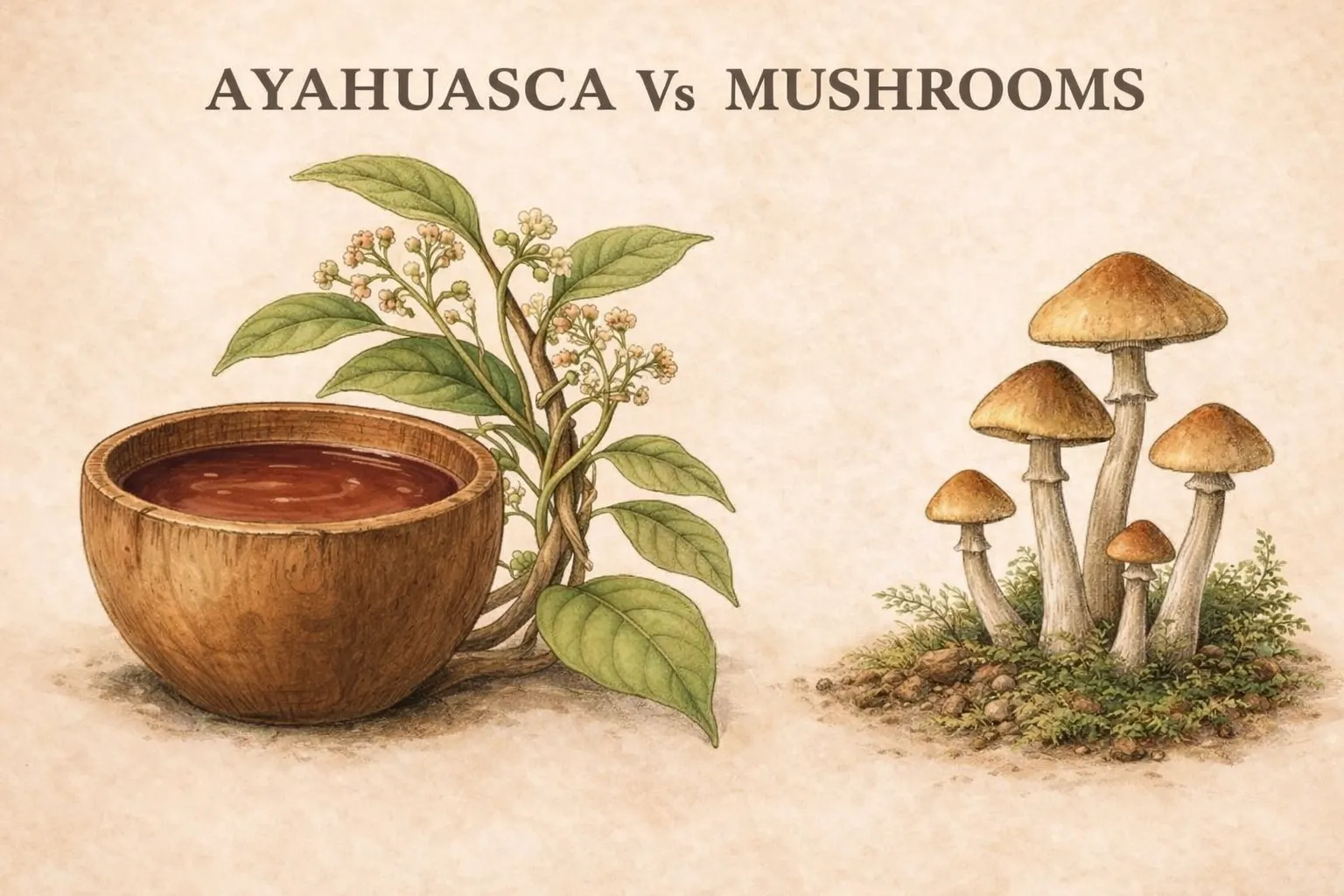
Ayahuasca is a brewed tea prepared from two Amazonian plants: Banisteriopsis caapi (the vine) and Psychotria viridis (the leaf). The leaves supply DMT (N,N-dimethyltryptamine), the compound responsible for ayahuasca’s psychedelic effects. DMT on its own is nearly useless when swallowed: the digestive system destroys it before it reaches the brain.
The vine solves this. Banisteriopsis caapi contains beta-carboline alkaloids, primarily harmine, harmaline, and tetrahydroharmine, that temporarily disable the enzyme (monoamine oxidase A) responsible for that breakdown, allowing DMT to survive digestion and reach the brain intact (Hermanns et al., 2024; Pinder and Sandeman, 2020).
The vine enables the leaf. Together they do something neither could accomplish alone.
Psilocybin mushrooms, most commonly Psilocybe cubensis, work differently. They contain psilocybin, a prodrug: the body converts it to psilocin in the digestive system, and psilocin crosses directly into the brain. No MAO inhibition required. No special plant combination. No dietary restrictions. Psilocin is orally active on its own, which is why mushrooms are considerably more straightforward to prepare for than ayahuasca.
Both substances activate the same 5-HT2A receptors, and that shared mechanism explains why their therapeutic applications and experiential themes overlap. The differences lie in duration, physical intensity, the ceremonial container each tradition has built around the experience, and the depth of preparation each demands.
Both also connect with a broader universe of plant medicine traditions. Ayahuasca ceremonies often incorporate other master plants: rapé, sananga, and dedicated plant diets that build on the ayahuasca foundation. Mushrooms carry their own vast ancestral lineage, one that many people in the modern world were never introduced to properly.
2. Ayahuasca vs Mushrooms: Side-by-Side Comparison
The fastest way to see where these two plant medicines actually diverge, before going deeper on any single dimension.
The table below covers the most important practical differences when comparing ayahuasca vs mushrooms. Legal status is as of March 2026. Verify before making any decisions, as laws change frequently.
Factor | Ayahuasca | Psilocybin Mushrooms |
Primary psychoactive | DMT (N,N-dimethyltryptamine) | Psilocybin / psilocin |
Source | Brew (Banisteriopsis caapi + Psychotria viridis) | Dried mushrooms (Psilocybe cubensis most common) |
Onset | 20 to 60 minutes | 20 to 60 minutes |
Duration | 4 to 8 hours | 4 to 6 hours |
Typical setting | Ceremonial, guided, group | Ceremonial, therapeutic, or solo |
Physical intensity | High: nausea and vomiting (la purga) common | Low to moderate, nausea possible at onset |
Visuals | Vivid, complex, geometric and narrative | Patterns, colors, perceptual shifts; varies by dose |
Emotional intensity | Very high | Moderate to high depending on dose |
Body load | Significant | Mild to moderate |
Dietary restrictions | Required (tyramine-restricted dieta) | None required |
SSRI interaction risk | Severe, washout period required | Moderate, reduced effect, lower direct risk |
Legal status (US) | Schedule I, illegal federally, religious exemptions only | Schedule I, illegal federally, licensed in Oregon and Colorado |
Addiction potential | None significant | None significant |
Integration support | Usually provided by retreat facilitators | Varies by context |
Individual responses vary considerably based on dose, personal history, mental health, and setting. No figure in this table should be treated as a guarantee.
3. The Experience: What Does Each Feel Like?
Ayahuasca cleanses and expands. Mushrooms expand. The difference between those two words is the difference between the experiences.
Both substances work in part by suppressing the Default Mode Network (DMN), the brain network most active during self-referential thinking, rumination, and the internal monologue we call the self. A 2023 systematic review by Kowalczuk et al., synthesizing 28 fMRI studies, found that both psilocybin and ayahuasca acutely decrease connectivity and blood flow within DMN nodes.
The part of the brain most responsible for the story of who you are goes quiet. That quieting is at least partly why both substances can produce experiences of expanded perspective, emotional release, and in clinical contexts, therapeutic benefit.
The foundational psilocybin fMRI study by Carhart-Harris et al. (2012) showed that the intensity of this subjective loosening correlated directly with the degree of DMN deactivation. The deeper the quieting, the more profound the experience.
But the texture of the two experiences is different, and that difference matters.
The ayahuasca experience is both cleansing and expansive. Onset takes 20 to 60 minutes. What follows is typically immersive, confrontational, and physically demanding: complex geometric visions, vivid imagery, emotional catharsis, and at depth, what many describe as contact with presences and dimensions that feel autonomous and real. The visions have a particular quality: narrative, purposeful, unlike anything mushrooms produce.
Then there is la purga, the purge. Nausea, vomiting, sometimes shaking or tears. Within Amazonian healing traditions, this is not a side effect to be managed. It is part of what the medicine does. The body releases something to make space for what follows.
Ayahuasca is not something to approach alone. It requires a container: experienced facilitators, a ceremonially prepared space, and protection that the tradition itself has built over generations. The plant works with everything in that container.
The psilocybin mushroom experience has a different texture. Visual changes happen, including color enhancement, geometric patterns, and perceptual shifts, but they tend to be less architecturally dense than ayahuasca at equivalent intensity. Emotionally, mushrooms often bring introspection and warmth.
Ego dissolution, the temporary fading of the boundary between self and environment, is possible at higher doses and is one of the most commonly reported peak effects. The experience runs 4 to 6 hours. Body load is milder. Nausea is possible but less reliably intense.
Many people find that mushrooms come first. They show you that there is depth: in life, in yourself, in what is possible. For many, that recognition becomes the preparation for seeking something deeper.
It is worth naming something that pharmacology cannot fully contain: both substances, within their traditions, are understood as living medicines with their own intelligence. That understanding is part of how the traditions have held them for generations. It belongs in any honest description of what these plant medicines actually are.
Neither experience should be approached casually. Challenging moments are real with both: anxiety, difficult emotions surfacing suddenly, disorientation. The quality of the container shapes outcomes more than most people expect (Kowalczuk et al., 2023; Carhart-Harris et al., 2012).
Dosage Reference
Informational only. Do not self-medicate. Both substances are Schedule I in the United States.
Substance | Threshold | Moderate | Strong | Notes |
Ayahuasca (brewed) | 20 to 30 mL | 50 to 100 mL | 100 to 150 mL+ | Varies substantially by preparation strength |
Psilocybin mushrooms (dried) | 0.5 to 1 g | 1 to 3.5 g | 4 to 5 g+ | Potency varies by species. Golden Teacher: under 1 g is low; 1 to 3 g is medium. Do not underestimate medium doses. |
4. Safety, Risks, and Medical Contraindications
The most preventable harms in both plant medicines involve drug interactions. Know your medications before you consider either path.
This section contains medical information relevant to your safety. It is not medical advice. Consult a qualified healthcare provider before considering either substance, especially if you take any medications or have a personal or family history of psychiatric illness.
Both substances carry real risks. Ayahuasca carries more of them, and more severe ones, primarily because of its MAOI content.
The core ayahuasca risk: MAOI interactions. Ayahuasca’s beta-carboline compounds inhibit MAO-A, the enzyme responsible for breaking down serotonin and related neurotransmitters. This inhibition is what makes the experience possible. It is also what creates serious drug interaction risks.
The most dangerous combination is with SSRIs and SNRIs. MAOIs prevent serotonin breakdown; SSRIs prevent serotonin reuptake. Together, they produce dangerous accumulation of serotonin, a condition called serotonin syndrome. Anyone taking an SSRI or SNRI must complete a minimum washout period before any MAOI exposure, generally at least two weeks, or five weeks in the case of fluoxetine (Edinoff et al., 2022).
Serotonin syndrome can cause agitation, rapid heart rate, high fever, muscle rigidity, and in severe cases, death. This is not a theoretical risk.
A second serious risk involves tyramine. Aged cheeses, cured meats, fermented foods, and alcohol contain tyramine, which MAO-A normally breaks down. When that enzyme is blocked, tyramine accumulates and causes a sudden, severe blood pressure elevation, a hypertensive crisis. This is the pharmacological reason behind the ayahuasca dieta. The dietary restrictions are medically necessary (Edinoff et al., 2022).
Understanding what ayahuasca’s chemistry actually does to your body is the foundation of safe preparation. The Ayahuasca Framework is a free course that covers this in depth, including what to discuss with your doctor before you make any decisions.
Psilocybin does not inhibit MAO. Its drug interaction profile is narrower. SSRI use reduces the intensity of the psilocybin experience but does not carry the same serotonin syndrome risk profile as ayahuasca. The combination of psilocybin with lithium has been associated with increased seizure risk (Callahan et al., 2018).
Medical Contraindications
Contraindication | Ayahuasca | Psilocybin Mushrooms | Notes |
SSRI or SNRI use | Severe, do not combine | Moderate, reduces effect, lower direct risk | 2 to 5 week washout required for ayahuasca (Edinoff et al., 2022) |
SNRI use | Severe | Moderate | Same mechanism as SSRI risk |
Lithium | High risk | High risk | Seizure risk documented (Callahan et al., 2018) |
Tyramine-rich foods | Severe, hypertensive crisis risk | No risk | Strict dieta required for ayahuasca (Edinoff et al., 2022) |
Personal or family history of psychosis or schizophrenia | High risk | High risk | Both substances can trigger or worsen psychotic episodes (Callahan et al., 2018) |
Bipolar disorder with psychotic features | High risk | High risk | Contraindicated for both without specialist guidance |
Cardiovascular conditions | Moderate to high risk | Moderate risk | Medical clearance advised for both |
Pregnancy | Contraindicated | Contraindicated | Insufficient safety data; both should be avoided |
5. Preparation: What You Need to Do Before Each Experience
For ayahuasca, preparation is medically necessary. For mushrooms, it is practically wise. The difference matters.
Preparation for these two plant medicines differs in both scope and urgency. For ayahuasca, several preparation steps carry direct physiological consequences. For psilocybin mushrooms, preparation is about set, setting, and intention, less medically critical, but no less important for the quality and safety of the experience.
Preparation Element | Ayahuasca | Psilocybin Mushrooms |
Dietary restrictions | Required: avoid tyramine-rich foods (aged cheese, cured meats, fermented foods, alcohol) for minimum 2 to 3 days before | None required |
Medication washout | Required: SSRIs/SNRIs minimum 2 weeks; fluoxetine minimum 5 weeks (Edinoff et al., 2022) | Recommended but not medically critical; SSRIs reduce effect |
Health screening | Essential: provider must know full medication and health history | Recommended, especially for psychiatric history |
Set and setting | Ceremonial container essential; not suitable for solo use | Flexible: ceremonial, therapeutic, or guided solo |
Fasting | Recommended, light eating 4 to 6 hours before | Helpful but not required |
Intention setting | Central to traditional preparation | Recommended for meaningful experience |
Integration planning | Essential: arrange support before, not after | Strongly recommended |
The dieta, the pre-ceremony dietary and behavioral protocol for ayahuasca, carries both spiritual significance in traditional frameworks and a real physiological rationale. Some lineages extend the dieta to weeks or months when a deeper plant medicine process is undertaken.
For psilocybin mushrooms, preparation is primarily about psychological readiness. Set (mindset) and setting (environment) are the variables that most reliably predict whether a mushroom experience moves in a meaningful direction. Neither should be left to chance.
6. Therapeutic Use and Research: What the Science Says
Psilocybin has the larger clinical evidence base. Ayahuasca has the most important single trial. Both are early.
Both substances have moved significantly into clinical research in the past decade. The research bases are at different levels of maturity, and that difference is relevant for anyone considering these plant medicines for therapeutic purposes.
Psilocybin has attracted the larger research investment. As of 2023, over 134 registered clinical trials had been initiated across 54 indications (Gukasyan and Nayak, 2023). The FDA granted Breakthrough Therapy designation to COMPASS Pathways in October 2018 for psilocybin in treatment-resistant depression, and to Usona Institute in 2019 for major depressive disorder (COMPASS Pathways, 2018; Gukasyan and Nayak, 2023).
That designation means the FDA recognized preliminary clinical evidence suggesting substantial improvement over available treatments. It does not mean approval.
Ayahuasca’s strongest clinical evidence comes from a 2019 randomized placebo-controlled trial by Palhano-Fontes et al., the only published blinded RCT for ayahuasca in treatment-resistant depression. A single dose produced significant reductions in depression scores versus placebo, with a large effect size (Cohen’s d = 0.98) at day 7. The trial involved 29 participants, a meaningful result, but a small sample.
Both substances appear to work in part by disrupting habitual patterns of brain activity, specifically by quieting the Default Mode Network, the neural system most associated with rumination and rigid self-narrative (Kowalczuk et al., 2023; Carhart-Harris et al., 2012). This disruption may be what creates the window for new perspectives to form.
For anyone seeking a clinically supported therapeutic path, psilocybin currently has the more developed research infrastructure. Ayahuasca’s evidence is promising and growing, but not yet at the same clinical maturity. Both fields are early.
7. Legality: Where Are Ayahuasca and Psilocybin Legal?
Psilocybin has moved faster through legal reform. Ayahuasca remains more restricted outside specific religious contexts.
Legal status as of March 2026. Laws change frequently. Verify current status before making any decisions.
Jurisdiction | Ayahuasca | Psilocybin Mushrooms |
United States (federal) | Schedule I, illegal federally | Schedule I, illegal federally |
Oregon | No specific legal framework | Licensed and regulated: Oregon Psilocybin Services (OHA, 2026) |
Colorado | No specific legal framework | Regulated access framework established, verify current DORA status |
Brazil | Legal for religious use, verify current status | No explicit legal framework |
Netherlands | Unscheduled, retreat industry operates legally in many contexts | Truffles legal; dried mushrooms banned, verify before travel |
Jamaica | No scheduling, retreat industry operates legally | No scheduling, legal |
Canada | Illegal, DMT Schedule III | Illegal, psilocybin Schedule III; exemptions available for clinical contexts |
Religious exemptions in the US., União do Vegetal (UDV) and Santo Daime, have established legal protections for ayahuasca use in religious ceremonies under the Religious Freedom Restoration Act. These exemptions are specific to registered members of those organizations and do not extend to personal or recreational use.
The psilocybin legalization trend has moved faster than the ayahuasca equivalent in the United States. Oregon and Colorado have both created regulated access frameworks for psilocybin, making it the more legally accessible plant medicine option in those states as of 2026.
8. Which Is Right for You?
The question underneath the comparison is not which is more powerful. It is which path you are actually ready to walk into.
Many people arrive at the ayahuasca vs mushrooms comparison carrying something: a question they haven’t been able to answer, a pattern they want to break, a grief they haven’t finished, or simply a pull toward depth they can’t fully explain yet. That pull deserves a real answer.
For most people, mushrooms come first. They are more accessible, more forgiving at low to medium doses, and available through a growing network of legal and semi-legal contexts. More importantly, they often do exactly what is needed before ayahuasca: they show you there is depth. They prepare the ground.
Ayahuasca is a different order of commitment. Not because it is more powerful (though for most people, it is), but because it requires a container that mushrooms do not. Experienced facilitators. Ceremonial preparation. A lineage that knows how to hold what the medicine opens. It is not something to take casually or alone.
Both have their own ancestral paths, often underestimated in the modern world. Many people were introduced to mushrooms as recreational tools rather than as the plant medicine tradition they actually represent. Ayahuasca rarely gets that treatment. Its demands make casual use difficult. But the depth in mushrooms, approached properly, is real.
Choose Ayahuasca If:
- You are drawn to a ceremonial, guided, group experience with a structured traditional or neo-traditional container
- You are seeking deep emotional processing: grief, trauma, or long-term psychological patterns that feel resistant to other approaches
- You are prepared for a physically demanding experience including possible nausea and purging
- You are not taking any medications that interact with MAOIs, or you are prepared to complete the required washout period under medical guidance
- You can access a ceremony through a facilitator with genuine training and experience in the tradition
- You are comfortable with the overnight ceremonial format and longer duration
Choose Psilocybin Mushrooms If:
- You are newer to plant medicine and want a shorter, more manageable first experience
- You want access to a legally licensed, clinically informed context in Oregon or Colorado as of 2026
- You are taking medications that make ayahuasca’s MAOI interaction risks prohibitive
- You prefer flexibility in setting: therapeutic, ceremonial, or (in legal contexts) more personal
- Your primary interest is in mental health applications where psilocybin has the more developed clinical research base
- You feel drawn to mushrooms on their own terms, not as a stepping stone, but as a complete path
Whatever draws you toward either tradition, the quality of the container shapes outcomes more than the substance itself. The ceremony structure, the facilitator’s experience, the pre-ceremony screening, the support available afterward: these are the variables the research consistently identifies as what matters most (Kowalczuk et al., 2023).
Integration matters for both. The period after matters as much as the experience itself. Making deliberate meaning from what emerged, ideally with support from a trained therapist or facilitator, is where much of the value consolidates (Palhano-Fontes et al., 2019).
If you are moving toward ayahuasca specifically, the Ayahuasca Framework is a free course built around what genuine preparation actually looks like, from understanding the pharmacology to choosing the right facilitator.
9. Frequently Asked Questions
Ayahuasca vs Mushrooms
Conclusion
The pharmacological comparison between ayahuasca vs mushrooms is the least important thing to understand before walking into either tradition.
Ayahuasca and psilocybin mushrooms share a category: serious plant medicines with long ancestral histories and powerful psychoactive effects, but they are far more different than they are alike. One is a brewed tea from the Amazon that cleanses and expands through an all-night ceremonial process. The other is a fungus that expands perception and opens depth in a shorter, more accessible experience.
For most people, mushrooms come first. They prepare the ground. Ayahuasca goes deeper, but demands more, requires more protection, and should never be entered without a genuine container and honest preparation.
Both paths deserve respect. Both have more depth than most people realize when they first encounter them. And for many people on a healing journey, both have their place.
The question worth sitting with before comparing ayahuasca vs mushrooms is not which is more powerful. It is: what am I actually ready for, and who am I learning from?
Those questions matter more than any table.
10. References
- Callahan LM, et al. (2018). Ayahuasca: An ancient sacrament for treatment of contemporary psychiatric illness? Mental Health Clinician. PMC6007657. https://pmc.ncbi.nlm.nih.gov/articles/PMC6007657/
- Carhart-Harris RL, et al. (2012). Neural correlates of the psychedelic state as determined by fMRI studies with psilocybin. Proceedings of the National Academy of Sciences, 109(6):2138-2143. https://www.pnas.org/doi/10.1073/pnas.1119598109
- COMPASS Pathways. (October 23, 2018). COMPASS Pathways receives FDA Breakthrough Therapy designation for psilocybin therapy for treatment-resistant depression. https://ir.compasspathways.com/News–Events-/news/news-details/2018/COMPASS-Pathways-receives-FDA-Breakthrough-Therapy-designation-for-psilocybin-therapy-for-treatment-resistant-depression/default.aspx
- Edinoff AN, Swinford CR, Odisho AS, et al. (2022). Clinically Relevant Drug Interactions with Monoamine Oxidase Inhibitors. Health Psychology Research, 10(4):39576. PMC9680847. https://pmc.ncbi.nlm.nih.gov/articles/PMC9680847/
- Gukasyan NJ, Nayak SM. (2023). The Promise of Therapeutic Psilocybin: 134 Clinical Trials, 54 Indications, 0 Approvals. Journal of Psychoactive Drugs. PMC11016263. https://pmc.ncbi.nlm.nih.gov/articles/PMC11016263/
- Hermanns et al. (2024). Neurobiological research on N,N-dimethyltryptamine (DMT) and its potentiation by monoamine oxidase (MAO) inhibition. PMC11387584. https://pmc.ncbi.nlm.nih.gov/articles/PMC11387584/
- Kowalczuk et al. (2023). Default Mode Network Modulation by Psychedelics: A Systematic Review. International Journal of Neuropsychopharmacology, 26(3):155. PMC10032309. https://pmc.ncbi.nlm.nih.gov/articles/PMC10032309/
- Oregon Health Authority. (Continuously updated, confirmed March 2026). Oregon Psilocybin Services. https://www.oregon.gov/oha/ph/preventionwellness/pages/oregon-psilocybin-services.aspx
- Palhano-Fontes F, et al. (2019). Rapid antidepressant effects of the psychedelic ayahuasca in treatment-resistant depression: a randomized placebo-controlled trial. Psychological Medicine, 49(4):655-663. https://pubmed.ncbi.nlm.nih.gov/29903051/
- Pinder R, Sandeman D. (2020). The pharmacological interaction of compounds in ayahuasca: a systematic review. Journal of Psychoactive Drugs. PMC7678905. https://pmc.ncbi.nlm.nih.gov/articles/PMC7678905/
