
Ayahuasca and the Law in Colombia: Legality, Lineage, and What Visitors Should Actually Know
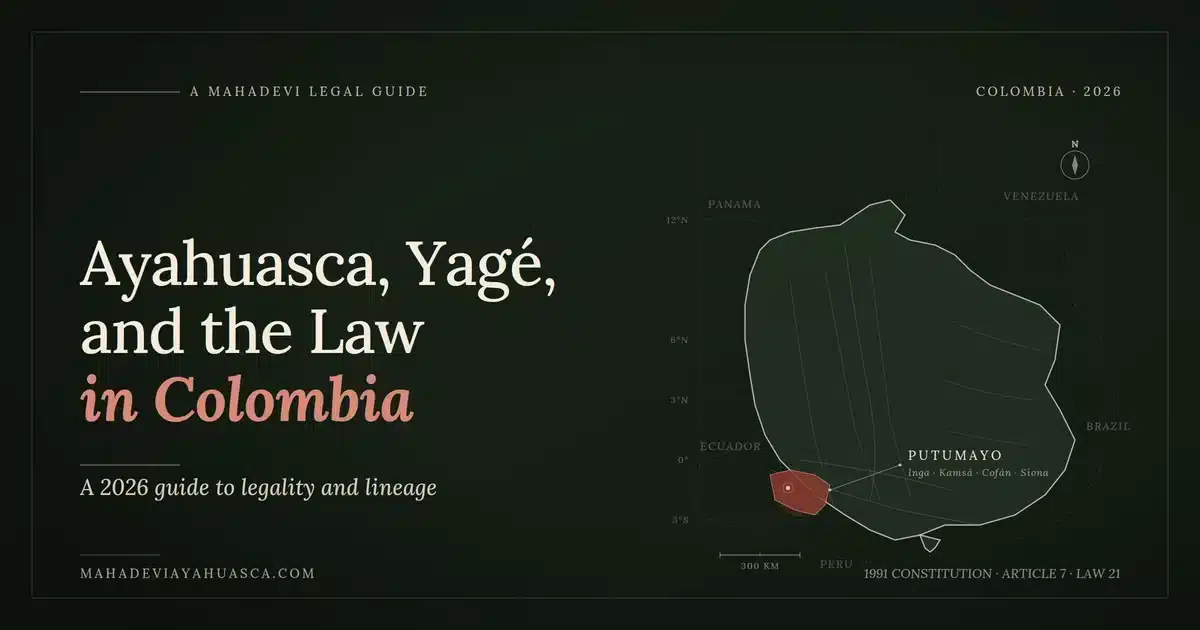
Yagé, what most of the world calls ayahuasca, has no specific law that prohibits or permits it in Colombia. The brew sits inside constitutional protections for indigenous medicine and ethnic territories rather than inside a drug-control framework. Colombia has the highest per-capita ayahuasca consumption of any country in the world, around 0.8 percent of the population, and the state has never moved to criminalize it. Foreigners can drink yagé legally on Colombian soil. They cannot legally fly home with it. The brew itself is unscheduled internationally; its molecule, DMT, is not.
| Question | Answer |
|---|---|
| Is yagé legal in Colombia? | Yes, in practice. Protected as indigenous cultural and medical practice under the 1991 Constitution. |
| Can foreigners legally drink yagé in Colombia? | Yes. There is no specific prohibition for participants on Colombian soil. |
| Can the brew be exported? | No. DMT is internationally controlled; customs will treat the brew as a controlled substance. |
| Who is recognized to hold the medicine? | Indigenous Taitas from Inga, Kamsá, Cofán, Siona, Tukanoan and other Amazonian lineages. |
| Is there a specific yagé law? | No. Protection runs through indigenous-rights and cultural-heritage frameworks rather than a dedicated statute. |
Most of the confusion about ayahuasca in Colombia comes from looking for a law that does not exist. There is no statute permitting yagé and no statute prohibiting it. What there is, instead, is a Constitution that recognizes indigenous medicine as a protected cultural practice, a network of Taitas who have carried the medicine through colonial rupture and rubber-boom violence, and a state that has consistently chosen not to criminalize them (Suárez Álvarez & ICEERS, 2023). The piece below lays out what the legal framework actually looks like, which lineages hold the medicine, how Colombia compares internationally, and what visitors should understand before they drink.
This article is for educational purposes only. The legal status of ayahuasca varies by country and changes over time. Decisions about whether and where to drink yagé require careful research and, in some cases, legal counsel. Decisions about medical fitness to drink require a qualified clinician familiar with your medications, conditions, and history. The information below reflects published research, government records, and indigenous-organization guidance and does not replace either.
What Ayahuasca Is (and What Yagé Means in Colombia)
The brew is older than the laws written about it.
Ayahuasca is a decoction. Two plants, boiled together for hours, sometimes for days. The vine is Banisteriopsis caapi. It contains beta-carbolines (harmine, harmaline, tetrahydroharmine) that inhibit monoamine oxidase, the enzyme that would otherwise break down DMT in the gut. The second plant supplies the DMT. In Peru that plant is usually Psychotria viridis, called chacruna. In the Colombian Putumayo it is more often Diplopterys cabrerana, called chagropanga, and the resulting brew tends to carry significantly higher DMT concentrations than its Peruvian counterpart (Chambers et al., 2020).
The synthesis itself, combining a peripheral MAOI with an oral DMT source, is one of the most precise pharmacological discoveries in indigenous history (Schultes, Hofmann, & Rätsch, 2001). No single plant produces the experience. Two plants do, in concert, and the cultures that figured this out did so without chemistry labs.
In Colombia the brew is rarely called ayahuasca. Inga and Kamsá speakers, Cofán curacas, Siona and Tukanoan elders all use yagé. The word is older than the borders. The clinical-pharmacology literature now recognizes the regional admixture difference, naming Diplopterys cabrerana as the Colombian and Ecuadorian DMT source rather than Psychotria viridis (Brito-da-Costa et al., 2020).
If you want a longer treatment of what ayahuasca is and how it works pharmacologically, MahaDevi keeps a reference page on plant-medicine basics that goes deeper than this section. The piece you are reading now stays focused on the law.
Is Ayahuasca Legal in Colombia? Why No Specific Law Exists
There is no law for it. There is no law against it. That is not an oversight.
Colombia’s 1991 Constitution recognizes the country as pluri-ethnic and multicultural. Article 7 of the Constitution, together with Law 21 of 1991 (which incorporates ILO Convention 169 on the rights of indigenous peoples), establishes that indigenous communities have the right to preserve and practice their cultural and medical traditions, and to govern their own territories under their own authorities. Yagé sits inside that frame, not inside a drug-control frame (Suárez Álvarez & ICEERS, 2023).
Three observations follow from how the law actually works. First, there is no specific Colombian statute that prohibits yagé and none that permits it. Second, the state has never prosecuted Taitas for ceremony, and Constitutional Court interpretation has consistently sided with indigenous health practices when they have been challenged (Suárez Álvarez & ICEERS, 2023). Third, DMT is not specifically scheduled under Colombian domestic law for the plant; the country has chosen not to import the international scheduling regime into national plant-medicine policy.
The prevalence data tells the rest of the story. Around 0.8 percent of the Colombian population, roughly 300,000 people, has consumed yagé. That is the highest per-capita rate in the world. Most of those ceremonies are conducted by itinerant Taitas from the Putumayo, who travel between the Sibundoy Valley, Bogotá, Medellín, Cali, and the coast, holding tomas in private houses, urban centers, and increasingly in retreat settings. The phenomenon dates to the 1970s, intensified by the public-safety pressures of armed conflict in the southern Amazon and by demand from urban Colombians and foreigners (Suárez Álvarez & ICEERS, 2023).
The legal protection here is structurally different from a religious or sacramental exemption. It is cultural and constitutional. That distinction matters in three practical ways. The protection extends most clearly to indigenous practitioners and to the participants who drink with them. Mestizo and foreign-led commercial ceremonies operate in a softer zone of practical tolerance rather than explicit recognition. And customs law remains a separate question entirely. Possessing yagé inside Colombia is not the same as exporting it. The brew itself is unscheduled at the international level (UNODC, 1971; Sánchez Avilés & Rebollo, ICEERS, 2019). For the testing-and-customs side of the question specifically, see our guide on whether ayahuasca shows up on a drug test.
How Colombia’s Approach Compares to Other Countries
Every country approached this question from a different angle.
The cleanest way to see what Colombia is doing is to put it next to the major alternative frameworks.
| Country | Legal Status | Legal Mechanism | Year of Key Action |
|---|---|---|---|
| Colombia | Protected in practice; no specific statute | 1991 Constitution (Art. 7) + Law 21/1991 (ILO Convention 169); indigenous-rights framework | 1991 onward |
| Peru | Legal; declared National Cultural Patrimony | INC Resolution 836; cultural-heritage framework | 2008 |
| Brazil | Legal for religious use | CONAD Resolution No. 1; religious-liberty framework with ten ethical principles | 2010 |
| United States (federal) | DMT is Schedule I; narrow religious exemptions for UDV and Santo Daime | Gonzales v. UDV (Supreme Court ruling under RFRA) | 2006 |
| Netherlands | Illegal to import | Dutch Supreme Court ruling under the Opium Act, ending a 17-year religious exemption | 2019 |
Colombia’s framework looks closer to Peru’s than to Brazil’s or the United States’. Both Andean countries protect ayahuasca through cultural-heritage and indigenous-rights mechanisms rather than through sacramental religious exemption. The difference is that Peru issued an explicit declaration; Colombia operates through constitutional principle and judicial interpretation (INC Peru, 2008). Brazil regulates the religious use of ayahuasca through a national drug-policy council, which is a far more interventionist arrangement than either Andean country has chosen (CONAD Resolução No. 1, 2010). The United States grants narrow religious exemptions on a church-by-church basis, beginning with the Supreme Court’s 2006 ruling in favor of the União do Vegetal (Gonzales v. O Centro Espírita Beneficente União do Vegetal, 546 U.S. 418, 2006). The Netherlands, after a long period of tolerance for Santo Daime, reversed course in 2019 and now treats ayahuasca importation as a controlled-substance offense (Domsac, Russo & Sánchez Avilés, ICEERS, 2023).
The Lineages That Hold Yagé in Colombia
The medicine in Colombia is not generic. It travels through specific people, in specific languages, from specific valleys.
Four lineage clusters carry most of the contemporary Colombian yagé practice. They are concentrated in the southwestern Amazonian piedmont and the northwest Amazon.
Inga and Kamsá (Sibundoy Valley, Putumayo). The Inga are Quechua-speaking and are believed to descend from Quechua migrants who settled in Sibundoy in the pre-Columbian period. The Kamsá speak a language isolate, related to no other known language, and are rooted in the same valley. Both peoples maintain a distinctive Sibundoy synthesis: yagé gardens, multi-year Taita initiation through successive visions, the central figure of the curaca, and a tight relationship between yagé and a wider repertoire of plant medicines including Datura (Ramírez de Jara & Pinzón Castaño, 1993). Putumayo Taitas, especially the itinerant ones, are the most visible holders of yagé in urban Colombian ceremony. They use sound, particular icaros and whistled invocations, as the primary tool for shaping the ceremonial container (García Molina, 2014).
Siona (Putumayo, Western Tucanoan). The Siona were declared nearly extinct as a yajé tradition by the 1970s. Across the following decades they revitalized the practice, partly in coordination with transnational shamanic networks and partly through political work tied to territorial defense and ethnic-identity reconstruction (Langdon, 2016). Today Siona Taitas are central to Indigenous Guard organizing in their territories and to cosmological resistance against extractive industries on Putumayo land.
Cofán (A’i) (Putumayo and the Colombia-Ecuador border). Cofán yajé practice is governed by a strict apprenticeship hierarchy. Curacas are trained over many years, and their authority is defended forcefully when outsiders attempt to claim Cofán lineage without it. The 2018 case in which the Cofán community publicly repudiated the foreign teacher Alberto Varela, who had been representing himself as initiated by them, is the clearest recent example of how Colombian lineages defend their authority over the medicine (Jütte, 2018). Cofán cosmology treats yajé as the technology by which a curaca crosses between the visible world and the spirit-saturated world, mediating both healing and harm (Cepek, 2019).
Tukanoan peoples (Vaupés and the Northwest Amazon). Tukanoan yajé practice is older, more ceremonially elaborate, and less commercially exposed than the Putumayo traditions. The Desana, Barasana, and Cubeo all maintain communal yajé rituals tied to initiation, mourning, and cosmological maintenance (Reichel-Dolmatoff, 1975). Schultes documented the payés (medicine men) of the Colombian Amazon in fieldwork that established yagé as central to a sophisticated, centuries-old botanical knowledge system (Schultes & Raffauf, 1992).
In 1999, five of these peoples (Cofán, Inga, Siona, Coreguaje, Kamëntsá) formed UMIYAC, the Union of Indigenous Yagé Healers of the Colombian Amazon. UMIYAC unifies them around shared yagé ceremony as the central act of territorial and cultural defense, particularly against deforestation, oil extraction, armed groups operating in their territories, and the commercialization of their medicine (Arsenault / UMIYAC, 2020). Colombia’s Constitutional Court has classified all five UMIYAC peoples as at risk of physical and cultural extermination, which gives the alliance unusual legal standing.
What the Colombian Framework Means for Visitors
Legal to drink. Wrong to export.
A foreigner can sit in a yagé ceremony in Colombia legally. They can travel into the country specifically to attend a retreat. They cannot fly out with brew in their luggage. DMT is a Schedule I substance in the United States and prohibited under most Western drug-control regimes, regardless of how it was prepared (DEA Diversion Control Division, 2024). Customs will treat the brew as a controlled substance. The plant being unscheduled at the international level does not protect the alkaloid extracted from it (UNODC, 1971).
Inside Colombia the legal exposure sits more with practitioners than with participants. A community-recognized Taita conducting a tomá in a private setting is operating inside protected cultural practice, often documented by a cabildo (indigenous local authority) certificate. A foreign-led ceremony with no indigenous lineage, conducted commercially in a hotel or wellness studio, sits in a softer legal zone, neither explicitly legal nor explicitly illegal. The two are not the same arrangement, even when the brew is identical.
Legality is also not safety. In a 10,836-person global survey of ayahuasca users, around 70 percent reported acute physical adverse effects, mostly vomiting, and 2.3 percent required medical attention for an adverse event. The same study found that the large majority of those who experienced challenging mental health effects considered them part of a positive growth process (Bouso et al., 2022). A separate international survey of 11,912 users with prior diagnoses found that 78 percent of those with depression and 70 percent of those with anxiety reported significant symptom improvement following ayahuasca consumption (Sarris et al., 2021). Set, setting, screening, and lineage matter. For the medication side of screening specifically, see our SSRI and MAOI interaction guide. The science confirms what the Taitas have always said.
The Cultural and Ethical Stakes
Every legal framework is also a cultural one.
Colombia’s choice not to legislate has consequences in both directions.
On one side, it preserves indigenous authority over the medicine. Yagé in Colombia has not been folded into a state religious-exemption framework that would, by definition, locate the right to drink inside a particular church rather than inside a community. Indigenous Colombians retain the legal high ground when questions about lineage, authenticity, or commercialization arise. The cabildo certificate, issued by a local indigenous authority, has emerged as the de facto credentialing instrument for Taitas, and its legitimacy is anchored in the Constitution rather than in a drug-policy bureaucracy.
On the other side, the absence of explicit regulation makes it harder to police bad actors. Cases of facilitator misconduct, including sexual abuse during ceremony, have surfaced repeatedly across the global ayahuasca community, and Colombia is not exempt. The domestic boom in commercial ceremonies, much of it conducted by people without lineage authorization, exposes participants to risks that indigenous protocols would otherwise screen for.
The clearest articulation of the ethical frame from the indigenous side comes from Yuria Celidwen and colleagues, including UMIYAC spokesperson Miguel Evanjuanoy Chindoy. Their work names ten principles that bear directly on commercial ayahuasca practice: respect for the medicine, recognition of its source, transparent compensation, training under recognized lineage, refusal to treat the brew as a commodity, and consistent reciprocity with indigenous communities (Celidwen et al., 2022). That frame matters more than any law. It is the standard the law is silent enough to allow indigenous communities to enforce on their own terms.
Feel deeply.
Show up fully.
Frequently Asked Questions
Is ayahuasca legal in Colombia?
There is no specific Colombian law that prohibits or permits ayahuasca, called yagé locally. The brew sits inside constitutional protections for indigenous medicine rather than inside drug-control law. Article 7 of Colombia’s 1991 Constitution recognizes the country as pluri-ethnic and multicultural, and Law 21 of 1991 incorporates ILO Convention 169 on indigenous rights. The state has never criminalized yagé use, and the Constitutional Court has consistently protected indigenous health practices.
Can foreigners legally drink yagé in Colombia?
Yes. A foreigner attending a yagé ceremony on Colombian soil is participating in a culturally protected practice, not committing a controlled-substance offense. There is no special permit required to drink. The legal exposure, where it exists, sits with practitioners operating outside indigenous lineage authority rather than with participants.
Can I bring ayahuasca home from Colombia?
No. The brew is not scheduled internationally, but DMT, one of its active alkaloids, is. DMT is Schedule I in the United States and similarly controlled across most Western jurisdictions under the United Nations 1971 Convention on Psychotropic Substances. Customs authorities will treat the brew as a controlled substance regardless of where it was prepared or how it was packaged.
What is the difference between ayahuasca and yagé?
The two names refer to the same family of brews but different traditions. “Ayahuasca” is a Quechua name used widely in Peru and exported globally. “Yagé” is the term used in Colombia by Inga, Kamsá, Cofán, Siona, and Tukanoan peoples. The Colombian preparation often uses Diplopterys cabrerana (chagropanga) as the DMT-containing admixture instead of Psychotria viridis (chacruna), which can produce significantly higher DMT concentrations in the finished brew.
What is a Taita?
A Taita is the title given to a recognized yagé healer in the Putumayo and Sibundoy traditions. The word means roughly “father” in Inga, and is used for elders trained over many years, often decades, by senior practitioners. Among the Cofán, the equivalent title is curaca. A Taita’s work includes diagnosing illness, leading ceremony, transmitting icaros, and mediating between the community and the spirit world.
Which indigenous peoples in Colombia practice yagé?
The most prominent contemporary yagé peoples are the Inga, Kamsá, Cofán (A’i), Siona, and Coreguaje of the Putumayo and Sibundoy Valley, and the Desana, Barasana, and Cubeo of the Vaupés and Northwest Amazon. Five of these peoples (Inga, Kamsá, Cofán, Siona, Coreguaje) form the UMIYAC alliance, the Union of Indigenous Yagé Healers of the Colombian Amazon, founded in 1999.
What does UMIYAC do?
UMIYAC was founded in 1999 to defend yagé tradition against commercialization, biopiracy, and territorial encroachment. It coordinates cultural defense among five Colombian Amazonian peoples and engages internationally on questions of indigenous medicine, deforestation, and reciprocity. Colombia’s Constitutional Court has classified all five UMIYAC peoples as at risk of physical and cultural extermination.
Are urban yagé ceremonies in Bogotá or Medellín legal?
Ceremonies led by recognized indigenous Taitas, often documented by a cabildo certificate, operate inside protected cultural practice. Itinerant Taitas have conducted urban tomas across Colombian cities since the 1970s and are not prosecuted. Commercial ceremonies led by people without lineage authorization sit in a softer legal zone, neither explicitly legal nor explicitly illegal. The question of legitimacy is increasingly enforced through indigenous councils more than through state action.
How does Colombia’s framework compare to Peru’s?
Both countries protect ayahuasca through cultural-heritage and indigenous-rights mechanisms rather than through religious exemption. Peru issued an explicit declaration in 2008, naming ayahuasca’s traditional use as National Cultural Patrimony through INC Resolution 836. Colombia has no equivalent declaration; protection runs through constitutional principle and Constitutional Court interpretation. Peru’s framework is more visible in writing. Colombia’s is structurally similar but operates through silence rather than declaration.
Is yagé safe?
Yagé has a documented risk profile. Vomiting is common, transient cardiovascular effects are universal, and a small percentage of participants will require medical attention for an adverse event. In a 10,836-person global survey, 2.3 percent of users required medical attention; the figure rises in unscreened or unsupervised settings. Pre-existing psychiatric conditions, certain medications including SSRIs and MAOIs, and cardiovascular disease all change the risk profile materially. Proper screening matters.
Why isn’t ayahuasca explicitly legalized in Colombia?
Because it is already protected through a higher legal mechanism. Indigenous medicine is constitutionally protected, and creating a specific ayahuasca law would risk subordinating yagé to a drug-policy framework rather than to an indigenous-rights framework. The current arrangement, while ambiguous to outsiders, is structurally favorable to the lineages that hold the medicine. The silence is the protection.
What does the scientific literature say about ayahuasca’s mental health effects?
Large international surveys consistently report symptom improvement in users with prior depression, anxiety, and trauma diagnoses. In one international cross-sectional study of 11,912 ayahuasca users with prior diagnoses, 78 percent of those with depression and 70 percent of those with anxiety reported their symptoms as very much improved or completely resolved after ayahuasca use. These are self-report data, not randomized controlled trials, and they describe ceremonial use rather than clinical administration.
Conclusion
The legal framework is stable because it isn’t really a legal framework. Colombia did not write a yagé statute. It wrote a Constitution that recognized indigenous medicine, and it let the medicine stay where it had always been: inside a community, with a Taita, in a particular valley.
That is what makes the country distinct. Peru has its declaration. Brazil has its religious resolution. The United States has its narrow Supreme Court exemption. Colombia has its silence, and the silence is the protection.
For a visitor it means yagé is legal to drink and wrong to export. It means the lineage matters more than the receipt. It means the ceremony is older than any of the words being used to describe it.
The medicine is real. The protection is real. And the lineages are still here.
References
Arsenault, C. (2020). Indigenous Colombians Mount a Spiritual Defense of the Amazon. Mongabay.
Domsac I, Russo S, Sánchez Avilés C. (2023). Legal Status of Ayahuasca in the Netherlands. ICEERS.
García Molina A. (2014). The Sound Tactics of Upper Putumayo Shamans. NEIP.
Sánchez Avilés C, Rebollo N. (2019). International Regulation of Ayahuasca Practices. ICEERS.
