Peyote vs Ayahuasca: What’s the Difference?
The short answer: this peyote vs ayahuasca guide covers two sacred plant medicines, two completely different compounds, traditions, and experiences.
At a Glance
| Duration | Peyote: 12 to 14 hours | Ayahuasca: 4 to 6 hours |
| Compound | Mescaline | DMT (dimethyltryptamine) |
| Experience | Grounded, communal | Intense, inward |
| Purging | Rare | Common |
| Legal status | Schedule I, NAC exemption | Schedule I, UDV / Santo Daime exemption |
Quick Comparison
| Peyote | Ayahuasca | |
| Active compound | Mescaline | DMT (dimethyltryptamine) |
| Duration | 12 to 14 hours | 4 to 6 hours |
| Ceremony | Communal circle, all-night | Individual, inward, lying down |
| US legal status | Schedule I, NAC exemption | Schedule I, UDV / Santo Daime exemption |
Full Answer
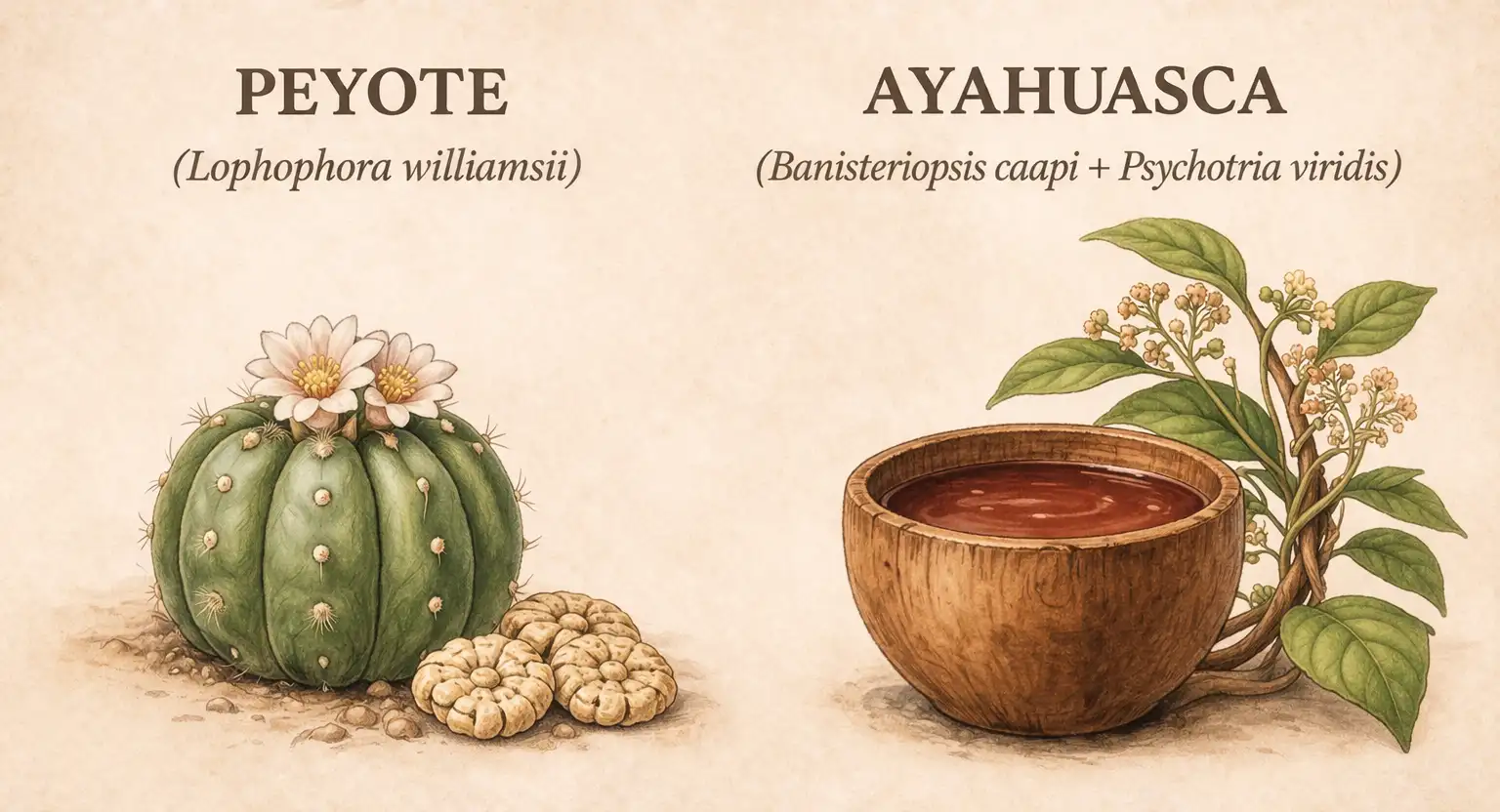
Peyote and ayahuasca are both sacred plant medicines with deep indigenous roots, but they differ fundamentally in origin, chemistry, and experience. Peyote is a slow-growing cactus (Lophophora williamsii) native to Mexico and the southwestern United States, whose active compound is mescaline. Ayahuasca is a brew made from the Banisteriopsis caapi vine and the Psychotria viridis shrub, whose active compound is DMT (dimethyltryptamine). Peyote ceremonies typically last 12 hours or more and are community-focused; ayahuasca ceremonies run roughly 4 to 6 hours and move inward. Both are Schedule I controlled substances in the United States, with narrow religious exemptions that apply to specific groups under specific conditions.
What Is Peyote? Origins, Botany, and Active Compound
A 5,700-year-old cactus, not a mushroom, with a precisely documented history and a compound profile no synthetic can replicate.
Start with a misconception worth clearing up. Peyote is not a mushroom. It is a small, spineless cactus, Lophophora williamsii, that grows across the desert scrublands of northern Mexico and the Rio Grande Valley of southern Texas. Both peyote and psychedelic mushrooms appear in indigenous ceremony, which is probably where the confusion originates, but they share nothing botanically. Peyote is a flowering plant. Mushrooms are fungi. Different kingdoms entirely.
The history of peyote use is not vague or approximate. It has been measured. Radiocarbon dating of preserved peyote specimens combined with alkaloid analysis confirming the presence of mescaline places deliberate human use of this cactus at roughly 5,700 years ago, approximately 3780 to 3660 BC (El-Seedi et al., 2005). It makes peyote one of the most archaeologically documented psychoactive plant traditions in the world.
Mescaline is peyote’s primary active compound, a naturally occurring psychedelic alkaloid from the phenethylamine chemical family (Doesburg-van Kleffens et al., 2023). The plant also contains dozens of other alkaloids including pellotine, anhalonidine, and hordenine. This full constellation of compounds, taken together within a ceremonial context, may produce something meaningfully different from isolated mescaline alone (Doesburg-van Kleffens et al., 2023).
The cactus is not simply a mescaline delivery system, and practitioners have understood that for centuries.
Peyote is consumed as dried buttons, the rounded tops of the cactus. A typical dose runs three to six buttons, corresponding to roughly 200 to 400 mg of mescaline (Doesburg-van Kleffens et al., 2023). Among the Huichol (Wixaritari) people of Mexico and members of the Native American Church across North America, those buttons are consumed within structured ceremonial settings refined over generations.
The American Indian Religious Freedom Act (U.S. Congress, 1978, amended 1994) explicitly recognizes this continuity, identifying peyote use as an integral part of Native American cultural and religious life, a recognition grounded not in policy generosity but in centuries of documented practice.
One last thing belongs in any honest introduction to peyote: the cactus is ecologically fragile. It grows slowly, takes more than six years to recover after a single harvest, and cannot easily recolonize disturbed land (NatureServe, 2020). That vulnerability matters, and it becomes relevant again when we reach the decision framework at the end of this guide.
What Is Ayahuasca? Origins, Botany, and Active Compound
Not a plant but a brew, and its pharmacology is one of the more remarkable chemical partnerships in nature.
Ayahuasca is not a single plant. That distinction does more work than it might first appear, and it shapes everything that follows.
The brew combines the Banisteriopsis caapi vine with plants containing DMT, most commonly Psychotria viridis, also known as chacruna. Across Amazonian traditions it travels under many names: iowaska, yage, caapi, natem, daime, vegetal. The word ayahuasca itself can refer to the vine, the finished brew, or related preparations depending on who you ask and where in the Amazon they come from (ICEERS, n.d.; Luna, 2011).
More than 100 botanical species have been documented as additives across different cultural preparations, which means there is no single fixed recipe (ICEERS, n.d.).
The pharmacology of ayahuasca is genuinely unusual. DMT (dimethyltryptamine) is present in Psychotria viridis. The problem is that DMT taken orally is rapidly destroyed in the digestive system by an enzyme called monoamine oxidase A (MAO-A) before it can reach the brain. Swallow DMT on its own and your body neutralizes it before it does anything.
The Banisteriopsis caapi vine solves this. It contains beta-carboline alkaloids, specifically harmine, harmaline, and tetrahydroharmine (THH), that disable MAO-A long enough for DMT to survive digestion, enter the bloodstream, and reach the brain (Brito-da-Costa et al., 2020; ICEERS, n.d.; White et al., 2024). The vine enables the companion plant. Together they do something neither could accomplish alone.
Western documentary accounts of ayahuasca appear in Jesuit writings from the 1730s and 1740s, with later scientific descriptions by naturalists in the mid-1800s (ICEERS, n.d.). The traditions themselves predate those records considerably.
Unlike peyote, where radiocarbon dating gives a precise archaeological anchor, the exact antiquity of ayahuasca use has not yet been established from physical evidence. What is established is the breadth of its cultural presence. Luna (2011) documents ayahuasca as central to the spiritual, medical, and social life of more than 70 indigenous groups across the Amazon basin, including the Shipibo-Konibo, Shuar, Siona, Tukano, and Ashaninka peoples.
In recent decades, ayahuasca has traveled far beyond its origins. Syncretic religious traditions including Santo Daime, the Uniao do Vegetal (UDV), and Barquinha have built international communities around ceremonial use. A growing global retreat sector has brought the brew to seekers far outside the Amazon. That expansion raises real questions about cultural respect, practitioner quality, and the difference between traditional healing and modern adaptation, questions that deserve more space than this article can give them.
Peyote vs Ayahuasca: Side-by-Side Comparison
Same legal category, same cultural weight, completely different chemistry and ceremonial structure.
The peyote vs ayahuasca table below draws from the pharmacological and cultural evidence covered above. It is the fastest way to see where these two medicines actually differ.
| Factor | Peyote | Ayahuasca |
| Plant type | Cactus (Lophophora williamsii) | Brew (vine + shrub) |
| Geographic origin | Mexico / SW United States | Amazon (Peru, Brazil, Ecuador, Colombia) |
| Active compound | Mescaline | DMT (dimethyltryptamine) |
| Supporting compounds | 60+ alkaloids | MAOIs (harmine, harmaline, THH) |
| Onset time | 2 to 4 hours | 30 to 60 minutes |
| Duration | 12 to 14 hours | 4 to 8 hours |
| Intensity | Moderate, grounding, stimulating | High, intense, inward |
| Purging | Rare | Common (la purga) |
| Ceremony structure | Communal circle, upright, all-night | Individual inner journey, lying down |
| Cultural tradition | Native American / Huichol (Wixaritari) | Amazonian / Shipibo-Konibo and others |
| US legal status | Schedule I (NAC religious exemption) | Schedule I (UDV / Santo Daime exemption) |
| Conservation status | Vulnerable, slow recovery (6+ years) | More abundant (vine cultivated) |
What the table makes visible is that peyote and ayahuasca are not two versions of the same thing. They come from different continents, different chemical families, and different ceremonial structures. The overlap, including altered states of consciousness, indigenous sacred use, and Schedule I classification in the US, is real. It just sits on top of much deeper differences.
Effects and Experience: What Do They Actually Feel Like?
Peyote settles. Ayahuasca expands and clears. The difference in how they move is as significant as the difference in what they contain.
What happens in any peyote vs ayahuasca ceremony depends as much on the setting, the facilitator, and the individual’s psychological state as on the pharmacology. The evidence and the ethnographic record describe tendencies, not guarantees.
Peyote works slowly. Not by pushing, but by settling things into place. Onset typically takes two to four hours, and what follows tends to feel clarifying rather than overwhelming, the mind clearing without force, and what comes forward feeling grounded in the body, in the land, in the people sitting with you. Mescaline produces these effects by activating serotonin 5-HT2A receptors in the brain, the same receptors targeted by most classical psychedelics (Doesburg-van Kleffens et al., 2023). These receptors are involved in perception, mood, and cognition, and activating them changes how sensory information is processed and felt.
Geometric visuals arise. Colors intensify. Measurable physiological effects include elevated heart rate, higher body temperature, and pupil dilation.
Peyote is a medicine that connects. In ceremony it moves you toward the group, toward the land, toward something steady underneath the noise of ordinary thinking. That quality, grounding rather than dissolving, is what practitioners have described across generations. It is what distinguishes peyote’s character from ayahuasca’s. Not a gentle experience, but a rooted one.
Ayahuasca moves differently. There are two mechanics worth understanding.
One expands: the DMT opens perception, emotion, and memory all at once, producing what White et al. (2024) describe as radical shifts in consciousness, including profound visionary and emotional experiences most people find genuinely difficult to compare to anything else.
The other clears: the purge creates space through vomiting, shaking, tears, or breath, a physical release that allows something to move. Within Amazonian healing frameworks, la purga is not a side effect to be managed. It is part of what the medicine does.
There is also an energetic layer to the ayahuasca experience that is harder to describe precisely. Not everyone perceives it the same way. What can be said honestly is that within indigenous contexts, the experience is understood as contact with dimensions of reality not ordinarily accessible, with ancestors, healing forces, and the natural world at depth (Luna, 2011). These interpretations are part of how the tradition frames and integrates what happens. They are worth naming rather than leaving out.
Neither experience should be approached casually. Challenging moments are a genuine possibility with either substance, including anxiety, difficult emotions surfacing suddenly, and disorientation. The quality of the container around the experience shapes outcomes more than most people expect (Doesburg-van Kleffens et al., 2023; White et al., 2024).
Ceremony and Preparation: What to Expect
The ceremony is not the context for the medicine. In both traditions, the ceremony is part of the medicine.
The ceremonial context surrounding each substance is not decoration. Within their respective traditions, the ceremony is understood as part of what the medicine is.
A peyote ceremony in the Native American Church typically runs through the entire night. Participants gather in a circle, often inside a ceremonial tipi, and remain upright and alert through singing, drumming, prayer, and the passing of the peyote. The fire holds the structure. Everything returns to it.
The songs, the silence, the collective attention, the whole night moves around that center, steady and continuous until morning. This is not a solo inner journey managed by a guide, but a collective ceremony conducted in relationship to the group, the sacred fire, and the tradition that surrounds it. In Huichol practice, the ceremony connects to the pilgrimage to Wirikuta, the desert where the cactus grows. Some traditions also incorporate a temazcal, a ceremonial sweat lodge, as part of the wider ritual context.
An ayahuasca ceremony has a different form. Participants lie on mats in darkness or near-darkness. The structure depends on the lineage.
In the Shipibo way, the icaros, sacred healing songs, shape and direct the space, guiding the medicine’s action from opening to close. In the Colombian Taita tradition it moves differently: the harmonica, the fire, the limpieza with copal, and moments of joyful music all guide what unfolds. Tobacco, Agua Florida, plant essences, and rape are also used to shift or steady what is moving in the room. The journey is largely inward. A ceremony may run four to six hours, sometimes longer.
Preparation carries genuine pharmacological weight with ayahuasca. The brew contains monoamine oxidase A inhibitors, compounds that temporarily disable one of the body’s key enzyme systems. With MAO-A blocked, certain foods and medications that the body would normally process safely can accumulate to dangerous levels (White et al., 2024).
Tyramine-rich foods such as aged cheeses, cured meats, and fermented products are the main dietary concern. Serotonergic drugs are the main medication concern. These are not theoretical risks. They are why reputable providers require thorough health screening and provide detailed dietary guidance well in advance.
The dieta, the pre-ceremony dietary and behavioral protocol, carries both spiritual significance in traditional frameworks and a real physiological rationale. A dedicated preparation guide is worth seeking out before attending any ayahuasca ceremony.
For peyote, preparation is primarily relational and ceremonial. The appropriate protocol, the right context, and ideally an invitation from within the tradition itself, not a retreat booking made online.
Safety, Risks, and Legal Status
The most preventable harms involve drug interactions. Know your medications before you consider either substance.
This article is for educational purposes only. Both peyote and ayahuasca are Schedule I controlled substances in the United States. Nothing here constitutes medical or legal advice. If you take any medication or manage a health condition, consult a qualified healthcare provider before making any decisions related to these substances. The safety information below reflects published research and does not replace clinical guidance.
Getting the risk picture right means resisting two kinds of distortion: the clinical alarm that frames these as purely dangerous substances, and the retreat-sector enthusiasm that treats them as reliably healing ones. The evidence sits between those positions.
The most comprehensive recent assessment comes from a 2024 systematic thematic review in the International Journal of Toxicology. Ayahuasca carries an acceptable safety profile in healthy populations when used in controlled settings, with serious adverse events rarely reported in otherwise healthy individuals (White et al., 2024).
The most common effects are nausea and vomiting, expected in traditional contexts and considered part of the ceremony. Less common but documented effects include transient anxiety, headaches, and temporary increases in blood pressure. A smaller percentage of survey respondents reported more serious events, including chest pain, breathing difficulty, and in rare cases seizures, approximately 1.4% in one dataset. Many of these cases involved pre-existing conditions, concurrent substance use, or uncontrolled settings rather than ayahuasca alone (White et al., 2024).
Drug interactions are the most preventable category of harm. Ayahuasca’s beta-carboline alkaloids inhibit MAO-A, the enzyme that normally breaks down serotonin and related compounds. When MAO-A is blocked, serotonergic drugs can reach dangerous levels. SSRIs, SNRIs, MAOIs, MDMA, amphetamines, dextromethorphan, tryptophan, and some herbal products are all documented as dangerous combinations (ICEERS, n.d.; White et al., 2024).
Serotonin syndrome, a potentially serious medical emergency involving agitation, dangerously elevated body temperature, and rapid heart rate, is the theoretical risk. No confirmed cases attributable specifically to ayahuasca have been documented in the literature, but the pharmacological mechanism is established (White et al., 2024). The interaction risk is real enough that these combinations are contraindicated regardless of confirmed case counts.
People with a history of psychotic disorders, schizophrenia, bipolar disorder with psychotic features, or related psychiatric vulnerabilities face meaningfully higher risk of adverse psychological effects and are generally advised to avoid ayahuasca entirely (ICEERS, n.d.; White et al., 2024).
Peyote carries a different profile. Mescaline produces measurable physiological effects, including increased blood pressure, elevated body temperature, and pupil dilation, and can cause nausea and vomiting at doses above approximately 400 mg (Doesburg-van Kleffens et al., 2023). Physical dependence is not a significant concern; no strong evidence of addiction potential has been found for mescaline (Doesburg-van Kleffens et al., 2023). Mental health contraindications apply in the same way as with ayahuasca. Cardiovascular conditions warrant medical clearance before exposure to either substance.
Contraindications for both substances:
- SSRIs, SNRIs, or MAOIs, serious interaction risk, especially with ayahuasca
- History of schizophrenia, psychosis, or bipolar disorder with psychotic features
- Heart conditions or high blood pressure without prior medical clearance
- Pregnancy, contraindicated for both substances
- Liver conditions, particularly relevant for ayahuasca
- Concurrent recreational drug use or polydrug environments
On legal status: both substances are Schedule I controlled substances under United States federal law. The exceptions are narrower than most people realize.
Peyote has an explicit, codified exemption written into federal statute. Under 21 CFR section 1307.31 (DEA, 2026), the Schedule I prohibition does not apply to nondrug peyote use in bona fide Native American Church ceremonies. The American Indian Religious Freedom Act (U.S. Congress, 1978, amended 1994) reinforces this, specifically protecting the right of Native Americans to use, possess, and transport peyote for legitimate ceremonial purposes. Statutory protection, written into law, not dependent on case-by-case judicial interpretation.
Ayahuasca does not have equivalent protection. The closest legal anchor is the Supreme Court’s 2006 ruling in Gonzales v. O Centro Espirita Beneficente Uniao do Vegetal, which held that blocking the UDV church’s sacramental use of the brew under the Religious Freedom Restoration Act was unjustified when the government failed to demonstrate a compelling interest (U.S. Supreme Court, 2006). Significant ruling. Narrow application. It covers the UDV specifically, not individuals, not retreat centers, not the general public. Consuming ayahuasca outside a recognized religious organization in the United States carries no federal legal protection.
Which Should You Choose? A Decision Framework
The right question is not which is more powerful. It is which tradition you are genuinely being invited into.
If you are comparing these two medicines, you are probably not just researching. Something is pulling you toward one of these paths, and the question underneath the comparison is whether you are actually ready to step into it. That is worth sitting with before anything else.
This question deserves a real answer, not a deflection. No article can know your specific health situation or what you are actually looking for. What follows is a framework for thinking it through, not a personal recommendation.
Consider peyote if you feel a genuine connection to North American indigenous traditions and are engaging through a legitimate ceremonial invitation from people with authentic roots in those traditions. The peyote experience in its traditional context is communal, slower to build, and grounding in a way that is distinct from other plant medicines. If that register fits and your health profile is compatible, it is worth pursuing through the proper channels, not through a wellness retreat booking.
Consider ayahuasca if you are drawn to Amazonian healing traditions and are engaging with a practitioner who has genuine training and experience. Be clear-eyed about the intensity: the experience tends to be emotionally demanding and fast-moving. Rigorous health screening is not optional. If any provider seems casual about medications or health history, treat that as a serious warning sign.
Consider neither if you are currently taking SSRIs, SNRIs, or MAOIs; if you have a personal or family history of psychosis, schizophrenia, or bipolar disorder with psychotic features; if you have cardiovascular conditions without physician clearance; or if you are pregnant.
One consideration absent from most comparisons: peyote is ecologically vulnerable. NatureServe classifies Lophophora williamsii as globally vulnerable (G3) and declining. Habitat destruction, energy infrastructure, and harvesting pressure from both legal ceremonial use and illegal recreational collection are all contributing factors. The plant may take more than six years to regenerate after a single harvest and does not recolonize disturbed land easily. Growing demand from wellness tourism is accelerating pressure on a population already under strain.
If peyote’s conservation status gives you pause, San Pedro cactus (Trichocereus pachanoi) contains mescaline and grows considerably faster, carrying none of the same conservation burden. Ayahuasca is also cultivated deliberately across South America, with the Banisteriopsis caapi vine reported to reach usable maturity over several years, making sustainable sourcing considerably more achievable.
Whatever draws you toward either tradition, the quality of the container around the experience shapes outcomes more than the substance itself. The ceremony structure, the facilitator’s experience and ethics, the pre-ceremony screening, the support available afterward, these are the variables the research consistently identifies as what matters most (White et al., 2024; ICEERS, n.d.).
If you are moving toward ayahuasca specifically, the Ayahuasca Framework is a free course built around what genuine preparation actually looks like, from understanding the pharmacology to choosing the right facilitator.
Frequently asked questions
Peyote is a cactus, Lophophora williamsii, native to Mexico and the southwestern United States. It is botanically unrelated to mushrooms, which are fungi. Peyote contains mescaline; psilocybin mushrooms contain psilocybin. Two different plant kingdoms, two different compounds, two different traditions. Radiocarbon-dated archaeological evidence places peyote use at approximately 5,700 years ago (El-Seedi et al., 2005), making it one of the most precisely documented ancient psychoactive traditions in the world. No. DMT is ayahuasca’s primary psychoactive compound, but the brew is not interchangeable with DMT alone. Taken orally without the vine, DMT is destroyed in the digestive system before it reaches the brain. Ayahuasca works because the Banisteriopsis caapi vine contributes beta-carboline alkaloids, harmine, harmaline, and THH, that disable the enzyme responsible for that breakdown, allowing DMT to become orally active. Remove the vine, remove the effect. The experience reflects the full pharmacological interaction between all compounds (MDPI Pharmaceuticals, 2020; White et al., 2024). Peyote lasts considerably longer. Effects typically begin two to four hours after ingestion and continue for 12 to 14 hours (Doesburg-van Kleffens et al., 2023). Ayahuasca onset arrives within 30 to 60 minutes, with peak effects running four to six hours (MDPI Pharmaceuticals, 2020). This difference in duration is structural. Peyote ceremonies are all-night events by design, while ayahuasca ceremonies are typically concluded before dawn. No. This is the most important safety question in this article. Ayahuasca’s beta-carboline alkaloids inhibit MAO-A, the same enzyme that MAOI antidepressants target. Combining them can produce dangerously elevated serotonergic activity, including risk of serotonin syndrome. SSRIs and SNRIs also interact dangerously with ayahuasca’s MAOI compounds (ICEERS, n.d.; White et al., 2024). If you take any medication affecting serotonin, consult a physician before any involvement with ayahuasca. Disclose all medications to any provider. This is not negotiable. Understanding what ayahuasca actually does to your body chemistry is the first step in preparing responsibly. The free Ayahuasca Framework covers this in depth, including what to discuss with your doctor before you make any decisions. Peyote ceremonies in the Native American Church are communal and all-night: participants sit in a circle around a sacred fire, engaged in collective prayer, singing, and drumming. The whole night moves around that center. Ayahuasca ceremonies have a different architecture: participants lie down in near-darkness while the lineage holder guides through song, plant medicines, and healing work. The structure varies by tradition. Shipibo icaros move differently from a Colombian Taita ceremony, but the direction is consistently inward (Luna, 2011; ICEERS, n.d.). Peyote is classified as globally vulnerable (G3) by NatureServe (2020) and is declining. The main threats are habitat destruction from agriculture and energy infrastructure, and harvesting pressure from both legal ceremonial use and illegal recreational collection. Peyote may take more than six years to recover after a single harvest and does not easily recolonize disturbed land. Growing demand from wellness tourism is increasing that pressure. This is a real conservation concern, and one practical reason some people choose San Pedro cactus as an alternative mescaline source. Ayahuasca is classified as a Schedule I controlled substance in the United States because it contains DMT, which is federally Schedule I (U.S. Supreme Court, 2006). It is not legal in any general sense. The UDV and Santo Daime have narrow legal protection based on the 2006 Supreme Court ruling in Gonzales v. O Centro, which found that blocking their sacramental use violated the Religious Freedom Restoration Act. That protection covers those specific organizations only, not individuals, retreat operators, or the general public. Consuming ayahuasca outside a legally recognized religious context in the United States carries no federal legal protection.Peyote vs Ayahuasca
Conclusion
The pharmacological comparison is the least important thing to understand before approaching either tradition.
The peyote vs ayahuasca comparison reveals two medicines that share a category, sacred plant medicines with long indigenous histories and serious psychoactive effects, but they are far more different than they are alike. One is a cactus from the Chihuahuan Desert; the other is a brew from the Amazon. One’s active compound is mescaline, a phenethylamine that settles and grounds through the night; the other’s is DMT, made orally active through a pharmacological partnership between vine and shrub. One has clear statutory legal protection in the United States; the other has a narrower, case-based exemption for specific religious communities. One unfolds communally, around a fire; the other moves inward, in the dark.
For anyone drawn to explore either tradition, the pharmacological comparison is probably the least important thing to understand. More important are the questions that do not appear in any table. Who am I learning from, and do they have genuine roots in the tradition they are offering? What container is being held around this experience? Have I been completely honest about my health and my medications? Do I actually respect what I am approaching?
Those questions matter more than which substance is more powerful.
References
NatureServe (2020). NatureServe Explorer: Lophophora williamsii, Conservation Status.
U.S. Supreme Court (2006). Gonzales v. O Centro Espirita Beneficente Uniao do Vegetal, 546 U.S. 418.
