Ayahuasca and Epilepsy: The Real Risks, Seizure Triggers, and What People with Epilepsy Need to Know
Ayahuasca and epilepsy are not a safe combination. The brew contains MAO-inhibiting beta-carbolines (harmine, harmaline, tetrahydroharmine) that can lower the seizure threshold, alongside DMT, which floods the same cortical receptors implicated in seizure activity. US Poison Control logged 12 seizures across 531 ayahuasca exposures between 2005 and 2015. The brew interacts dangerously with SSRIs, tramadol, and most antiepileptic drugs. People with diagnosed epilepsy should not participate in ayahuasca ceremonies, and most neurologists will not clear them. The brew offers no proven benefit for epilepsy and several documented routes to harm.
| Question | Short Answer | Key Reason |
|---|---|---|
| Is ayahuasca safe with epilepsy? | No | Lowers seizure threshold; interacts with AEDs |
| Can it trigger a seizure? | Yes, documented | 12 of 531 US Poison Control cases (2005 to 2015) |
| Can it cure epilepsy? | No evidence | Zero clinical trials in seizure disorders |
| Safe with SSRIs? | No | Risk of fatal serotonin syndrome |
| Legal in the US? | Schedule I | Religious exemption only; no medical use |
If you have epilepsy, every concern in this article begins at the chemistry. Ayahuasca is a serotonergic compound carried in a vehicle that inhibits the enzyme system the body uses to keep that compound in check. For most healthy adults in supervised settings, the risk is small. For a brain that already lives close to its seizure threshold, the same chemistry shifts the floor.
The pharmacology, the surveillance data, and every published harm-reduction protocol point in the same direction. The piece below walks through what is known, what is not known, and what an epilepsy patient should actually do with the information.
This article is for educational purposes only. It is not medical advice and does not replace evaluation by a neurologist, epileptologist, or qualified prescriber. Decisions about psychedelic participation in the context of a seizure disorder require a clinician who knows your specific case. Decisions about antiepileptic medication require a prescriber. The information below reflects published research and clinical consensus and does not replace either.
What Ayahuasca Actually Is and Why That Matters for Epilepsy
The risk to a brain with epilepsy starts at the chemistry, not the ceremony.
Ayahuasca is a brewed combination of two Amazonian plants. The vine is Banisteriopsis caapi. The DMT-bearing leaf is Psychotria viridis in most Peruvian and Brazilian traditions, or Diplopterys cabrerana (chagropanga) in Colombian yagé lineages (Brito-da-Costa et al., 2020). The vine carries beta-carboline alkaloids: harmine, harmaline, and tetrahydroharmine. The leaf carries N,N-dimethyltryptamine (DMT). Cooked together for hours, the resulting brew is drunk in ceremony (Callaway, Brito, & Neves, 2005).
For a fuller treatment of what ayahuasca is, where it comes from, and how the brew is prepared, see our overview of ayahuasca and its lineage. The piece you are reading now stays focused on the part that matters most for epilepsy: the pharmacology.
Beta-carbolines from the vine inhibit monoamine oxidase A (MAO-A). Without that inhibition, oral DMT would be broken down before reaching the brain. With it, DMT crosses into circulation and activates serotonin receptors at 5-HT1A, 5-HT2A, and 5-HT2C (Egger et al., 2024).
Two psychoactive systems run at once. One is a serotonergic agonist. One is a monoamine oxidase inhibitor. Each, on its own, has been linked to neurological excitation. Together, they create a chemistry any epileptologist would recognize as concerning.
That is the floor of this article. Not the ceremony. Not the cosmology. The chemistry. Everything that follows is what that chemistry does to a brain that already has a lower threshold for electrical disturbance.
Ayahuasca and Epilepsy: What the Evidence Actually Says
The signal is small, the consequences are large, and the mechanism is plausible.
There is no large-scale prospective study of ayahuasca in people with epilepsy. There is unlikely to ever be one. Schedule I status, ethical barriers, and the fact that an enrollment criterion of “diagnosed seizure disorder” would not pass an institutional review board all close the door.
What does exist is surveillance and observational data. The most direct U.S. signal comes from a ten-year analysis of poison control center calls. Across 531 ayahuasca exposures between 2005 and 2015, clinicians logged 12 seizures (2 percent), 4 cardiac arrests (1 percent), 7 respiratory arrests (1 percent), 92 ICU admissions (17 percent), and 3 deaths (Heise & Brooks, 2017).
The denominator captures only the people who reached emergency systems. Most ceremony participants who experience adverse events do not. The true rate is unknown. The signal exists.
The Global Ayahuasca Survey of 10,836 users found that acute physical adverse effects (mainly vomiting) occurred in 69.9 percent of participants, but only 2.3 percent required medical attention. Non-supervised context and pre-existing psychiatric diagnoses were the strongest predictors of adverse outcomes (Bouso et al., 2022).
A 2024 systematic toxicology review concluded that ayahuasca is generally safe in healthy populations in controlled settings, but flagged harmaline as the alkaloid carrying the most preclinical toxicity, and noted that co-administration with certain medications increases risk (White et al., 2024).
Now to the mechanism. The plausibility is not speculative.
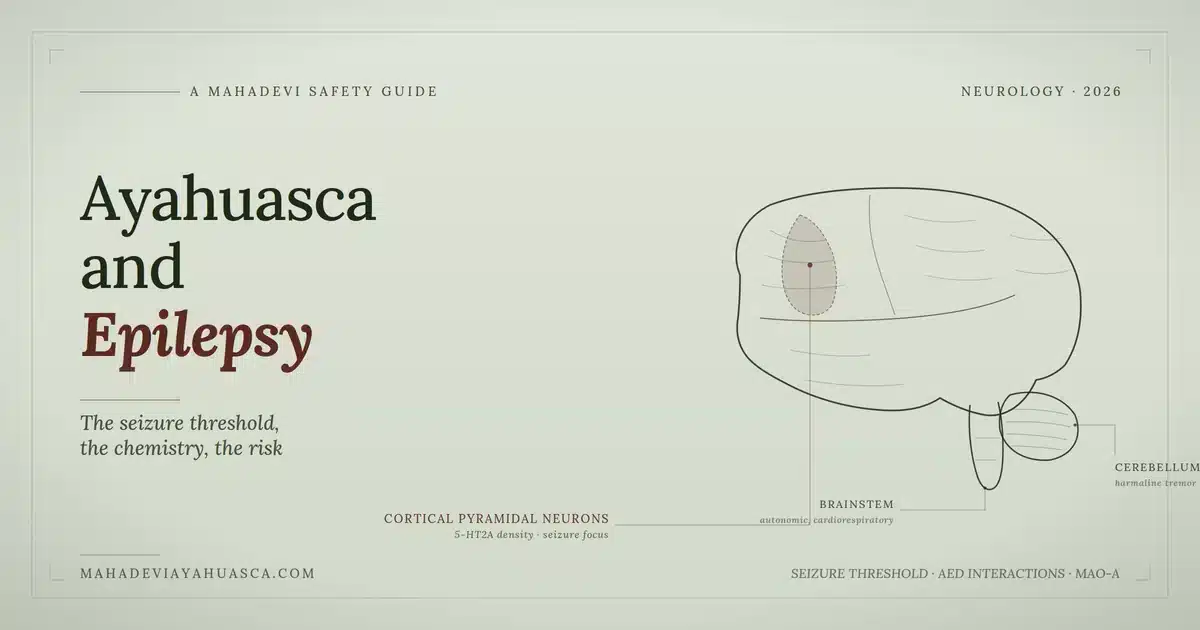
MAO inhibition raises monoamine concentrations across the brain, including serotonin and norepinephrine, both implicated in seizure threshold modulation. DMT acts at 5-HT2A receptors, which are densely expressed in cortical pyramidal neurons, the same neurons whose abnormal synchronization defines focal seizures. Harmaline has been used as a preclinical convulsant in animal models for decades.
Put plainly: a person with epilepsy drinking ayahuasca is consuming a compound that has been used to induce tremor and seizure-like activity in laboratory animals, alongside another compound that floods the cortex with the neurotransmitter most relevant to seizure initiation.
Why Ayahuasca Is Especially Dangerous for People with Epilepsy
Two mechanisms compound. They do not cancel out.
The first problem is direct. Beta-carbolines lower the seizure threshold. The threshold is the level of cortical excitation at which neurons begin to fire synchronously rather than independently. Antiepileptic drugs (AEDs) work by raising it. Beta-carbolines move it the other way. A brain that already lives close to the threshold has less margin to absorb the shift.
The second problem is interactional. Most AEDs work through specific molecular targets: sodium channel blockade for carbamazepine, lamotrigine, oxcarbazepine, and phenytoin; calcium channel modulation for ethosuximide and gabapentin; GABA enhancement for phenobarbital, benzodiazepines, and valproate’s multiple actions; and synaptic vesicle binding for levetiracetam. Many of these drugs are metabolized through the cytochrome P450 system, which ayahuasca’s beta-carbolines also engage. Harmine is a CYP2D6 inhibitor (Ruffell et al., 2020).
The pharmacokinetic consequence is unpredictable. AED levels can rise into toxicity, fall into breakthrough seizure range, or both at once depending on which enzymes the specific drug uses. There is no reliable model. There are no human pharmacokinetic studies of ayahuasca co-administered with AEDs. Zero.
The pharmacodynamic consequence compounds the kinetics. Even if AED levels held steady, beta-carbolines and DMT would still be modifying neurotransmitter availability at synapses the AED is trying to stabilize. The math is bad on both axes.
Drug Interactions Every Epilepsy Patient Must Know
An MAOI in the body changes the rules of every other drug in the body.
Many people with epilepsy are also on serotonergic antidepressants. SSRIs and SNRIs are widely co-prescribed for the depression and anxiety that frequently accompany seizure disorders. This is where the interaction picture moves from concerning to genuinely life-threatening.
Combining an MAOI (the ayahuasca beta-carbolines) with a serotonergic antidepressant produces serotonin syndrome, a potentially fatal cascade of autonomic instability, hyperthermia, rigidity, and altered mental status. Callaway and Grob first flagged this in 1998 (Callaway & Grob, 1998). Multiple subsequent reviews have confirmed it (Ruffell et al., 2020; Malcolm & Lee, 2018). A documented serotonin syndrome case has been reported in a patient combining fluoxetine with ayahuasca. For washout windows by drug class and how prescribers handle each agent, see our dedicated SSRI and MAOI interaction guide.
Tramadol, often prescribed for chronic pain and sometimes used in epileptic patients with comorbid pain conditions, carries dual risk. It is itself a seizure-threshold-lowering drug, and it has serotonergic activity that compounds the MAOI risk.
The table below is a working reference. It is not exhaustive. Any epilepsy patient considering ayahuasca should review their full medication list with a neurologist and a pharmacist who has psychedelic harm-reduction training.
| Substance | Interaction Mechanism | Risk for Epilepsy Patients |
|---|---|---|
| SSRIs and SNRIs (fluoxetine, sertraline, venlafaxine, etc.) | Serotonin syndrome via dual serotonergic and MAO-A inhibition | Severe, life-threatening |
| Tramadol | Lowers seizure threshold + serotonergic + MAOI interaction | Severe |
| MDMA, amphetamines | Unpredictable potentiation; fatalities reported with harmala combinations | Severe |
| Alcohol (tyramine-rich forms) | Hypertensive crisis with MAOIs | High |
| Opioids (especially methadone, pethidine) | Rare fatal reactions documented; respiratory depression risk | High |
| Dextromethorphan, linezolid | Serotonin syndrome | Severe |
| Cannabis | Unpredictable psychoactive potentiation; rare psychosis | Moderate |
| Most AEDs (lamotrigine, valproate, carbamazepine, levetiracetam) | Pharmacokinetic disruption + threshold modification at the same synapse | High; not studied in humans |
| Lithium, trazodone, St. John’s wort | Serotonergic; MAOI contraindication | Severe |
| Triptans (sumatriptan, etc.) | Serotonergic; risk compounded by MAOI | High |
Sources for the interaction profile above: the Ruffell pharmacological systematic review, the Malcolm and Lee clinical pharmacology review, and the ICEERS Safety Profile, which converge on the same contraindication list (Ruffell et al., 2020; Malcolm & Lee, 2018; ICEERS, 2024).
The table is not a list of substances to time around. It is a list of substances that should not coexist with ayahuasca in the same body during the same ceremony window. Washout periods for SSRIs run weeks. For drugs with active metabolites (fluoxetine especially), longer.
For someone on an AED, a “washout” is not an option. Stopping antiepileptic medication carries its own seizure risk. Withdrawal seizures can be more severe than baseline, and abrupt cessation of certain AEDs can trigger status epilepticus, a medical emergency. This is the trap. The drugs that protect the seizure threshold cannot be safely paused for a ceremony, and the ceremony chemistry compounds with those drugs in ways that have never been studied.
Can Ayahuasca Cure or Heal Epilepsy? Myth vs Reality
The question is honest. The honest answer is no.
People searching “ayahuasca cure epilepsy” are usually doing so because conventional treatment has failed them, or because they have read something hopeful online. The honest answer is that there is no clinical evidence ayahuasca treats epilepsy. There is no randomized trial. There is no case series. There is no observational cohort.
What exists is depression research. The Palhano-Fontes 2019 randomized placebo-controlled trial in 29 patients with treatment-resistant depression found a single dose of ayahuasca produced significant antidepressant effects compared to placebo at Day 7, with response rates of 64 percent versus 27 percent (Palhano-Fontes et al., 2019). For the broader depression evidence base and how it is being interpreted clinically, see ayahuasca for depression.
Earlier observational work showed similar rapid signals (dos Santos et al., 2016). A 2024 BMJ network meta-analysis of psychedelics for depression found that ayahuasca shows benefit within psychedelic trial conditions, while only high-dose psilocybin was clearly superior to a well-blinded antidepressant placebo (Hsu et al., 2024).
None of this is evidence for epilepsy. Depression is a different disorder with different mechanisms. The fact that a substance promotes serotonergic plasticity in a depressed brain does not mean it is safe, much less therapeutic, in a brain prone to abnormal electrical synchronization.
There is preclinical interest in beta-carboline derivatives and in DMT as neuroplasticity agents. None of this work has crossed into human seizure-disorder treatment. The mechanisms that make these molecules interesting for plasticity research, particularly 5-HT2A activation and dentate gyrus neurogenesis, are the same mechanisms that raise concern about cortical hyperexcitability in epileptic tissue.
If a retreat, facilitator, or website tells you ayahuasca can cure your epilepsy, they are either uninformed or actively misleading you. The chemistry runs the wrong direction for the claim.
Who Should Absolutely Avoid Ayahuasca
Every responsible screening protocol includes the same names.
The major safety reviews and screening protocols are remarkably consistent. The ICEERS Best Practices Guide names epilepsy explicitly as a contraindication, alongside cardiovascular disease, severe psychiatric conditions, and pregnancy (ICEERS, 2019). The Rossi clinical guidelines for ayahuasca administration lay out exclusion criteria and adverse-event protocols for clinical settings (Rossi et al., 2023).
The dos Santos psychosis review identifies psychiatric exclusions with case-level evidence (dos Santos et al., 2017). The ICEERS Safety Profile covers contraindications across drug interaction and disease categories (ICEERS, 2024).
Absolute contraindications across these sources:
- Diagnosed epilepsy or any seizure disorder
- Personal history of psychotic disorders (schizophrenia, schizoaffective disorder, schizophreniform)
- Personal history of bipolar I or psychotic mania
- Family history of bipolar I or schizophrenia in a first-degree relative (treat as a strong relative contraindication)
- Current use of SSRIs, SNRIs, MAOIs, tricyclic antidepressants, lithium, or trazodone
- Current use of tramadol, pethidine, methadone, dextromethorphan, or linezolid
- Significant cardiovascular disease (uncontrolled hypertension, recent myocardial infarction, severe arrhythmia)
- Pregnancy
- Severe hepatic or renal impairment
The first line on that list is the one this article exists for. Epilepsy is not a relative contraindication. It is an absolute one in every published harm-reduction guide that names it specifically.
If You Have Epilepsy and Are Still Considering It: Harm-Reduction Reality Check
Harm reduction is not endorsement. It is what to do if you are going to do it anyway.
Some readers will reach this section and still want to participate. This article does not exist to override that decision. It exists to make the decision an informed one.
Talk to your neurologist before, not after. Bring this article if it helps. Ask specifically about your seizure profile (focal versus generalized, controlled versus refractory), your AED regimen and known interactions, and whether your seizure pattern includes precipitants that ceremony settings would amplify (sleep deprivation, dehydration, sensory overload, prolonged fasting).
Most neurologists will decline to clear ayahuasca. Some will engage seriously with the question. The willingness to refuse is, by itself, a marker of competence. A clinician who says “go for it, no problem” without reviewing the pharmacology does not understand the pharmacology.
Vet the retreat ruthlessly. Specifically: does the retreat conduct medical screening, or only an intake form? Will they refuse participants with epilepsy? If yes, they are not the problem. They are a credible center. If no, they are not safe. Is there on-site medical staff with seizure response capacity? What is the protocol if a participant seizes during ceremony? A center that cannot answer these questions in writing should not be considered.
Do not taper your AEDs to qualify. Reducing or stopping antiepileptic medication to “clear” you for ceremony is the most dangerous version of this entire scenario. Withdrawal seizures from abrupt AED cessation can be more severe than the baseline disorder.
Recognize that the ceremony environment itself is a seizure provocation. Long fasts, extended wakefulness, candle and firelight, intense emotional content, and group breath patterns all touch known precipitants for photosensitive and stress-related seizures.
Have someone with you who can call EMS without hesitation and who knows your full medical history. Carry your AED list, your prescriber’s contact information, and any seizure action plan from your neurologist. Make sure the facilitator has all of this in writing before you drink.
This is not a guide to safe ceremony for people with epilepsy. There is no such thing. This is a guide to harm reduction for people who have already decided. The category is real. Telling people simply not to do it has never worked and will not start working now.
Legal Status of Ayahuasca in the US and Why It Matters for Epilepsy Patients
Schedule I is not an opinion. It is a federal classification with consequences.
DMT is a Schedule I controlled substance under the U.S. Controlled Substances Act (DEA Diversion Control Division, 2024). Schedule I is reserved for substances the federal government classifies as having no accepted medical use and high potential for abuse (DEA, 2024). The ayahuasca brew, because it contains DMT, falls under the same control.
There are exceptions. The 2006 Supreme Court ruling in Gonzales v. O Centro Espírita Beneficente União do Vegetal granted the UDV church the right to use ayahuasca sacramentally under the Religious Freedom Restoration Act (Gonzales v. UDV, 2006). Subsequent court rulings extended similar protection to certain Santo Daime branches. These exemptions are religious. They are not medical.
There is no medical exemption for ayahuasca in the United States. Not for depression. Not for epilepsy. Not for any condition. The DEA has not granted a treatment investigational new drug (IND) for ayahuasca. No FDA approval exists. No compassionate-use pathway has been established.
For people with epilepsy, this matters in three concrete ways. You cannot legally obtain ayahuasca in the U.S. for any therapeutic purpose. Retreat centers operating in the U.S. outside the religious exemption are operating illegally, regardless of how clinical they appear.
And retreat centers in countries where the brew is legal (Peru, Brazil, Colombia, Costa Rica) are subject to local regulations and screening practices, which vary widely. Internationally, ICEERS notes that the brew itself is not under international treaty control, while DMT as an isolated compound is (Sánchez Avilés & Rebollo, 2019).
For an epilepsy patient considering travel to a legal jurisdiction, the legal status changes nothing about the pharmacology. What ayahuasca does to a seizure threshold in Peru is what it does to a seizure threshold in California.
Feel deeply.
Show up fully.
Frequently Asked Questions
Is ayahuasca safe for people with epilepsy?
No. Ayahuasca contains MAO-inhibiting beta-carbolines that can lower the seizure threshold and DMT, which acts at the cortical receptors most relevant to seizure activity. The brew also interacts unpredictably with antiepileptic drugs, and dangerously with SSRIs and tramadol that epilepsy patients are often co-prescribed. Every published harm-reduction guide that names epilepsy lists it as an absolute contraindication.
Can ayahuasca trigger a seizure?
Yes. U.S. Poison Control logged 12 seizures across 531 ayahuasca exposure calls between 2005 and 2015, alongside cardiac arrests, respiratory arrests, and three deaths. The mechanism is plausible: harmaline has been used as a preclinical convulsant in animal models for decades, and DMT activates the cortical 5-HT2A receptors implicated in seizure initiation. The true rate in ceremony populations is unknown.
Can ayahuasca interact with epilepsy medications?
Yes, on two axes. Ayahuasca’s beta-carbolines inhibit cytochrome P450 enzymes (including CYP2D6) that metabolize many AEDs, which can shift drug levels into toxicity or breakthrough range. Separately, the brew alters neurotransmitter availability at the synapses AEDs are working to stabilize. There are no human pharmacokinetic studies of ayahuasca with antiepileptic drugs. The interactions are real and unstudied.
Can ayahuasca cure or heal epilepsy?
No. There are zero clinical trials of ayahuasca in seizure disorders, no case series, and no observational cohorts. The clinical research that does exist is in depression, not epilepsy. Depression is a different disorder with different mechanisms, and the same neuroplasticity pathways that make ayahuasca interesting for mood research raise concerns about cortical hyperexcitability in epileptic tissue.
What drugs should people with epilepsy avoid before ayahuasca?
SSRIs, SNRIs, tricyclic antidepressants, MAOIs, lithium, trazodone, tramadol, methadone, pethidine, dextromethorphan, linezolid, triptans, MDMA, and St. John’s wort are all contraindicated. Most antiepileptic drugs themselves cannot be safely paused, which is precisely the trap: the drugs protecting the threshold cannot be removed, and the ceremony chemistry interacts with them in ways no one has studied.
Who should absolutely not take ayahuasca?
Absolute contraindications across published guidelines: diagnosed epilepsy or seizure disorder; personal history of schizophrenia, schizoaffective disorder, or psychotic mania; personal history of bipolar I; current use of contraindicated medications; significant cardiovascular disease; pregnancy; and severe liver or kidney impairment. A first-degree family history of bipolar I or schizophrenia is a strong relative contraindication. Responsible centers screen for all of these.
Are there documented cases of ayahuasca causing seizures?
Yes. The Heise and Brooks 2017 analysis of U.S. Poison Control calls is the clearest published surveillance source: 12 seizures across 531 exposures over a decade. The systematic toxicology review by White and colleagues in 2024 also catalogs adverse events including seizure-related presentations. There are no large prospective studies, but the case-level signal in surveillance data is consistent and not negligible.
Is ayahuasca legal in the US for epilepsy treatment?
No. DMT is Schedule I under the Controlled Substances Act, and the brew falls under the same control because it contains DMT. The only legal exemptions are religious, granted to specific churches under the Religious Freedom Restoration Act. There is no medical exemption, no FDA approval, and no compassionate-use pathway for ayahuasca in the United States, for epilepsy or any other condition.
Conclusion
Ayahuasca is a serotonergic compound carried in a vehicle that inhibits the enzyme system the body uses to keep that compound in check. For most healthy adults in supervised settings, the risk is small. For people with epilepsy, it is not small. Two mechanisms compound. Documented seizures sit in the surveillance data. The interactions with antiepileptic medication have not been studied. The interactions with serotonergic medications can be fatal.
There is no clinical evidence that the brew treats epilepsy. There is evidence it can trigger or worsen seizure activity, and that the pharmacological cascade with AEDs is unpredictable on both kinetic and dynamic axes.
If you are searching for a way through your seizures, the search is honest. The answer this medicine offers is not. Other paths exist. Specialized epilepsy centers, vagus nerve stimulation, responsive neurostimulation, ketogenic and modified Atkins diets, and a deepening evidence base for cannabidiol in specific syndromes all do something this brew cannot.
The chemistry will not be argued with.
References
Drug Enforcement Administration. (2024). Drug Scheduling. U.S. Drug Enforcement Administration.
Sánchez Avilés C, Rebollo N. (2019). International Regulation of Ayahuasca Practices. ICEERS.
