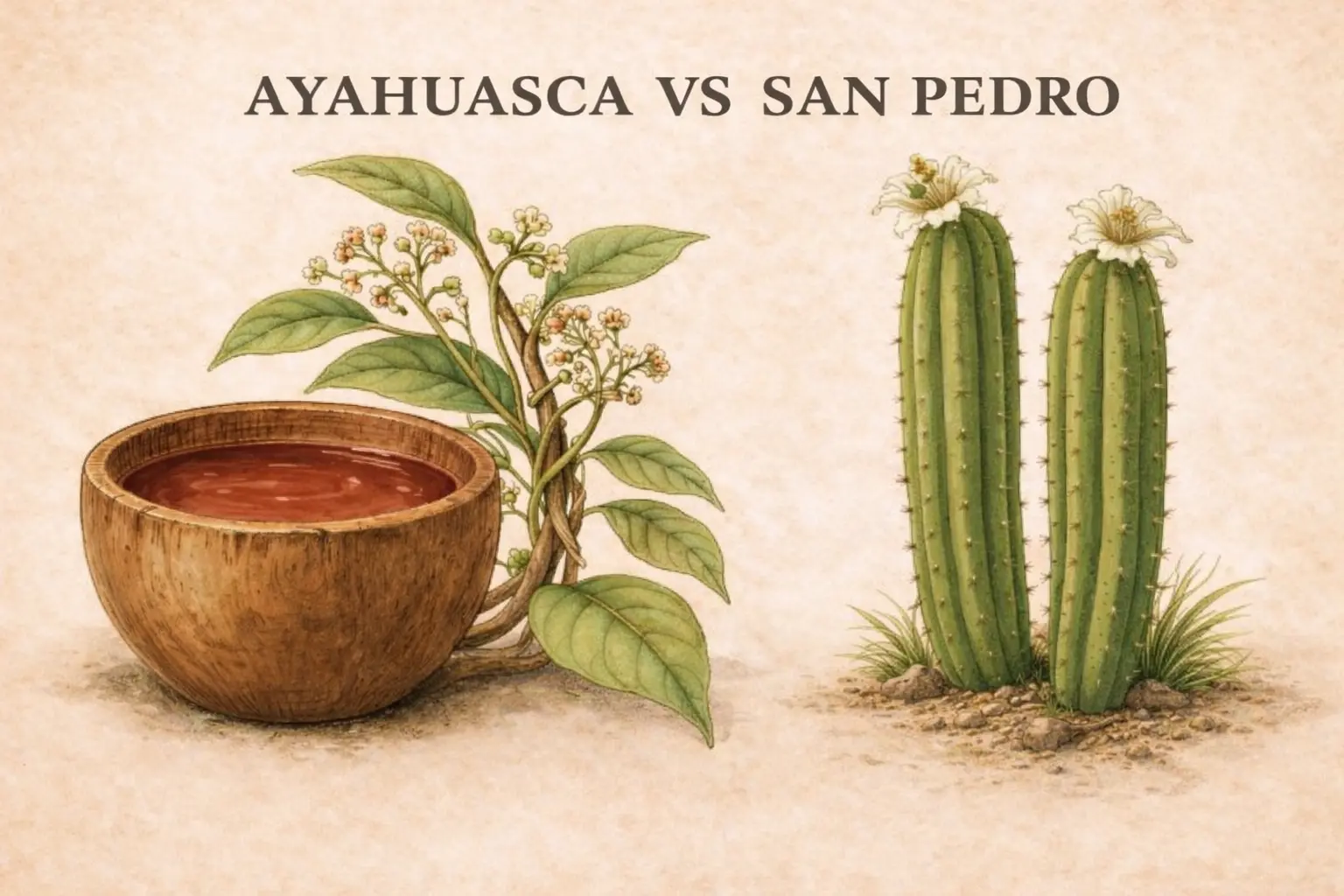
Ayahuasca vs San Pedro (Huachuma): 7 Key Differences Between Two Sacred Plant Medicines
ANSWER
Ayahuasca vs San Pedro is a comparison of two sacred plant medicines from South America that work through entirely different chemistry, ceremony structures, and experiential qualities — ayahuasca is a DMT-based Amazonian brew taken at night lasting 4–6 hours, while San Pedro is a mescaline-containing Andean cactus taken during the day lasting 8–14 hours.
At a Glance
| Ayahuasca | San Pedro (Huachuma) | |
| Duration | 4–6 hours | 8–14 hours |
| Active compound | DMT + harmala alkaloids | Mescaline |
| Setting | Night ceremony | Daytime ceremony |
| Purging | Very common (91–97%) | Less common |
| Intensity | High, inward, visionary | Expansive, heart-centred |
Quick Comparison
| Factor | Ayahuasca | San Pedro |
| Compound | DMT (orally active via MAOIs) | Mescaline (phenethylamine) |
| Onset | 20–45 minutes | 1–2 hours |
| Tradition | Amazonian (Shipibo and others) | Andean (3,000+ years of use) |
| US Legal Status | Schedule I / UDV exemption | Schedule I / ornamental plant legal |
| Typical cost | USD $1,500–$3,500+ | USD $800–$2,500+ |
Full Answer
Ayahuasca and San Pedro (Huachuma) are both sacred plant medicines with deep roots in South American indigenous tradition, but they differ fundamentally in origin, chemistry, and experience. Ayahuasca is a brew made from the Banisteriopsis caapi vine and Psychotria viridis leaf; its active compound is DMT, made orally active by the vine’s MAO-inhibiting alkaloids. San Pedro is a tall columnar cactus native to the Andes; its active compound is mescaline, a phenethylamine psychedelic. In comparing ayahuasca vs San Pedro: ayahuasca ceremonies run 4–6 hours at night and tend toward intense visionary and psychological work; San Pedro ceremonies run 8–14 hours during the day and tend toward heart-centred, nature-connected experience. Both are Schedule I controlled substances in the United States, with narrow religious exemptions.
1. What Are Ayahuasca and San Pedro? Origins and Active Compounds
Two sacred plant medicines from South America, two entirely different pharmacological engines — and understanding how each one works is where every meaningful comparison begins.
Two plant medicines. Two continents of tradition. Very different paths to the same general territory.
Ayahuasca is a brew made from two Amazonian plants: Banisteriopsis caapi (the vine) and Psychotria viridis (the leaf). The vine contains harmala alkaloids, beta-carboline compounds that act as MAO inhibitors. These inhibitors disable an enzyme in your digestive system that would otherwise neutralise the brew’s primary active compound before it reaches your brain.
That compound is DMT (dimethyltryptamine), a potent psychedelic present in the P. viridis leaf. The combination makes DMT orally active. Without the vine, there is no experience. This pharmacological partnership has been understood and used by Amazonian peoples, including the Shipibo tradition, for thousands of years — and it remains one of the more remarkable chemical collaborations in the natural world.
San Pedro, also called huachuma or wachuma in Andean tradition, is a tall columnar cactus (Trichocereus pachanoi) native to the Andes of South America. Its active compound is mescaline, a phenethylamine psychedelic.
Mescaline activates serotonin 5-HT2A receptors in the brain, the same receptors involved in perception, mood, and meaning-making. In plain terms, it shifts how you process sensory experience and emotional memory, producing an altered state characterised more by expanded feeling than by visual dissolution.
San Pedro has been used ceremonially in Andean cultures for at least 3,000 years, possibly considerably longer. Both medicines are consumed in ceremony, under the guidance of an experienced facilitator or curandero, with the intention of healing physical, psychological, and spiritual dimensions of a person’s life.
To learn more about plant medicine traditions and their contexts, visit MahaDevi’s plant medicine guide.
2. Ayahuasca vs San Pedro: Side-by-Side Comparison
The 7 key differences between ayahuasca and San Pedro span chemistry, duration, ceremony structure, and cultural tradition — not just surface-level variations in intensity.
The differences between ayahuasca vs San Pedro run deeper than most comparison guides acknowledge. The table below covers the most important dimensions:
| Aspect | Ayahuasca | San Pedro (Huachuma) |
| Active compound | DMT + harmala alkaloids | Mescaline |
| Duration | 4–6 hours | 8–14 hours |
| Setting | Night ceremony | Daytime ceremony |
| Onset | 20–45 minutes | 1–2 hours |
| Purging rate | Very common (91–97%) | Less common than ayahuasca |
| Ceremony style | Structured, curandero-led with icaros | Varied; group singing, nature immersion |
| Tradition | Amazonian (Shipibo and others) | Andean |
| Primary healing mode | Psychological, visionary, shadow work | Heart-centred, relational, nature connection |
| Intensity | High, often challenging | Generally gentler, more expansive |
| Typical retreat cost | USD $1,500–$3,500+ | USD $800–$2,500+ |
A few things the table cannot fully capture. The duration difference is not a minor point.
An 8–14 hour San Pedro experience is a full day, often ending at sunset. That changes everything about how you prepare, rest, and return to ordinary life afterward. San Pedro also tends to keep you functional enough to walk, eat, and interact with others during the experience. Ayahuasca tends not to.
The purging rates reflect something pharmacological and cultural simultaneously. In ayahuasca ceremony, vomiting — la purga, the purge — is considered part of the healing itself, a physical release that mirrors the emotional and psychological work happening internally. San Pedro ceremonies involve far less of this, though nausea remains possible.
For a full comparison of ayahuasca with another well-known plant medicine, see Peyote vs Ayahuasca: Key Differences.
3. Effects and the Ceremony Experience: What to Expect
Ayahuasca confronts. San Pedro opens. The physical effects and experiential qualities of these two medicines are as distinct as the traditions they come from.
What happens in either ceremony depends as much on the setting, the facilitator, and the individual’s psychological state as on the pharmacology. The evidence and the ethnographic record describe tendencies, not guarantees.
Ayahuasca
tends to produce an experience that is visionary, psychologically intense, and inward-directed. Visual phenomena are common and often elaborate: geometric patterns, narrative scenes, symbolic imagery.
Emotional content surfaces strongly, sometimes painfully. This is the territory often described as shadow work — confronting suppressed feelings, old wounds, patterns of thought or behaviour that no longer serve you. The setting reinforces this: a dark room, the curandero’s icaros (healing songs) guiding the space, other participants nearby but each in their own inner world.
Physiologically, nausea and vomiting affect the vast majority of ayahuasca drinkers. Durante et al. (2021, Brazilian Journal of Psychiatry) found nausea in 91.53% of participants and vomiting in 96.74% of cases. These physical effects are mostly transient and self-limited.
The same study found that only 0.81% of participants needed medical assistance, with no documented emergencies.
Both ayahuasca and mescaline activate the brain’s 5-HT2A receptors, the serotonin receptors involved in perception and emotional processing. Activating these receptors shifts how the brain filters and interprets sensory and emotional information.
De Vos, Mason, and Kuypers (2021, Frontiers in Psychiatry) found that a single psychedelic dose can increase BDNF (brain-derived neurotrophic factor), dendritic spines, and synapse density within 24 hours of administration.
In plain terms: the brain becomes temporarily more flexible and receptive to new patterns of connection. DMT and ayahuasca specifically have also been linked to the proliferation and migration of hippocampal stem cells in preclinical data. These effects outlast the acute experience — one reason researchers link ayahuasca use to sustained antidepressant-like outcomes.
San Pedro
tends toward a different quality of experience. The feeling is often described as expansive rather than confrontational — an opening of the heart, a deepened sense of connection to other people, the natural world, and one’s own body.
Visionary phenomena are less dominant than with ayahuasca. The landscape, the light, the other people present — these things tend to carry the ceremony rather than internal imagery alone. This is why San Pedro is often held outdoors, in nature, with shared music and group singing as part of the container.
Within Andean tradition, San Pedro is understood as a grandfather medicine — a presence that is steady, generous, and connected to the land and to ancestral ways of knowing. That dimension is part of what practitioners have described across generations. It is worth naming directly rather than leaving it out.
Neither experience should be approached casually. Difficult emotional content arises with both. The quality of the container around the experience shapes outcomes more than most people expect (Durante et al., 2021; De Vos et al., 2021).
4. Preparation and the Dieta: How to Get Ready
Ayahuasca’s dieta is pharmacologically necessary, not ceremonial preference — the MAO inhibitors in the brew make certain foods and medications genuinely dangerous.
Preparation is where ayahuasca vs San Pedro diverge most significantly, and where most comparison articles say almost nothing. The requirements differ not just in duration but in purpose.
| Preparation aspect | Ayahuasca | San Pedro |
| Dieta duration | 1–4 weeks before ceremony | 3–7 days before ceremony |
| Foods to avoid | Tyramine-rich foods: aged cheese, cured meat, fermented foods, alcohol, pork, caffeine | Alcohol, red meat, processed foods; lighter restrictions |
| Reason for dietary rules | MAO inhibitor interaction: certain foods cause dangerous blood pressure spikes | Respectful preparation; lighter pharmacological necessity |
| Medications | SSRIs, MAOIs, many psychiatric medications must be tapered under medical supervision | Fewer critical interactions; still review all medications with a doctor |
| Mental preparation | Set clear intentions; journaling recommended; prepare for psychological difficulty | Set intentions; time in nature recommended |
The ayahuasca dieta is strict because it has to be. The harmala alkaloids in ayahuasca are potent MAO inhibitors, and combining them with tyramine-rich foods or certain medications can cause dangerous interactions. This is pharmacologically necessary, not a cultural formality.
San Pedro preparation is lighter in the pharmacological sense. Many facilitators recommend similar lifestyle adjustments for clarity and presence. Setting your intention before either ceremony — even writing it down — significantly shapes the direction of the experience.
5. Safety, Risks, and Medical Contraindications
The most preventable serious harm with ayahuasca involves drug interactions — specifically SSRIs — and this risk is not theoretical.
This section covers life-safety information. It is not medical advice. Consult a qualified medical professional before participating in any plant medicine ceremony, particularly if you take prescription medications or have a history of psychiatric or cardiovascular conditions.
Plant medicine ceremonies carry real risks. Understanding them clearly — rather than either dismissing them or sensationalising them — is what this section is for.
The most serious risk with ayahuasca is the SSRI interaction. Ayahuasca’s harmala alkaloids inhibit monoamine oxidase A (MAO-A), the enzyme that breaks down serotonin. SSRIs prevent the brain from clearing serotonin.
Taking both together can cause serotonin syndrome, a potentially life-threatening condition characterised by agitation, dangerously elevated body temperature, rapid heart rate, and muscular rigidity.
Callaway and Grob (1998, Journal of Psychoactive Drugs) documented three cases and explicitly warned against this combination. This is not a theoretical risk. If you take any SSRI or antidepressant, you must taper off under medical supervision before an ayahuasca ceremony — and this process takes weeks, not days.
San Pedro’s interaction risks with SSRIs are lower, because mescaline does not carry the MAO inhibitor mechanism. However, combining any psychedelic with psychiatric medications carries risks and should not be undertaken without medical guidance.
Durante et al. (2021) found that antidepressant users in their sample showed no significant increase in adverse effects compared to non-users — but this does not mean the combination is safe. The study was not controlled for SSRI type or tapering status.
The same study found 41.86% of participants reported some form of persistent physical effects after ayahuasca — most mild, most resolving without intervention. Only 0.81% required medical assistance.
Context matters: these figures come from ceremonial settings with experienced facilitators. Self-administration outside a structured ceremony carries substantially higher risk.
| Condition | Ayahuasca Risk | San Pedro Risk |
| SSRIs / SNRIs | HIGH — serotonin syndrome risk; must discontinue under medical supervision | Lower, but review with a doctor |
| Heart conditions | HIGH — tachycardia and blood pressure changes documented | Moderate — mescaline also increases heart rate; cardiac history requires medical review |
| Psychosis / schizophrenia history | HIGH — contraindicated | HIGH — contraindicated |
| Pregnancy | CONTRAINDICATED | CONTRAINDICATED |
| Lithium use | Some clinicians advise against combining lithium with any psychedelic | Same caution applies |
| MAO inhibitors (prescribed) | CONTRAINDICATED — direct pharmacological conflict | Lower interaction risk; still disclose all medications |
If you are preparing for an ayahuasca ceremony and need to understand what is and is not safe to combine, the Ayahuasca Framework covers medication interactions, health screening, and what to discuss with your doctor before you make any decisions.
6. Legal Status: Is Ayahuasca vs San Pedro Legal?
Both medicines are Schedule I controlled substances in the United States — the exemptions are narrower than most people realise, and neither covers the general public.
This is general information only, not legal advice. Laws change. Verify current status with a qualified legal professional in your country before making any decisions.
Legal status is genuinely complicated for both medicines, and most comparison articles either skip this question or give vague answers. Here is what the evidence shows at a country level.
| Country | Ayahuasca | San Pedro |
| United States | DMT is Schedule I. Ayahuasca is federally illegal. Religious exemptions exist for UDV and Santo Daime. | Mescaline is Schedule I (DEA, 2020). San Pedro cacti are legal ornamentally. Extraction and use is illegal. |
| Peru | Legal. Considered cultural heritage. Ceremonial use openly permitted. | Not specifically regulated. Ceremonial use is practised. |
| Brazil | Ritual use regulated and permitted by CONAD resolution, 2010 (ICEERS). | Not specifically regulated. |
| Netherlands | DMT is controlled. Ayahuasca exists in a contested legal grey zone. | San Pedro cacti are legal to possess. Mescaline extraction is illegal. |
| United Kingdom | DMT is Class A. Ayahuasca is illegal (ICEERS). | Mescaline is Class A. Cacti legal ornamentally; extraction illegal. |
| Australia | DMT is Schedule 9. Ayahuasca is prohibited. | Mescaline is Schedule 9. Cacti legal ornamentally; extraction prohibited. |
The practical reality for most English-speaking seekers: both medicines are illegal in the US, UK, and Australia at the federal or national level. Legal access exists most clearly in Peru and, for ayahuasca, in Brazil.
The U.S. Embassy in Peru has issued a health advisory warning of risks associated with unregulated ayahuasca tourism, including safety incidents involving unlicensed facilitators (pe.usembassy.gov, accessed March 2026). This is worth noting for anyone considering international ceremony travel.
7. Which Is Right for You? A Readiness-Based Decision Guide
The right question is not which medicine is more powerful — it is which healing process you are genuinely ready to enter.
If you are comparing ayahuasca vs San Pedro, something is already drawing you toward one of these paths. That pull is worth sitting with before consulting any framework.
There is no universally correct answer. But there are patterns. Based on what the evidence and experiential literature consistently describe, here is a framework for thinking about your choice.
| Choose San Pedro if… | What it means |
| This is your first plant medicine experience | San Pedro’s longer but gentler quality tends to be more manageable for first-timers |
| You want to open your heart and feel connected | San Pedro is specifically associated with heart-centred, relational, nature-connected experiences |
| You want to remain physically mobile during the ceremony | San Pedro typically preserves enough function to walk, be in nature, and interact with others |
| You have a full day available | 8–14 hours is the commitment; plan your day accordingly |
| You are drawn to Andean tradition and landscape | San Pedro’s ceremonial context is outdoors, land-based, and communal |
| Choose Ayahuasca if… | What it means |
| You are ready to do deep psychological work | Ayahuasca tends to surface suppressed material with greater intensity and clarity |
| You want a visionary experience | DMT’s visual and narrative quality is distinctive and difficult to replicate elsewhere |
| You have specific healing intentions around trauma or depression | Osório et al. (2015) and Sanches et al. (2016) both found antidepressant effects of a single ayahuasca dose in patients with recurrent depression |
| You have done preparation work and understand the risks | Ayahuasca’s pharmacological complexity and purging intensity require genuine readiness |
| You are drawn to Amazonian tradition | The Shipibo ceremonial context — icaros, darkness, the specific energetic container — is part of what ayahuasca is |
Consider sequential use if you are on a longer journey. Many experienced seekers do both over time. San Pedro first is a common pattern — opening the heart, building trust with the medicine process, developing a foundation for the more intense psychological work that ayahuasca can catalyse. This sequencing is practised in various retreat models. It is not a requirement, but it is worth naming as an option.
Whatever draws you toward either tradition, the quality of the container around the experience shapes outcomes more than the substance itself. The ceremony structure, the facilitator’s experience and ethics, the pre-ceremony screening, the support available afterward — these are what the research consistently identifies as what matters most (Durante et al., 2021; De Vos et al., 2021).
If you are moving toward ayahuasca specifically, the Ayahuasca Framework is a free course built around what genuine preparation actually looks like, from understanding the pharmacology to choosing the right facilitator.
8. Integration and Aftercare: Life After the Ceremony
The ceremony opens the door. Integration is how you walk through it.
The ceremony is one part of the process. What happens in the weeks and months afterward shapes whether the insights become lasting change.
Both ayahuasca and San Pedro benefit from structured integration — the deliberate practice of making sense of what you experienced and finding ways to live it. Common integration practices include journaling, working with a therapist or integration circle, time in nature, creative expression, and reduced stimulation in the immediate post-ceremony period.
Ayahuasca experiences often produce material that takes significant time to fully understand. Symbolic or confrontational content that felt urgent during the ceremony may clarify over weeks. San Pedro experiences tend to leave a felt sense — an emotional or relational opening — that needs nurturing rather than analysis.
For anyone considering a sequential or multi-ceremony journey, integration between experiences matters as much as preparation for each new one. A dedicated integration guide covers this in depth separately.
9. Frequently Asked Questions
Direct answers to the most common questions about ayahuasca vs San Pedro — from duration and safety to legality and beginner suitability.
Ayahuasca vs San Pedro
- How long does San Pedro last compared to ayahuasca?Ayahuasca typically lasts 4–6 hours from first effects to resolution. San Pedro (huachuma) lasts 8–14 hours — roughly twice the duration. San Pedro also has a slower onset of 1–2 hours versus ayahuasca’s 20–45 minutes. Plan your San Pedro day accordingly: this is a full-day commitment, not an evening.
- Which plant medicine is better for beginners?San Pedro is generally more suitable as a first plant medicine experience. Its longer, gentler, heart-centred quality tends to be more manageable than ayahuasca’s intensity. That said, neither medicine is without challenge, and both require a qualified facilitator. Better for beginners does not mean safe without preparation.
- Can you legally buy San Pedro cactus in the US?Yes — San Pedro cacti are widely sold as ornamental plants in the US and are legal to purchase and possess. What is illegal is extracting mescaline from them for consumption. Mescaline is a Schedule I controlled substance under the federal Controlled Substances Act (DEA, 2020). Possessing the plant is legal; using it ceremonially is not under federal law.
- What medications are dangerous to take with ayahuasca or San Pedro?The most serious interaction is SSRIs with ayahuasca. Ayahuasca’s harmala alkaloids are MAO inhibitors; combining them with SSRIs risks serotonin syndrome, a potentially life-threatening condition. Three documented cases are described in Callaway and Grob (1998). Some clinicians also advise against combining lithium with any psychedelic. People with heart conditions should exercise caution with both medicines. Do not participate in any plant medicine ceremony while taking prescription psychiatric medications without first consulting your doctor.
- How does the dieta differ between ayahuasca and San Pedro?Ayahuasca requires a strict multi-week dieta: avoiding tyramine-rich foods — aged cheese, cured meat, fermented foods, alcohol — caffeine, and tapering off certain medications, because ayahuasca’s MAO inhibitors create pharmacological interactions with these substances. San Pedro preparation is lighter: typically 3–7 days, avoiding alcohol, red meat, and processed foods, with no equivalent pharmacological necessity. Both benefit from mental preparation and clear intention-setting.
- Does ayahuasca change your brain?Preliminary evidence suggests yes. De Vos, Mason, and Kuypers (2021, Frontiers in Psychiatry) found that a single psychedelic dose can increase BDNF, dendritic spine density, and synapse formation within 24 hours. DMT and ayahuasca specifically are linked to hippocampal neuroplasticity effects in preclinical data. These changes are associated with antidepressant-like outcomes that outlast the acute experience. The research is still early, but the neuroplasticity findings are among the more robust in the psychedelic science literature.
- Can ayahuasca and San Pedro be used together or sequenced?Not typically at the same time — their pharmacological profiles and durations make simultaneous use inadvisable. Sequential use over separate ceremonies is practised, and many experienced seekers report that San Pedro first provides a heart-opening foundation for the deeper psychological work of ayahuasca later. There is no universally prescribed order. Both medicines deserve their own dedicated time, preparation, and integration.
Conclusion
The pharmacological comparison is the starting point, not the destination.
Ayahuasca vs San Pedro is ultimately a comparison of two distinct healing traditions, each with its own chemistry, cultural context, and ceremonial structure.
Ayahuasca is a night medicine that confronts. San Pedro is a day medicine that opens. One moves inward through intensity. The other expands outward through connection. Both deserve genuine respect and genuine preparation.
For anyone drawn to explore either tradition, the pharmacological comparison is probably the least important thing to understand. More important are the questions that do not appear in any table.
Who am I learning from, and do they have genuine roots in the tradition they are offering? What container is being held around this experience? Have I been completely honest about my health and my medications? Do I actually respect what I am approaching?
Those questions matter more than which medicine is more powerful.
References
1. Durante, Í., dos Santos, R. G., Bouso, J. C., & Hallak, J. E. C. Risk assessment of ayahuasca use in a religious context: self-reported risk factors and adverse effects. Brazilian Journal of Psychiatry. 2021;43:362–369. https://pmc.ncbi.nlm.nih.gov/articles/PMC8352742/
2. de Vos, C. M. H., Mason, N. L., & Kuypers, K. P. C. Psychedelics and Neuroplasticity: A Systematic Review Unraveling the Biological Underpinnings of Psychedelics. Frontiers in Psychiatry. 2021;12:724606. https://pmc.ncbi.nlm.nih.gov/articles/PMC8461007/
3. Callaway, J. C., & Grob, C. S. Ayahuasca preparations and serotonin reuptake inhibitors: a potential combination for severe adverse interactions. Journal of Psychoactive Drugs. 1998;30:367–9. https://pubmed.ncbi.nlm.nih.gov/9924842/
4. Osório, F. de L., Sanches, R. F., Macedo, L. R., et al. Antidepressant effects of a single dose of ayahuasca in patients with recurrent depression: a preliminary report. Brazilian Journal of Psychiatry. 2015;37:13–20. https://pubmed.ncbi.nlm.nih.gov/25806551/
5. Sanches, R. F., Osório, F. de L., dos Santos, R. G., et al. Antidepressant effects of a single dose of ayahuasca in patients with recurrent depression: a SPECT study. Journal of Clinical Psychopharmacology. 2016;36:77–81. https://pubmed.ncbi.nlm.nih.gov/26650973/
6. Drug Enforcement Administration. Peyote and Mescaline Drug Fact Sheet. https://www.dea.gov/factsheets/peyote-and-mescaline
7. Drug Enforcement Administration. Controlled Substances Schedules. https://deadiversion.usdoj.gov/schedules/schedules.html
8. ICEERS. Brazil — Ayahuasca Legal Status. https://www.iceers.org/brazil/
9. ICEERS. England and Wales — Ayahuasca Legal Status. https://www.iceers.org/england-and-wales/
10. U.S. Embassy in Peru. Health Alert: Do Not Use Ayahuasca or Kambo. https://pe.usembassy.gov/health-alert-do-not-use-ayahuasca-kambo/ (accessed March 2026)
