The Kamentsá Yagé Tradition
of Putumayo, Colombia
A living lineage carried by Taita Miguel Mavisoy across at least twelve generations. Served on ancestral land, with medicine prepared fresh.
A Lineage, Not a Service
The Kamentsá ayahuasca lineage, also written Camsá or Kamsá, is a yagé tradition kept by the Kamentsá indigenous people of Colombia's Sibundoy Valley in the upper Putumayo. The lineage passes from Taita to apprentice across generations and uses Banisteriopsis caapi vine combined with chagra, the lineage's name for the leaf of Diplopterys cabrerana (also called chagropanga or chaliponga), grown alongside other medicinal plants in the traditional yané gardens of the Sibundoy.
MahaDevi's ceremony work is rooted in this lineage through Taita Miguel Mavisoy, a Kamentsá elder whose family has carried this medicine across at least twelve generations, who received yagé for the first time at six months of age, and who began serving medicine at fourteen.
The ceremonies he holds at MahaDevi are not adapted, modernized, or softened for outside audiences. They are the Kamentsá tradition itself, served on ancestral land, with medicine prepared fresh.
Who Are the Kamentsá People?
The Kamentsá, often written Camsá or Kamsá in everyday usage, are an indigenous people of the Sibundoy Valley in Colombia's Putumayo Department, on the Andean side of the Amazon basin. Their population sits in the range of roughly 4,773 to 7,000 depending on the source and census year, with the largest concentration in and around Sibundoy, Santiago, Colón, and San Francisco. The Kamentsá share the valley with the Inga people, with whom they have lived in close cultural exchange for centuries while keeping a distinct identity, ceremonial system, and language.
Their language, Kamëntšá Biya, is what linguists call a language isolate (O'Brien, 2018). In plain terms, that means it does not belong to any known language family and has no proven relationship to neighboring tongues like Quechua or the Tucanoan languages of the lowland Amazon. A language isolate is unusual and significant. It suggests a population whose cultural roots predate the spread of the major Andean and Amazonian language groups, which gives the Kamentsá tradition an unusually deep claim to continuity in this territory.
The Kamentsá have not been passive recipients of cultural influence. Recent scholarship reframes them as active agents who have absorbed and re-articulated outside elements (Catholic, mestizo, Andean, Amazonian) through deep pre-Hispanic experience with what anthropologists call transculturation (Glass, 2022). The lineage has survived because it has never been frozen.
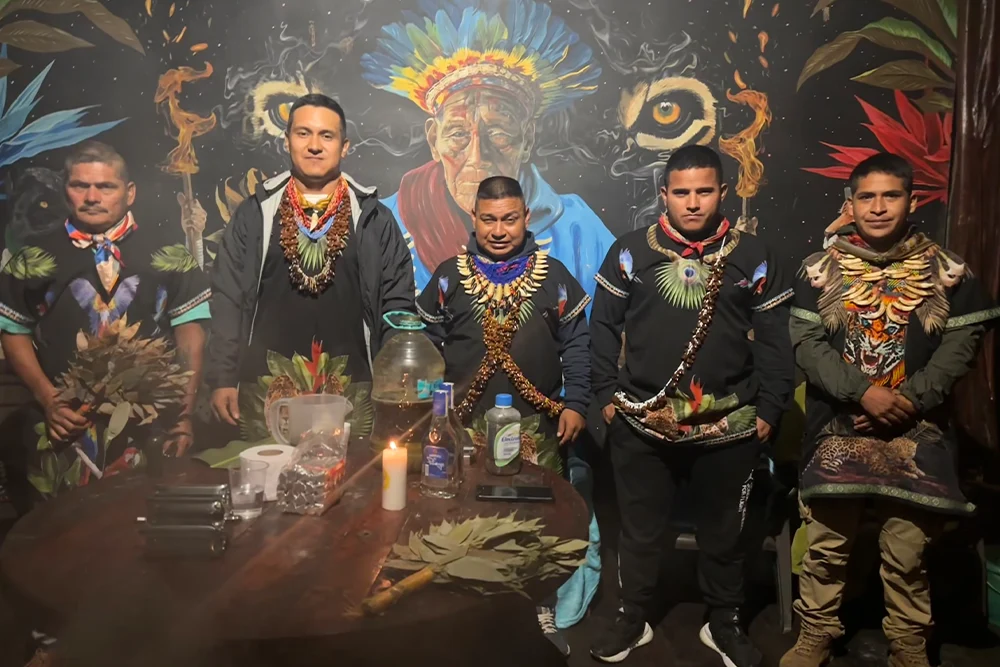 Kamentsá healers from the Sibundoy Valley, Putumayo.
 The Sibundoy Valley and the Yané Gardens
The Sibundoy Valley sits at roughly 2,200 meters in the Putumayo Department, cradled by the eastern slope of the Colombian Andes. It is one of the most ecologically and culturally significant corridors in northwest South America. The valley functions as a bridge between two ecosystems and two ceremonial traditions: the high Andean world above, with its mountain medicines and Pachamama cosmology, and the Amazon lowlands below, with their plant teachers and the Banisteriopsis vine. The lineage is not a portable practice. It belongs to this geography.
The medicinal plants used in yagé ceremony, including Banisteriopsis caapi and chagra, are grown in yané gardens, the traditional polyculture system of the Sibundoy taitas. Schultes documented gardens of this kind during his Colombian Amazon fieldwork between 1941 and 1953 and described them as botanical archives of extraordinary depth (Schultes & Raffauf, 1992). Ramírez de Jara and Pinzón Castaño, drawing on Colombian institutional fieldwork in Sibundoy, described these yané gardens in detail: maintained by families across generations, holding Banisteriopsis caapi alongside Brugmansia cultivars and other companion plants, with each plant occupying a specific role in the ceremonial pharmacopeia (Ramírez de Jara & Pinzón Castaño, 1993).
This matters for what MahaDevi offers. The yané garden where Taita Miguel grows the medicine is on his own land in Putumayo. It is not imported, not cooked-and-shipped, not reconstituted from paste. It is prepared fresh, by hand, for the specific people sitting in ceremony.
 Caapi vine prepared in the Kamentsá tradition.
 Ayahuasca vs Yagé: Same Vine, Different Worlds
The single most common question seekers ask before booking with a Colombian retreat is whether yagé and ayahuasca are the same thing. The short answer is yes and no.
Botanically, both names refer to brews built around Banisteriopsis caapi, the woody vine whose beta-carboline alkaloids (harmine, harmaline, tetrahydroharmine) act as monoamine oxidase inhibitors. In plain terms, the vine disables the enzyme that would otherwise break down DMT before it ever reached the brain, which is what allows the visionary effect to occur orally (Egger et al., 2024). This pharmacological core is the same in both traditions.
Where the two diverge is in everything else. Ayahuasca is the Quechua name, dominant in Peru and Ecuador and carried into global use by Shipibo-Konibo and mestizo vegetalista lineages. Yagé is the name used across the Colombian Amazon and the Sibundoy Valley, carried by Kamentsá, Inga, Cofán, and Siona peoples (Suárez Álvarez & ICEERS, 2023). Choosing the word yagé over ayahuasca is a small act of fidelity to the lineage one is actually working with.
The most concrete distinction sits in the admixture leaf. Peruvian Shipibo and most mestizo lineages use chacruna (Psychotria viridis), a small flowering shrub. The Kamentsá lineage MahaDevi works within uses chagra, also called chagropanga or chaliponga (Diplopterys cabrerana), a related liana whose leaves carry significantly more DMT per gram than chacruna. Laboratory analysis quantified chagra at 2.4 mg of DMT per gram of leaf compared to 0.94 mg per gram for chacruna, with chagra-based brews producing measurably higher DMT concentrations than chacruna-based brews (Brito-da-Costa et al., 2020; Chambers et al., 2020). The botanical type specimen of D. cabrerana, the reference specimen that formally established the species, was collected by Schultes from Colombia's Vaupés region, which fixes its provenance squarely in the Colombian Amazon (Gates, 1982).
Some Colombian lineages also work with chacruna in certain contexts. Taita Miguel's Kamentsá lineage, however, primarily uses chagra. That choice is not stylistic. It is part of what defines the lineage.
For a fuller treatment, see our ayahuasca vs yagé guide and the ayahuasca in Colombia vs Peru comparison.
The Amazonian Healing Worlds
The Amazon does not hold one ayahuasca tradition. It holds many, each with its own understanding of what healing is and how it happens. These are summary sketches.
Land-bound, communal, lineage-carried
The ceremony is built around a sacred fire that burns through the night, with tobacco, harmonica, song, and the Taita's voice as the architecture of the space (García Molina, 2014). Healing in this tradition is not separate from the territory or the community that recognizes the healer. UMIYAC, the Union of Traditional Yagé Medics of the Colombian Amazon, was formed by Kamentsá, Inga, Cofán, Siona, and Coreguaje Taitas to defend that fabric against extraction, displacement, and cultural appropriation (Arsenault for Mongabay, 2020).
Diagnostic, song-driven
The Shipibo-Konibo onanyabo (master healers) sing icaros, sacred songs received from plant teachers during years of solitary dieta, each song calibrated to a specific person and a specific energetic state (Gonzalez et al., 2021). The ceremony happens in darkness or near-darkness. The healer reads the room through song and adjusts in real time. Peru declared ayahuasca a national cultural heritage in 2008 (INC Peru Resolución 836, 2008).
Collective, hymnal, structured
Santo Daime, founded in the 1930s by rubber-tapper Raimundo Irineu Serra, brings together indigenous vegetalismo with Afro-Brazilian, Catholic, and esoteric traditions. Participants stand in formation and sing prescribed hinários for hours. The União do Vegetal, founded in 1961, takes a more contemplative form. Brazil legalized religious ayahuasca use in 1987 and formalized that recognition in 2010 (Labate & MacRae, 2010).
Between Colombia and Peru
The Shuar call the medicine natema and frame it around arutam, spiritual force acquired through visionary experience that protects against violence and misfortune. The Cofán of the Colombia-Ecuador border carry yagé across the political line that the medicine itself does not recognize (Cepek, 2019). As in Colombia, the admixture leaf is typically chagra rather than chacruna.
These are not different versions of the same therapy. They are different cosmological systems that share a plant and a territory.
Indigenous Origins, Colonial Erasure, and the Modern Return
The phrase psychedelic therapy is recent. The practice it describes is not.
For most of the twentieth century, the dominant Western framing of Amazonian peoples was an inheritance of colonial anthropology: traditions like yagé were described as primitive, the healers as superstitious, the medicine as dangerous folklore. Early ethnographic literature is full of language that today reads as straightforwardly racist. The peoples who carried this knowledge were not primitive. They had developed pharmacological systems sophisticated enough that, a thousand years before the modern psychedelic era began, harmine and DMT were already being intentionally combined by a pre-Columbian shaman whose ritual bundle archaeologists later found preserved in a Bolivian cave (Miller et al., 2019). The combination was deliberate and measured. The sophistication was already there.
The current Western interest in psychedelic therapy, as it appears in clinical trials, biotech investment, and licensed treatment frameworks, is built on knowledge that indigenous Amazonian communities have carried for generations. Recognizing this is not a courtesy. It is the precondition for any honest engagement with the medicine. Celidwen and colleagues, writing in The Lancet Regional Health – Americas with co-author Miguel Evanjuanoy Chindoy of UMIYAC, set out the principles that meaningful engagement requires: reverence, respect, responsibility, regulation, reparation, restoration, and reconciliation (Celidwen et al., 2022). Without those, what gets called psychedelic therapy is, structurally, extraction.
That said, the world is moving. Conventional Western mental health treatment has well-documented limits. Treatment-resistant depression, complex trauma, and addictive patterns often do not respond to the available pharmacological tools. The Western medical establishment is increasingly acknowledging this, and some of its most rigorous research has begun studying ayahuasca specifically. A 2024 meta-analysis across 126 studies found ayahuasca produced large therapeutic effects on depression and anxiety (Yao et al., 2024). A landmark 2019 placebo-controlled trial in treatment-resistant depression patients reported a between-group effect size of Cohen's d = 1.49 at one week, a large effect by any clinical standard (Palhano-Fontes et al., 2019). Survey data from 6,877 international ayahuasca drinkers showed that ceremonial setting quality, mystical experience strength, and community support were the variables most strongly associated with positive mental health outcomes (Perkins et al., 2021).
The research is genuinely promising. It also makes clear what the indigenous traditions have known for centuries: the medicine alone is not the medicine. The container is. The lineage is. The land is. The community is. Set, setting, song, fire, Taita, all of it. This is why MahaDevi works in Putumayo with Taita Miguel rather than offering a clinical model in another country with imported paste. The research points back toward what the lineage already holds.
The Taita: Lineage Transmission in the Kamentsá Tradition
A Taita is a Kamentsá and broader Putumayo word for an elder, healer, and ceremonial leader who carries plant medicine knowledge. The word translates loosely as father or grandfather and signals respect for someone who has earned the role through decades of apprenticeship. A Taita is not a shaman in the loose New Age sense of that word. The role is specific, lineage-bound, and recognized by the community a Taita serves. The word shaman itself comes from the Tungus people of Siberia and has no meaningful connection to the Amazon. Here the healers are called Taitas, and the title is conferred by community recognition rather than self-assignment.
Lineage transmission in the Kamentsá tradition follows an apprentice-to-elder path that often begins in childhood. Ramírez de Jara and Pinzón Castaño (1993) documented a multi-stage initiation process among Sibundoy taitas built around successive yagé visions, deepening relationship with specific plants, and the slow building of recognition by elder taitas. The training is not modular. An apprentice learns through dieta with specific plants, sustained ceremonial work, the memorization and reception of icaros, the maintenance of the healing altar, and the cultivation of medicinal plants in the yané garden. García Molina (2014), drawing on fieldwork in the Sibundoy among Kamentsá and Inga taitas, showed that sound itself, including specific songs, whistles, and ceremonial music, is the primary tool the Taita uses to construct the ceremonial space.
In practical terms, an apprentice does not become a Taita by completing a course or paying for a title. They become a Taita when their elder, their family, and their community recognize them as one.
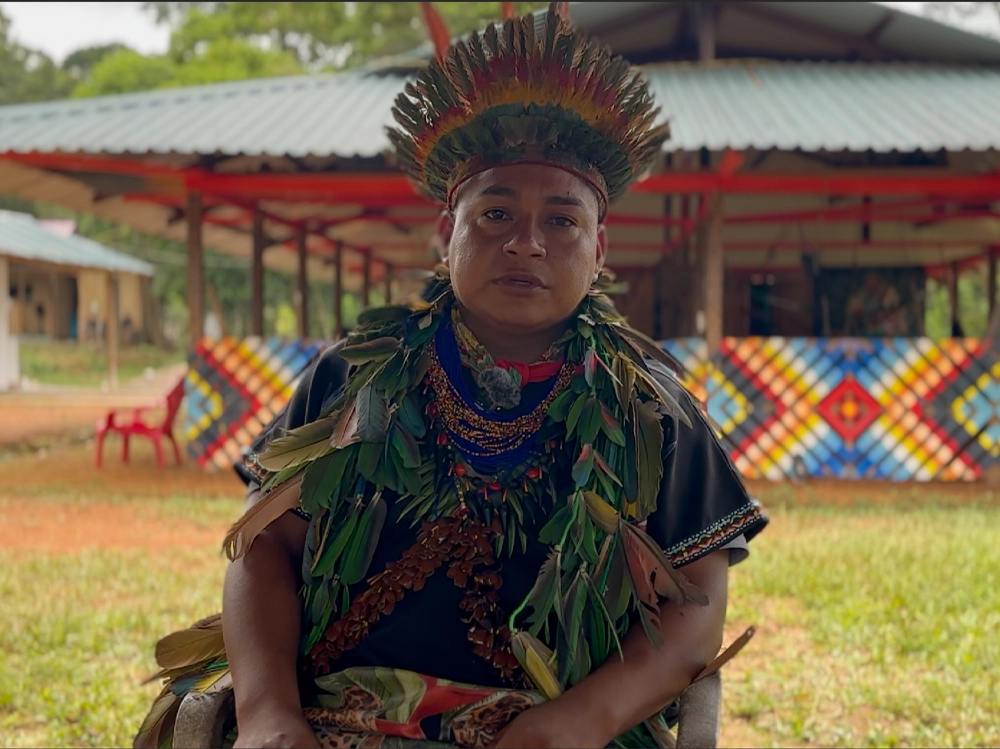 Taita Miguel Mavisoy, Kamentsá elder.
 Taita Miguel Mavisoy
Taita Miguel Mavisoy is a Kamentsá elder from the Sibundoy region of Putumayo. He is known for his warmth, his humility, and his deep commitment to preserving and sharing the ancestral traditions of yagé.
Taita Miguel was introduced to the medicine path at six months old by his parents, both recognized healers within the Kamentsá tradition. By the age of fourteen, he had begun serving medicine, carrying forward the knowledge and responsibility of his lineage. His family's lineage runs unbroken across at least twelve generations.
He grew up in the village of Buena Vista near the Ecuadorian border, raised within a communal way of life that values presence, humility, and connection to the land. His wife is also a healer, and they work together. The people who come to sit with him arrive from Colombia, Europe, and the United States, drawn to ceremonies grounded in tradition, respect, and community.
The values Taita Miguel was raised within shape how he holds ceremony. His ceremonies often include traditional Kamentsá music and cultural elements that deepen the ceremonial space. There is fire, there is song, there is tobacco, there is the harmonica, and there is the Taita's voice. There is also room for the people sitting with him. The Kamentsá tradition is not austere. It is communal. It carries joy alongside the difficulty of the work.
Taita Miguel's presence, care, and steadiness are central to MahaDevi's ceremonial work. To learn more about him and the other lineage holders we work with, see our team page.
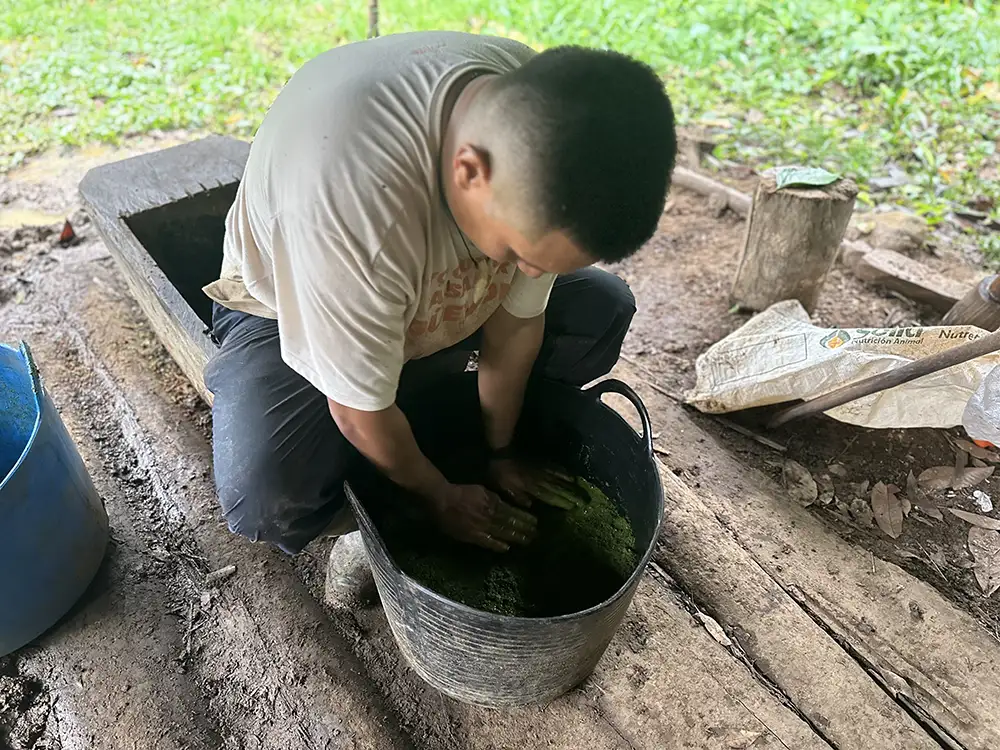 Crudo preparation: vine and leaf hand-processed without fire.
 Crudo and Cooked: Our Medicine Forms
One of the most distinctive aspects of working in Putumayo is that we serve both cooked and crudo yagé, prepared fresh on Taita Miguel's land for each ceremony.
Cooked yagé is the form most familiar internationally. The vine and chagra leaves are simmered together over many hours in successive water reductions, producing a thick, dark, concentrated brew that carries the quality of fire itself: dense, transformative, often physically demanding.
Crudo yagé, sometimes called cold-prepared yagé, is something else. The vine is harvested and scraped by hand on stone, and the medicine is processed and consumed within a day or two before fermentation begins. There is no fire, no long reduction, no concentration into paste. The brew is lighter on the body, milder in taste, and what many experienced practitioners describe as cleaner in quality. Because crudo ferments quickly, it cannot be transported, stored, or shipped. It exists only where it is made.
This matters because most of what is served at retreats outside the Amazon is paste medicine: brew that has been cooked down, dried, packaged, shipped across borders, and reconstituted with water. The active compounds survive the journey. The freshness, the fine adjustments to the specific ceremony, and the quality of medicine prepared with intention for specific people on a specific night do not.
At MahaDevi, every batch is grown, prepared, and served fresh. The choice between crudo and cooked is made in consultation with Taita Miguel, based on each person's constitution and what the ceremony calls for. For a fuller treatment, see our medicine page.
How MahaDevi Holds the Ceremony
Tradition at the core. Modern support around it.
MahaDevi's position on the relationship between traditional ceremony and modern Western practice is direct and worth stating clearly.
The ceremony itself is fully Kamentsá. It is not modified, modernized, softened, or adapted to outside audiences. What Taita Miguel offers in ceremony is what his family has carried across at least twelve generations: the songs, the fire, the medicine, the protocols, the prayers, the use of tobacco and Agua Florida, the relationship to land. None of that is changed.
What we add around that core is modern support, used as preparation, integration, and safety, never as a replacement for the medicine or the lineage holding it.
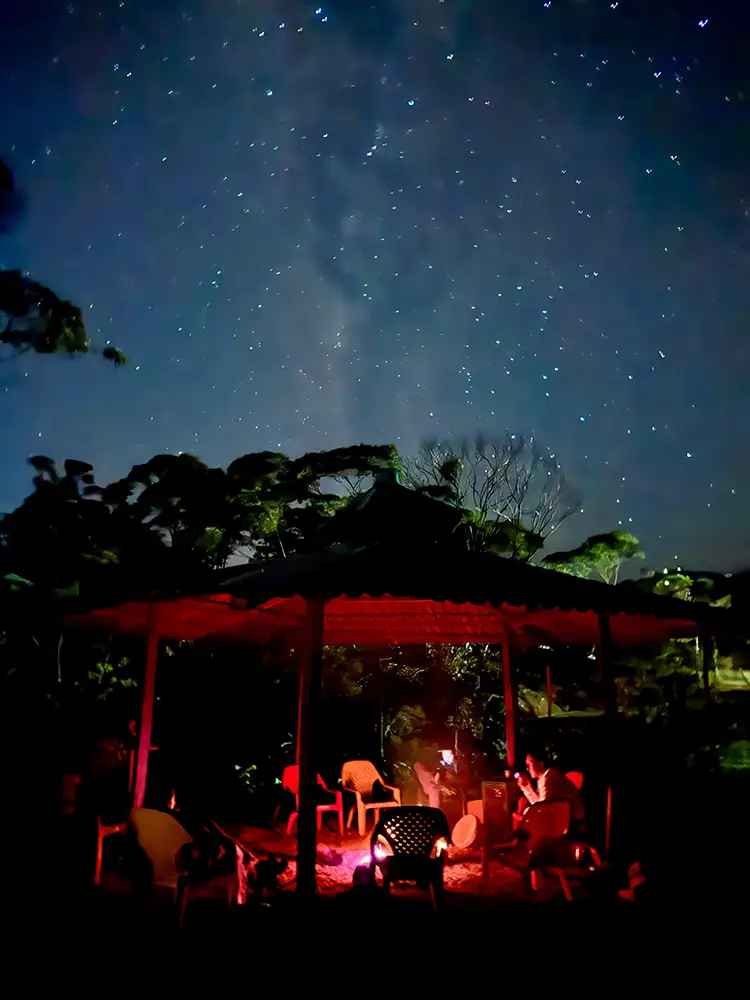 Sacred fire ceremony, Kamentsá tradition.
 Medical screening before ceremony
Every participant completes detailed medical and mental-health screening before being accepted. Yagé is not appropriate for everyone, and the screening exists to make that determination honestly rather than commercially.
Psychologist and psychiatrist on the advisory team
MahaDevi has a licensed psychologist and a licensed psychiatrist as advisors. They support pre-ceremony screening, advise on cases requiring extra care, and consult on integration.
A 90-day integration period for every participant
The work that begins in ceremony does not end there. We hold a structured three-month preparation and integration window with check-ins, integration calls, and access to written and video materials so the changes that began in Putumayo have time and structure to settle.
Extended integration for course work
People engaged in deeper preparation programs receive extended integration support beyond the standard 90 days, structured around the specific arc of their work.
The principle is simple. Modern psychological support, medical screening, and structured integration are useful tools and we use them rigorously. They serve the participant's safety and the durability of the work. They do not touch the ceremony itself. The ceremony remains what it has always been: spiritual healing within a living lineage on ancestral land, with medicine prepared fresh by the Taita who is holding the night.
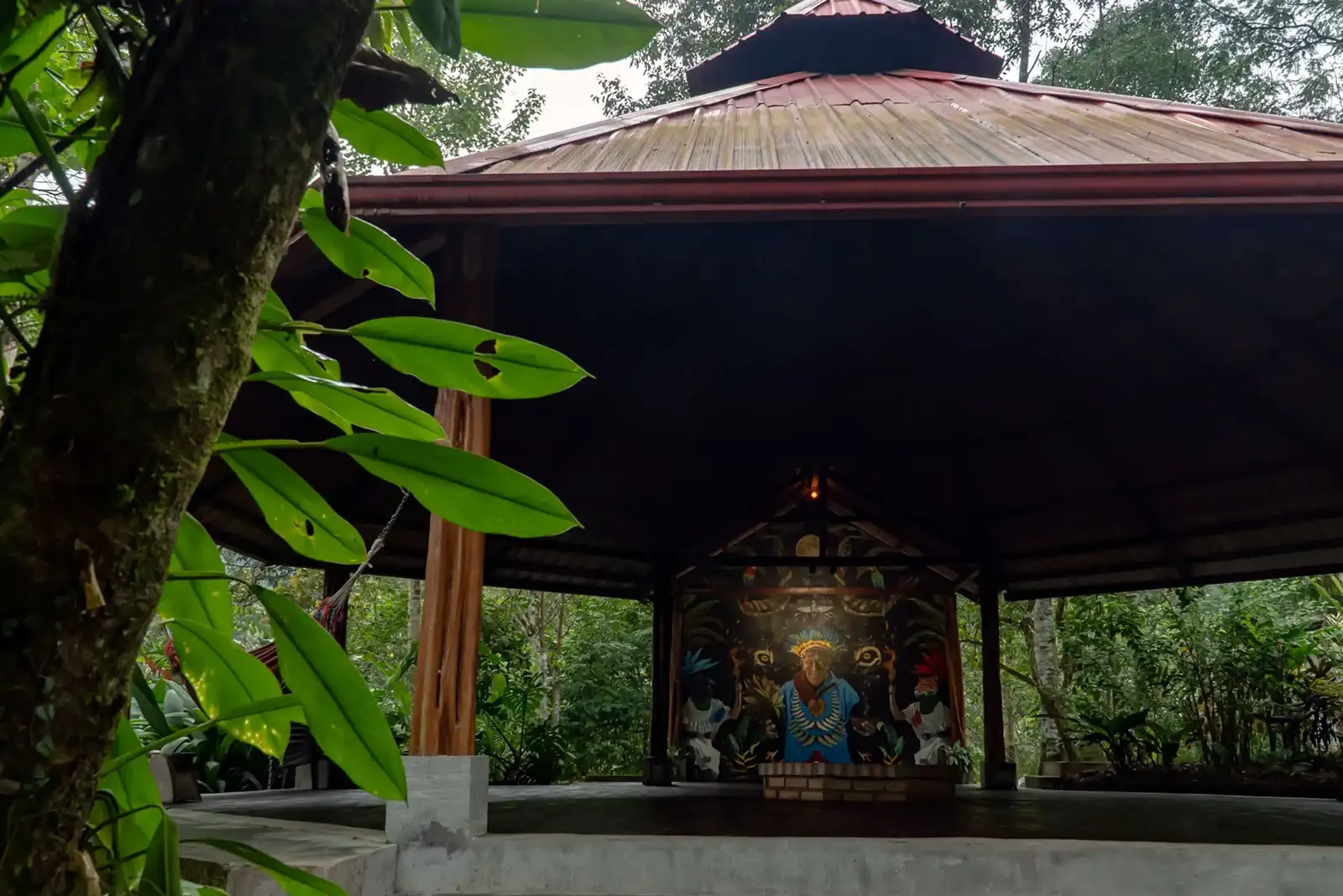 The maloka at MahaDevi: ceremonial space built in keeping with Kamentsá tradition.
 UMIYAC and the Ethical Frame of the Lineage
UMIYAC, the Unión de Médicos Indígenas Yageceros de la Amazonía Colombiana, is the indigenous-led alliance of yagé-carrying Taitas from the Kamentsá, Inga, Cofán, Siona, and Coreguaje peoples of the Colombian Amazon (Arsenault for Mongabay, 2020). All five of these peoples have been classified by Colombia's Constitutional Court as at risk of physical and cultural extermination. UMIYAC was formed within that legal context. Yagé ceremony is the medium through which member communities make collective decisions, transmit knowledge to younger generations, and resist deforestation, oil extraction, and armed conflict.
UMIYAC's ethical code is the closest thing the Colombian yagé tradition has to a shared standard for what a serious ceremony looks like. It addresses the qualifications of the Taita, the conditions under which medicine should be served, the responsibility to participants, and the protection of indigenous knowledge from commercial misuse. For anyone evaluating a Colombian retreat, asking whether the lineage is UMIYAC-aligned is one of the most useful single questions a seeker can pose.
MahaDevi's ceremony work is conducted in alignment with UMIYAC principles.
Living Culture: Bëtscnaté
The Kamentsá lineage is alive. The most visible expression of that aliveness is Bëtscnaté, often translated into Spanish as the Day of Forgiveness and observed annually as part of what outsiders sometimes call the Sibundoy Carnival. Bëtscnaté is not a festival in the casual sense. It is an annual renewal of the social fabric of the community: a public reweaving of relationships through music, dance, ritual exchange, the wearing of the traditional sayo and chaquira beadwork, and the symbolic clearing of grievances built up during the year.
Agioutanti and Cortés (2026), working with Kamentsá elder healer Mamita Maria Dolores, document how spirituality, plant medicine including yagé, storytelling, and communal garden labor together sustain Kamentsá identity and healing across centuries of colonial pressure. A tradition that holds an annual public ceremony of forgiveness has a functioning ethical core. The medicine work of the Kamentsá Taitas exists inside that core, not separate from it.
Kamentsá vs Other Ayahuasca Lineages
A side-by-side reference. None of these lineages is interchangeable with the others.
| Dimension | Kamentsá | Shipibo-Konibo | Santo Daime |
|---|---|---|---|
| Origin region | Sibundoy Valley, Putumayo, Colombia | Ucayali region, Peruvian Amazon | Acre, Brazil (founded 1930s) |
| Admixture leaf | Chagra / chagropanga (Diplopterys cabrerana) | Chacruna (Psychotria viridis) | Chacruna (Psychotria viridis) |
| Cultivation | Yané gardens (traditional Sibundoy polyculture) | Cultivated and wild-harvested | Cultivated, often church-grown |
| Ceremony format | Taita-led, sacred fire, communal music | Maestro/maestra-led, dark room, icaros central | Standing in formation, hymnal-based |
| Music tradition | Spoken/sung icaros, harmonica, leaf-whistle, guitar | Highly developed icaros, often unaccompanied vocal | Hinários with collective singing |
| Lineage transmission | Family-line apprenticeship, multi-stage initiation | Family-line apprenticeship | Founded lineage (Mestre Irineu) |
| Authority body | UMIYAC | Various Shipibo councils | Santo Daime church organization |
| Preparation style | Includes cold-prepared (crudo) forms | Long-boil reduction | Long-boil reduction, standardized |
How to Verify an Authentic Kamentsá Lineage
A surprising number of retreat operators describe their work as Kamentsá or Putumayo or Sibundoy without being able to substantiate the claim when pressed. The following checklist gives a seeker concrete questions to ask before booking. None of these questions are rude. A serious lineage-aligned operation will welcome all of them.
Ask for the full name of the Taita who will serve the ceremony, their age, where they grew up, and the elder who trained them.
Ask which community in the Sibundoy or wider Putumayo recognizes the Taita, and across how many generations the lineage runs.
A Colombian yagé operation should be able to speak clearly about its relationship to UMIYAC and the union's ethical code.
The medicine used in Kamentsá ceremony comes from cultivated yané gardens. Ask where the plants are grown and prepared, and whether the medicine is prepared fresh or imported as paste.
A lineage-aligned Putumayo operation typically works with chagra (also called chagropanga), though some Colombian lineages also use chacruna. Ask which the operation uses and whether it serves crudo, cooked, or both forms of yagé.
Ask how many participants per ceremony, how long the ceremony lasts, what musical and ceremonial elements are used, and what integration support follows.
A serious operation screens participants medically before accepting them and offers structured integration after ceremony.
A serious operation publishes its commitments. An operation that cannot articulate its ethics in writing should be approached with caution.
For MahaDevi's specific answers to these questions, see our team page and our retreats page.
Frequently Asked Questions
What defines an authentic Kamentsá yagé lineage?
A lineage is authentic when it is recognized by the indigenous community that carries it, transmitted through long apprenticeship from elder to student, accountable to a body like UMIYAC, and identifiable by specific plants, songs, and ceremonial protocols rather than generic claims. Among the Kamentsá, the lineage typically runs through families across multiple generations, with Taitas formed from childhood inside a living tradition.
Who is Taita Miguel Mavisoy?
Taita Miguel Mavisoy is a Kamentsá elder from Putumayo, Colombia. He is the Taita with whom MahaDevi works directly. He received yagé for the first time at six months of age, began serving medicine at fourteen, and carries a family lineage that runs unbroken across at least twelve generations.
What is the difference between yagé and ayahuasca?
Both names refer to brews built around Banisteriopsis caapi and a DMT-containing companion leaf. Ayahuasca is the Quechua name dominant in Peru, where the admixture is typically chacruna (Psychotria viridis). Yagé is the name used across the Colombian Amazon, where the admixture is typically chagra (Diplopterys cabrerana, also called chagropanga) grown in traditional yané gardens. The brews differ in lineage, plants, songs, ceremony format, and sometimes preparation method, including the cold-prepared crudo form unique to parts of the Putumayo.
What is chagra in the Kamentsá tradition?
In Taita Miguel's Kamentsá lineage, chagra is the name used for the leaf of Diplopterys cabrerana, also known scientifically as chagropanga or chaliponga. It is the DMT-containing admixture leaf that combines with the Banisteriopsis caapi vine to produce yagé. While some Colombian lineages also work with chacruna (Psychotria viridis), our lineage primarily uses chagra. The plants are grown in yané gardens, the traditional medicinal polyculture system of the Sibundoy.
Does MahaDevi use modern psychological support alongside ceremony?
Yes, but only as preparation, screening, and integration. The ceremony itself remains fully Kamentsá and is not modified by Western practice. MahaDevi has a psychologist and a psychiatrist as advisors, conducts detailed medical and mental-health screening before accepting participants, and offers a 90-day preparation and integration period after ceremony, with extended integration for participants doing course work. The medicine and the lineage holding it remain untouched.
Is ayahuasca legal in Colombia?
Yagé use within indigenous traditions is permitted in Colombia under the country's recognition of indigenous cultural rights, anchored in the 1991 Constitution and ILO Convention 169 (Suárez, ICEERS, 2023). Outside that frame, the legal picture is more complex and depends on context. This page does not provide legal advice. Anyone with concerns should consult a qualified attorney in their own jurisdiction.
What is UMIYAC?
UMIYAC is the Union of Indigenous Yagé Doctors of the Colombian Amazon, the alliance of Kamentsá, Inga, Cofán, Siona, and Coreguaje Taitas. Its role is to protect the yagé lineage, articulate an ethical code, and defend the territories within which the medicine is grown.
How is the Kamentsá lineage different from the Shipibo lineage?
The Kamentsá lineage comes from the Andean-Amazonian Sibundoy Valley in Colombia. It uses chagra as the admixture leaf, often prepared as crudo, and centers ceremony around fire, communal song, tobacco, and the harmonica. The Shipibo-Konibo lineage comes from the Peruvian Amazon's Ucayali region. It uses chacruna, cooks ayahuasca by long reduction, and centers ceremony in darkness around the icaros sung by the onanya healer. Both are legitimate. They are not interchangeable.
Working Within the Lineage
This page is a hub. The deeper detail on yagé preparation, on the Sibundoy Valley itself, on the Peruvian and Brazilian comparisons, on Bëtscnaté, and on the specific ceremonial elements MahaDevi works with lives across the cluster of articles linked throughout. What sits here is the foundation.
The Kamentsá ayahuasca lineage is a living tradition kept by specific families in a specific place, accountable to a specific ethical body. Taita Miguel Mavisoy carries it. MahaDevi was founded by Yasha Shah to work within it with the seriousness this tradition deserves. The ceremony is not modernized. The medicine is fresh. The land is ancestral. The support around the ceremony is rigorous and modern, and it stays where it belongs, in the work of preparation and integration, while the heart of the offering remains exactly what it has always been.
If you are evaluating a journey to Colombia and want to understand what working within this lineage involves, our retreats page, our team page, and our medicine page are the natural next stops.
Begin with a Conversation
The discovery call is where we hear your situation, you hear how we work, and together we work out whether MahaDevi is the right fit for you at this point in your life.
References
All citations sourced from the MahaDevi Citation Bank and linked to primary source where available.
Agioutanti, R. & Cortés, Y. (2026). Oral testimonies of traditional medicine: A Kamëntša woman's legacy. Fourth World Journal, 25(2), 100–124.
Arsenault, C. (2020, November 4). Indigenous Colombians mount a spiritual defense of the Amazon. Mongabay.
Brito-da-Costa, A.M., Dias-da-Silva, D., Gomes, N.G.M., Dinis-Oliveira, R.J., & Madureira-Carvalho, Á. (2020). Toxicokinetics and toxicodynamics of ayahuasca alkaloids. Pharmaceuticals, 13(11), 334.
Celidwen, Y., Redvers, N., Githaiga, C., Calambás, J., Añaños, K., Evanjuanoy Chindoy, M., Vitale, R., Rojas, J.N., Mondragón, D., Vázquez Rosalío, Y., & Sacbajá, A. (2022). Ethical principles of traditional indigenous medicine to guide Western psychedelic research and practice. The Lancet Regional Health – Americas, 18, 100410.
Cepek, M.L. (2019). Valueless value: The question of production in Cofán shamanism. HAU: Journal of Ethnographic Theory.
Chambers, M.I., Appley, M.G., Longo, C.M., & Musah, R.A. (2020). Detection and quantification of psychoactive N,N-dimethyltryptamine in ayahuasca brews. ACS Omega, 5(44), 28547–28554.
Egger, K., Aicher, H., Cumming, P., & Scheidegger, M. (2024). Neurobiological research on N,N-dimethyltryptamine (DMT) and its potentiation by monoamine oxidase (MAO) inhibition. Cellular and Molecular Life Sciences.
García Molina, A. (2014). The sound tactics of upper Putumayo shamans [Master's thesis, NEIP archive].
Gates, B. (1982). Banisteriopsis, Diplopterys (Malpighiaceae). Flora Neotropica Monograph 30.
Glass, R.F.F. (2022). Colombian counterpoint: Transculturation in Sibundoy Valley ethnohistory. University of Oregon Undergraduate Research Journal, 20(2).
Gonzalez, D., Cantillo, J., Perez, I., Carvalho, M., Aronovich, A., Farre, M., Feilding, A., Obiols, J.E., & Bouso, J.C. (2021). The Shipibo ceremonial use of ayahuasca to promote well-being. Frontiers in Pharmacology.
INC Peru (2008). Resolución Directoral Nacional No. 836/INC. Instituto Nacional de Cultura, Peru.
Labate, B.C. & MacRae, E. (Eds.) (2010). Ayahuasca, ritual and religion in Brazil. Equinox/Routledge.
Miller, M.J., Albarracin-Jordan, J., Moore, C., & Capriles, J.M. (2019). Chemical evidence for the use of multiple psychotropic plants in a 1,000-year-old ritual bundle from South America. PNAS, 116(23), 11207–11212.
O'Brien, C.A. (2018). A grammatical description of Kamsá, a language isolate of Colombia [PhD dissertation, University of Hawai'i at Mānoa].
Palhano-Fontes, F., Barreto, D., Onias, H., Andrade, K.C., Novaes, M.M., Pessoa, J.A., et al. (2019). Rapid antidepressant effects of the psychedelic ayahuasca in treatment-resistant depression. Psychological Medicine, 49(4), 655–663.
Perkins, D., Schubert, V., Simonová, H., Tófoli, L.F., Bouso, J.C., Horák, M., Galvão-Coelho, N., & Sarris, J. (2021). Influence of context and setting on the mental health and wellbeing outcomes of ayahuasca drinkers. Frontiers in Pharmacology.
Ramírez de Jara, M.C. & Pinzón Castaño, C.E. (1993). Sibundoy shamanism and popular culture in Colombia. In E.J. Langdon & G. Baer (Eds.), Portals of power: Shamanism in South America. University of New Mexico Press.
Schultes, R.E. & Raffauf, R.F. (1992). Vine of the soul: Medicine men, their plants and rituals in the Colombian Amazonia. Synergetic Press.
Suárez Álvarez, C. (2023, October 11). Colombia: Yagé territory. ICEERS.
Yao, Y., Guo, D., Lu, T., Liu, F.L., Huang, S., Diao, M., et al. (2024). Efficacy and safety of psychedelics for the treatment of mental disorders. Psychiatry Research.
Nothing on this page is medical or legal advice. Yagé is not appropriate for everyone, and anyone considering ceremony should review our medical considerations page and consult a qualified clinician about their specific medical and mental-health situation before booking.