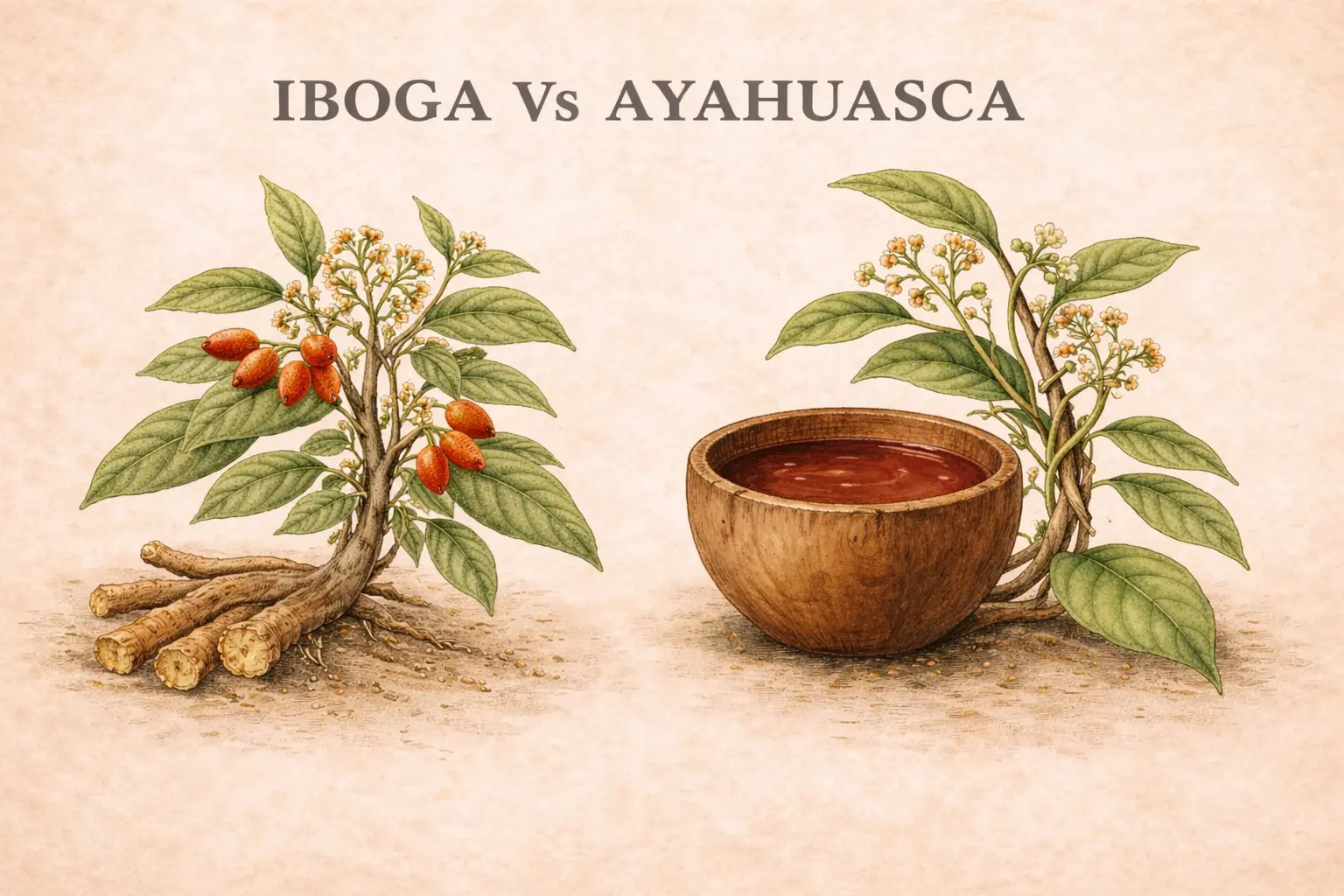
Iboga vs Ayahuasca: 7 Critical Differences You Must Know
Iboga vs Ayahuasca: Two ancient plant medicines, two continents, two completely different mechanisms, ceremonies, and healing paths.
At a Glance
Factor | Key Difference |
Duration | Iboga: 18 to 36 hours | Ayahuasca: 4 to 6 hours |
Active compound | Iboga: ibogaine + 12 alkaloids | Ayahuasca: DMT + MAOIs |
Primary use | Iboga: addiction, trauma reset | Ayahuasca: depression, emotional healing |
Cardiac risk | Iboga: significant (ECG required) | Ayahuasca: low in healthy individuals |
Legal status (US) | Both Schedule I, with narrow exemptions |
Quick Comparison
Iboga | Ayahuasca | |
Origin | West Africa (Gabon) | Amazon Basin |
Plant | Tabernanthe iboga root bark | Banisteriopsis caapi vine + Psychotria viridis |
Experience | Inward, confrontational, grounding | Visionary, emotional, relational |
Sessions | 1 to 3 lifetime | Repeated over months or years |
Purging | Less common; ataxia typical | Nausea and vomiting common (62%) |
Full Answer
Iboga vs ayahuasca is one of the most consequential comparisons in plant medicine. Iboga derives from the root bark of Tabernanthe iboga, a shrub native to West Africa, and delivers an 18 to 36-hour inward journey used primarily for addiction interruption and trauma work. Ayahuasca is a brew from the Amazon Basin combining the Banisteriopsis caapi vine and Psychotria viridis leaf, whose active compound, DMT, produces a 4 to 6-hour visionary experience used for depression, grief, and emotional healing. Both are Schedule I controlled substances in the United States, both require rigorous medical screening, and both have produced remarkable outcomes in clinical and ceremonial settings. The right choice depends on your condition, health profile, and the tradition you are genuinely prepared to engage.
The comparison between iboga vs ayahuasca generates genuine confusion, and the confusion is understandable. Both medicines carry deep cultural roots, compelling therapeutic evidence, and serious safety considerations. Both are being studied at major research institutions. And both have produced experiences that people describe as among the most significant of their lives.
But they are not interchangeable. They come from different continents, act through different mechanisms, require different preparation, carry different risks, and tend to suit different people at different moments. Getting that comparison right matters, not just for curiosity, but for safety.
This guide covers what each medicine actually is, how they compare across the dimensions that matter most, what the clinical evidence shows, and how to think clearly about which might be appropriate for you. Questions from plant medicine communities shaped what was prioritised throughout. For a deeper look at the clinical pharmacology, see Ibogaine vs Ayahuasca: The Clinical Comparison.
What Is Iboga? The Plant, the Tradition, and Why It Is Not Ibogaine
The distinction between iboga the plant and ibogaine the molecule is the most important thing to understand before this comparison goes any further.
Two words appear together so often in the iboga conversation that the distinction between them collapses. Iboga is the whole plant, specifically the root bark of Tabernanthe iboga, a slow-growing shrub native to the rainforests of Gabon, Cameroon, and the Republic of Congo. Ibogaine is a single alkaloid extracted and purified from that root bark, used in clinical and treatment settings at measured doses.
The root bark contains more than a dozen alkaloids in their natural proportions, including noribogaine (ibogaine’s primary active metabolite), tabernanthine, coronaridine, and ibogamine. Whether the full alkaloid profile matters therapeutically beyond ibogaine alone remains an open question in the research. What is clear is that whole-plant ceremonial iboga and isolated ibogaine are different experiences with different safety profiles.
The iboga plant sits at the heart of the Bwiti spiritual tradition of Gabon, where it has been used for centuries as a sacrament, a rite-of-passage medicine, and a tool for physical and psychological healing. Gabon has formally recognised iboga as a national cultural treasure (ICEERS). Within the Bwiti framework, the plant is understood not as a substance but as a teacher and ancestor, referred to as Grandfather Iboga. The initiation ceremony is one of the most significant events in a person’s life.
For a broader context on iboga within the wider world of plant medicine, see our introduction to plant medicine traditions.
This article focuses on iboga as traditionally used and as offered in ceremonial settings. When clinical trial data is referenced, that data involves ibogaine specifically. The two are related but not the same, and that distinction is carried throughout.
What Is Ayahuasca?
Ayahuasca is not a plant. It is a pharmacological system, and neither plant in the brew produces the full effect alone.
The brew combines the Banisteriopsis caapi vine with Psychotria viridis leaves, also known as chacruna. The vine contributes beta-carboline alkaloids, specifically harmine, harmaline, and tetrahydroharmine, which act as monoamine oxidase inhibitors, or MAOIs.
The leaves contribute DMT, formally N,N-Dimethyltryptamine, the compound responsible for the visionary experience. Here is why both plants are necessary: DMT taken orally is normally destroyed by the enzyme MAO-A in the gut before it ever reaches the brain. The vine’s beta-carbolines temporarily disable that enzyme, allowing DMT to pass into the bloodstream intact.
Remove the vine and the DMT does nothing. That pharmacological partnership is what makes ayahuasca remarkable, and it is also what makes the safety screening so non-negotiable.
The brew has been used for centuries across indigenous communities of Peru, Brazil, Colombia, and Ecuador. Luna (2011) documents ayahuasca as central to the spiritual, medical, and social life of more than 70 indigenous groups across the Amazon basin. Practitioners, known as ayahuasqueros or curanderos, work with the medicine in ceremony, guiding the experience through icaros, sacred healing songs, plant diets, and other elements of the broader healing framework.
Questions from this community and from people who have worked with ayahuasca shaped what was prioritised in this guide.
Iboga vs Ayahuasca: Side-by-Side Comparison
Same legal category, different continents, different chemistry, different ceremonial structures, and different therapeutic profiles. The overlap is real but sits on top of much deeper differences.
Iboga vs ayahuasca compared across the dimensions that actually matter for someone deciding between them:
Factor | Iboga | Ayahuasca |
Origin | Tabernanthe iboga shrub, West Africa (Gabon, Cameroon) | Banisteriopsis caapi vine + Psychotria viridis, Amazon Basin |
Active compounds | Ibogaine + 12 other alkaloids (full-spectrum root bark) | DMT + beta-carboline MAOIs (harmine, harmaline, THH) |
Duration | 18 to 36 hours active; residual effects 1 to 3 days | 4 to 6 hours per ceremony |
Number of sessions | Typically 1 to 3 lifetime sessions | Typically repeated ceremonies over months or years |
Character of experience | Inward, grounding, confrontational; Grandfather energy | Visionary, emotionally fluid, relational; Mother energy |
Primary therapeutic use | Addiction interruption, PTSD, trauma reset | Depression, emotional healing, grief, spiritual development |
Purging | Less common; ataxia (loss of coordination) typical | Nausea and vomiting common (62% in survey data) |
Cardiac risk | Significant: QT interval prolongation, bradycardia | Low in healthy individuals; MAOI interactions are primary risk |
Drug contraindication | Cardiac medications, CYP2D6 inhibitors | SSRIs, MAOIs, stimulants, tyramine-rich foods |
Medical screening | Yes: ECG mandatory before treatment | Yes: full medication review required |
Legal status (US) | Schedule I; Texas approved $50M trial initiative | DMT is Schedule I; religious exemptions exist (UDV, Santo Daime) |
Approximate cost | USD $3,000 to $10,000+ per treatment retreat | USD $1,500 to $5,000 per retreat (varies by location) |
Duration and session count are the most consequential practical differences. An iboga ceremony is not a long ayahuasca ceremony. The quality and texture of the experience is fundamentally different.
Iboga is frequently described as confrontational. The medicine tends to bring the person face-to-face with their own psychology, memories, and behavioural patterns in a way that is direct, sometimes relentless, and rarely visually spectacular. The journey is inward.
Ayahuasca is more often described as relational and visionary. The experience can feel like a conversation with the medicine, with aspects of oneself, with something larger. Emotional release is common. The imagery can be vivid and symbolic.
These tendencies are consistent enough across clinical literature, practitioner reports, and community accounts to be useful orientation. Individual experiences vary considerably.
Therapeutic Applications: What Does Each Medicine Treat Best?
The evidence bases look nothing like each other. Different conditions, different study designs, different stages of clinical development.
Iboga and Ibogaine: Addiction and PTSD
The strongest clinical case for iboga-derived treatment is addiction, specifically opioid dependence. Thirty percent of participants in an observational study of 30 patients reported complete cessation of opioid use following treatment, and of those who achieved abstinence, 54% had remained abstinent for at least one year, with 31% maintaining abstinence for two years or more (Davis et al., 2017). Eighty percent reported that ibogaine eliminated or drastically reduced withdrawal symptoms, a finding that has made iboga-derived treatment particularly compelling to addiction researchers.
It is worth being precise: this was an observational study with self-reported outcomes. The signal is strong. The evidence level is not the same as a randomised controlled trial.
A separate 12-month follow-up study in New Zealand followed 14 participants through a single ibogaine treatment (Noller et al., 2018). Drug use scores on the Addiction Severity Index dropped more than 80% from baseline to 12 months (p=0.002). Depression scores on the BDI-II decreased from a mean of 22.1 at baseline to 4.4 at 12 months. A clinically significant improvement maintained nearly a year after a single treatment.
The mechanism behind these effects involves ibogaine acting on multiple brain systems simultaneously. Administration significantly upregulates GDNF (glial cell line-derived neurotrophic factor) mRNA expression by 12-fold in the ventral tegmental area and 6-fold in the substantia nigra, and BDNF (brain-derived neurotrophic factor) by 220 to 340-fold in the nucleus accumbens (Marton et al., 2019). These are the reward circuits most directly disrupted by addiction.
In plain terms: ibogaine triggers the brain to produce growth factors in the exact regions damaged by long-term opioid use. That may explain why withdrawal interruption and craving reduction persist well beyond the drug’s clearance.
For PTSD, particularly in the context of traumatic brain injury, the most significant recent data comes from a 2024 Nature Medicine study. In 30 special operations veterans with TBI and comorbid PTSD, a magnesium-ibogaine protocol produced average reductions at one-month follow-up of 88% in PTSD symptoms, 87% in depression symptoms, and 81% in anxiety symptoms (Cherian et al., 2024). Disability ratings dropped from 30.2 (mild-to-moderate) to 5.1 (no disability). Effect sizes were large (Cohen’s d = 2.54 for PTSD).
The sample was small and the study was uncontrolled. The effect sizes are large enough that the findings merit serious attention regardless.
Ayahuasca: Depression and Emotional Healing
The strongest clinical case for ayahuasca is in treatment-resistant depression. An early open-label trial with six patients found reductions of up to 82% in depressive scores between baseline and 21 days after a single ayahuasca dose, measured across three validated scales (Osorio et al., 2015). The sample was very small and the study uncontrolled.
A subsequent randomised placebo-controlled trial enrolled 29 patients who had been depressed for an average of 11 years and had failed an average of nearly four previous antidepressant treatments (Palhano-Fontes et al., 2019). At day 7, the response rate in the ayahuasca group was 64% compared with 27% in the placebo group (p=0.04), with a between-group effect size of Cohen’s d = 1.49. This is the benchmark citation for ayahuasca’s antidepressant effects.
The mechanism acts predominantly through serotonin 5-HT2A receptor activation, the brain’s perception and mood receptors. Activating them strongly changes how sensory information is processed, how emotions surface, and how memory reconsolidation occurs during and after the experience. There is also emerging evidence of BDNF upregulation with ayahuasca, creating a neuroplasticity overlap between the two medicines.
Beyond formal depression research, ayahuasca is widely used for grief, emotional trauma, spiritual development, and existential questions where controlled trial data is limited but practitioner and community evidence is substantial.
Safety, Risks, and Who Should Not Use Either Medicine
The most preventable harms in both medicines involve drug interactions. Know your medications before you consider either path.
Medical disclaimer: This article is for informational purposes and does not constitute medical advice. Neither iboga nor ayahuasca should be used without consultation with a qualified healthcare provider who knows your full medical history.
Iboga: Cardiac Risk
The primary safety concern with iboga is cardiac. Ibogaine blocks hERG potassium channels in the heart, the channels responsible for the electrical signal controlling the heart’s repolarisation after each beat. The concentration required to inhibit these channels by 50% (IC50) is 4 uM, which falls within the therapeutic plasma concentration range for standard treatment doses (Koenig et al., 2014). At the doses used therapeutically, ibogaine reliably affects the heart’s electrical system.
The clinical consequence is QT interval prolongation, a lengthening of the electrical cycle that, at sufficient magnitude, creates risk of torsade de pointes, a potentially fatal ventricular arrhythmia. In a clinical study of 14 patients receiving ibogaine for opioid detoxification, 50% of patients exceeded a QTc of 500 ms, a clinically dangerous threshold, and the average QTc prolongation was 95 ms (range 29 to 146 ms) (Knuijver et al., 2021). Ibogaine also induced bradycardia in all participants.
Because ibogaine’s primary metabolite, noribogaine, has a half-life estimated at 28 to 49 hours, QTc elevation can persist for 7 to 12 days after administration. The cardiac risk window extends well beyond the acute experience.
At least one treatment-related fatality has been documented in the clinical literature (Noller et al., 2018), and deaths have been reported in unmonitored settings globally. The fatality risk is real and is not adequately managed without proper screening and monitoring.
Iboga Contraindications
- Cardiac conditions: any history of arrhythmia, QT prolongation, heart disease, or abnormal ECG is a hard contraindication
- Cardiac medications: antiarrhythmics, some antidepressants, and other QT-prolonging drugs are contraindicated
- CYP2D6 inhibitors: grapefruit, pomelo, and several medications inhibit the enzyme that metabolises ibogaine, raising plasma concentrations unpredictably
- Liver disease: ibogaine is hepatically metabolised; significant liver impairment increases risk
- Poorly controlled hypertension: cardiovascular stress during the experience is significant
- Pregnancy: not studied; avoid
- History of psychosis or bipolar I: contraindicated without specialist psychiatric clearance
Required Screening Before Iboga
- ECG (electrocardiogram): mandatory; baseline QTc must be within normal limits
- Liver function tests: assess metabolic capacity
- CYP2D6 genotyping: identifies poor or ultra-rapid metabolisers who face altered risk
- Full medication review: all current and recent prescriptions, supplements, and recreational substances
- Psychiatric evaluation: assess for psychosis history, bipolar disorder, active suicidality
- Substance use history: recent opioid, stimulant, or alcohol use affects safety protocol
Ayahuasca: MAOI Interactions and Serotonin Syndrome
Ayahuasca’s primary safety concern is pharmacological interaction. The beta-carboline alkaloids in the brew inhibit monoamine oxidase A (MAO-A), the enzyme that normally breaks down serotonin, dopamine, and other monoamines. When MAO-A is inhibited and the person is also taking an SSRI, SNRI, or other serotonergic medication, the combination can drive serotonin to toxic levels, a condition called serotonin syndrome. Symptoms range from agitation, tremor, and rapid heart rate through to hyperthermia and seizures in severe cases.
Callaway and Grob (1998) described the first documented case of serotonin syndrome in the ayahuasca literature, involving combination with an SSRI. More recent pharmacokinetic modelling confirms that SSRIs such as fluoxetine and paroxetine inhibit CYP2D6, increasing harmine exposure and amplifying the MAOI effect, meaning even modest SSRI levels in the system meaningfully change the risk profile (Ribeiro et al., 2026).
It is worth noting that ayahuasca’s beta-carbolines are reversible MAO-A inhibitors. Unlike classic irreversible MAOIs, the inhibition clears relatively quickly after the brew wears off. This likely explains why documented serotonin syndrome cases remain rare. But the contraindication stands: combining ayahuasca with SSRIs, SNRIs, or other serotonergic agents is dangerous.
Beyond drug interactions, ayahuasca’s adverse effects profile from real-world use is well characterised by the Global Ayahuasca Survey, the largest safety dataset to date with over 10,000 respondents. Acute physical adverse effects were reported by 69.9% of participants, primarily nausea and vomiting at 62.0%. Only 2.3% required medical attention (Bouso et al., 2022).
Adverse mental health effects in the weeks following a ceremony were reported by 55.9% of respondents. Of those, 87.6% described them as part of a positive process of growth or integration (Bouso et al., 2022). The data suggests ayahuasca’s acute physical effects are common but rarely medically serious in healthy, screened individuals.
Ayahuasca Contraindications
- SSRIs, SNRIs, MAOIs: hard contraindication; must be fully cleared from the system before ceremony
- Lithium: contraindicated; seizure risk
- Stimulants (amphetamines, MDMA, cocaine): dangerous interaction with the serotonergic system
- Uncontrolled cardiovascular disease: MAOI activity can affect blood pressure
- Active psychosis or schizophrenia: contraindicated
- Pregnancy: not studied; avoid
If you are considering ayahuasca and are currently taking any medication affecting serotonin, the Ayahuasca Framework is a free course that walks through what to discuss with your doctor, how the pharmacology works, and what genuine preparation looks like.
Preparation and Diet: What Each Medicine Requires
Preparation is not optional for either medicine. With ayahuasca, it carries direct pharmacological weight. With iboga, it is what keeps the cardiac risk window manageable.
Iboga Preparation
The standard recommendation is to stop CYP2D6-inhibiting substances well in advance. Grapefruit and pomelo contain furanocoumarins that block CYP2D6, the enzyme responsible for a significant portion of ibogaine’s metabolism. Disrupting it can raise plasma concentrations to dangerous levels unpredictably. Avoid both for at least a week before treatment.
Cardiac medications must be cleared in consultation with a prescribing physician, not simply stopped without guidance. Alcohol should be avoided for at least 48 to 72 hours. Stimulants and recreational drugs require longer clearance depending on the substance.
Most reputable iboga providers require a light diet in the 24 to 48 hours before treatment and a period of fasting (typically 4 to 8 hours) immediately before the ceremony. Physical rest and reduced emotional stimulation in the days prior are standard guidance.
Ayahuasca Preparation: The Dieta
The ayahuasca dieta is more extensive, rooted in indigenous tradition, and centres on the MAOI mechanism. The beta-carboline alkaloids inhibit MAO-A, the enzyme that breaks down tyramine in food. When MAO-A is inhibited and tyramine-rich foods are consumed, tyramine accumulates and can cause a dangerous spike in blood pressure, a hypertensive crisis (Callaway and Grob, 1998).
Foods to avoid for at least 24 to 48 hours before ceremony (many practitioners recommend 3 to 7 days):
- Aged cheeses (cheddar, parmesan, brie, blue cheese)
- Fermented foods (kimchi, sauerkraut, miso, tempeh, soy sauce)
- Cured and processed meats (salami, pepperoni, bacon)
- Red wine, beer, and other fermented alcoholic beverages
- Overripe or dried fruits
- Broad (fava) beans
- Yeast extracts (Marmite, Vegemite)
Beyond diet, ayahuasca preparation typically involves abstaining from sexual activity, reducing media consumption, and spending time in nature or reflection. The dieta is understood as a process of physical and energetic cleansing that makes the ceremony both more effective and safer. Reputable retreat centres have their own specific protocols that may extend or modify these general guidelines.
Legal Status: Where Iboga vs Ayahuasca Is Accessible
Legal status for both medicines is complex, jurisdiction-specific, and changes frequently. Always verify through ICEERS (iceers.org) before making any travel or treatment decision.
Country / Region | Iboga / Ibogaine | Ayahuasca |
United States | Schedule I (federal); Texas $50M trial initiative underway | DMT is Schedule I; religious exemptions (UDV, Santo Daime) |
Mexico | Unregulated / legal | Permitted; common retreat destination |
Brazil | Sao Paulo: legal in hospital settings (2016) | Regulated religious use (UDV, Santo Daime) |
Peru | Unscheduled | Culturally protected; traditional use legal |
Netherlands | Specific clinic-based use permitted | Legal uncertainty; ceremonial use continues |
New Zealand | Unscheduled; prescribable by physicians | DMT is Class A controlled substance |
South Africa | Schedule 6 (requires medical oversight) | Legal uncertainty |
Gabon | Declared national treasure; protected | Not traditional; no specific regulation |
France / Belgium / Sweden | Prohibited | Prohibited |
Australia | Schedule 9 (research only) | DMT scheduled; ceremonial use illegal |
A few points worth noting. The ayahuasca brew itself is not scheduled under the 1971 UN Convention on Psychotropic Substances, even though DMT (one of its active compounds) is. The International Narcotics Control Board has clarified that preparations of plants containing controlled substances are not automatically covered. In practice this has created a patchwork of national interpretations (ICEERS).
For iboga, the US trajectory is worth watching. Texas has approved $50M in funding for ibogaine clinical trials, the largest state-level investment in psychedelic research in US history (Stanford News, 2024). New Zealand’s model, where ibogaine is unscheduled and prescribable by physicians, represents one possible regulatory future.
Laws change. This section reflects general status and is not legal advice. Do not travel for plant medicine treatment based solely on this table.
How to Choose: Iboga or Ayahuasca?
The question underneath this comparison is not which medicine is more powerful. It is which tradition you are genuinely ready to enter, and whether your body is safe enough to do it.
Most people who reach this section are not simply researching. Something is pulling them toward one of these paths, and that pull deserves honest attention before any booking is made.
No article can know your specific health situation. What follows is a framework built from clinical evidence, practitioner experience, and community knowledge.
Choose Iboga If…
- You are seeking to interrupt a specific addiction, particularly opioid, alcohol, or stimulant dependence, and want a focused, time-limited intervention
- You carry significant trauma that needs to be met directly and thoroughly, rather than visited repeatedly over time
- You want a single intensive process rather than an ongoing ceremonial practice
- You have completed thorough medical screening and have no cardiac contraindications
Choose Ayahuasca If…
- You are working with depression, grief, emotional trauma, or questions of meaning and purpose
- You are drawn to a relational, ongoing relationship with a medicine and a tradition
- You are open to a visionary experience that may be emotionally fluid and unpredictable
- You are not on SSRIs or serotonergic medications and can complete the dietary preparation
Consider Neither Without…
- Medical screening with a physician who knows your full medication and cardiac history
- A reputable, experienced facilitator or clinical team, not an informal or unvetted setting
- Genuine readiness: both medicines can surface difficult material, and the integration period matters as much as the experience itself
- Realistic expectations: these are not guaranteed outcomes, and significant individual variation exists
The quality of the container around the experience shapes outcomes more than the substance itself. The ceremony structure, the facilitator’s ethics and experience, the pre-ceremony screening, the support available afterward: these are what the evidence consistently identifies as what matters most. For more, see our plant medicine preparation resources.
If you are moving toward ayahuasca specifically, the Ayahuasca Framework is a free course built around what genuine preparation actually looks like, from understanding the pharmacology to choosing the right facilitator.
Frequently Asked Questions
The questions people actually arrive with, answered directly.
Iboga vs Ayahuasca
Conclusion
The pharmacological comparison is the least important thing to understand before approaching either tradition.
Iboga vs ayahuasca is not a question with one right answer. It is a question that reveals your answer when you look at it honestly. One is a cactus from West Africa; the other is a brew from the Amazon. One’s active compound resets the brain’s reward circuits through a mechanism no other known substance replicates; the other activates perception and mood receptors through a pharmacological partnership between two plants that neither could accomplish alone. One unfolds over a day and a half; the other is complete before dawn. One tends to suit an intensive, once-in-a-lifetime confrontation; the other tends to suit an ongoing relationship with a medicine and a tradition.
Neither is a guaranteed cure. Both require proper screening, experienced facilitation, and genuine integration work afterward.
The right next step is not a booking. It is clarity about your own health profile, an honest conversation with a qualified facilitator, and, if you are moving toward ayahuasca, a thorough preparation. The Ayahuasca Framework is a good place to begin that preparation.
The experience is not the endpoint.
References
All sources verified live at time of research extraction.
Here are all 25 references with live hyperlinks:
- Ibogaine: Therapeutic Potential, Cardiac Safety, and Translational Challenges — Molecules scoping review (2026)
- Cherian et al. (2024). Magnesium-ibogaine therapy in veterans with traumatic brain injuries. Nature Medicine.
- Olash, Buchanan, Williams et al. (2026). Accelerated recovery using magnesium ibogaine: characterizing the subjective experience. NPJ Mental Health Research.
- Knuijver et al. (2024). The pharmacokinetics and pharmacodynamics of ibogaine in opioid dependent patients. Clinical Pharmacology.
- Coleman et al. (2019). Serotonin transporter-ibogaine complexes illuminate mechanisms of inhibition and transport. Nature.
- Frontiers in Pharmacology (2025). Ibogaine’s potential role in supporting reward system recovery.
- Frontiers in Neuroscience (2024). Ibogaine administration following repeated morphine — remyelination markers.
- Mash et al. (2018). Ibogaine Detoxification Transitions Opioid and Cocaine Abusers. Frontiers in Pharmacology.
- Brown and Alper (2017). Treatment of opioid use disorder with ibogaine: detoxification and drug use outcomes. American Journal on Addictions.
- Noller et al. (2018). Ibogaine treatment outcomes for opioid dependence — 12-month follow-up. American Journal of Drug and Alcohol Abuse.
- Davis et al. (2017). Subjective effectiveness of ibogaine treatment for problematic opioid consumption. Journal of Psychedelic Studies.
- Brazilian Journal of Psychiatry (2022). Ibogaine microdosing in a patient with bipolar depression.
- Nature Chemistry (2025). Efficient and Modular Synthesis of Ibogaine.
- UC Davis (2025). UC Davis Researchers Achieve Total Synthesis of Ibogaine.
- Alper et al. (2012). Fatalities temporally associated with the ingestion of ibogaine. Journal of Forensic Sciences.
- Therapeutic Advances in Psychopharmacology (2016). Ibogaine-associated cardiac arrest and death: case report and review.
- Frontiers in Pharmacology (2022). Drug Transporters ABCB1 (P-gp) and OATP — ibogaine/noribogaine pharmacokinetics.
- Glue et al. (2016). Ascending single-dose safety study of noribogaine in opioid-dependent patients. Clinical Pharmacology in Drug Development.
- Glue et al. (2015). Ascending-dose study of noribogaine in healthy volunteers. Journal of Clinical Pharmacology.
- UTHealth Houston (2025). UTHealth Houston awarded $50 million for ibogaine clinical trials.
- Texas Tribune (2025). Texas $50M ibogaine research.
- Marijuana Moment (2026). West Virginia and Mississippi ibogaine trial bills.
- ClinicalTrials.gov (2025). UCI MIND-OUD ibogaine trial. NCT07226570.
- MAPS/Noller (2012). Ibogaine Treatment in New Zealand.
- Palhano-Fontes F et al. (2019). Rapid antidepressant effects of the psychedelic ayahuasca in treatment-resistant depression: a randomized placebo-controlled trial. Psychological Medicine.
