
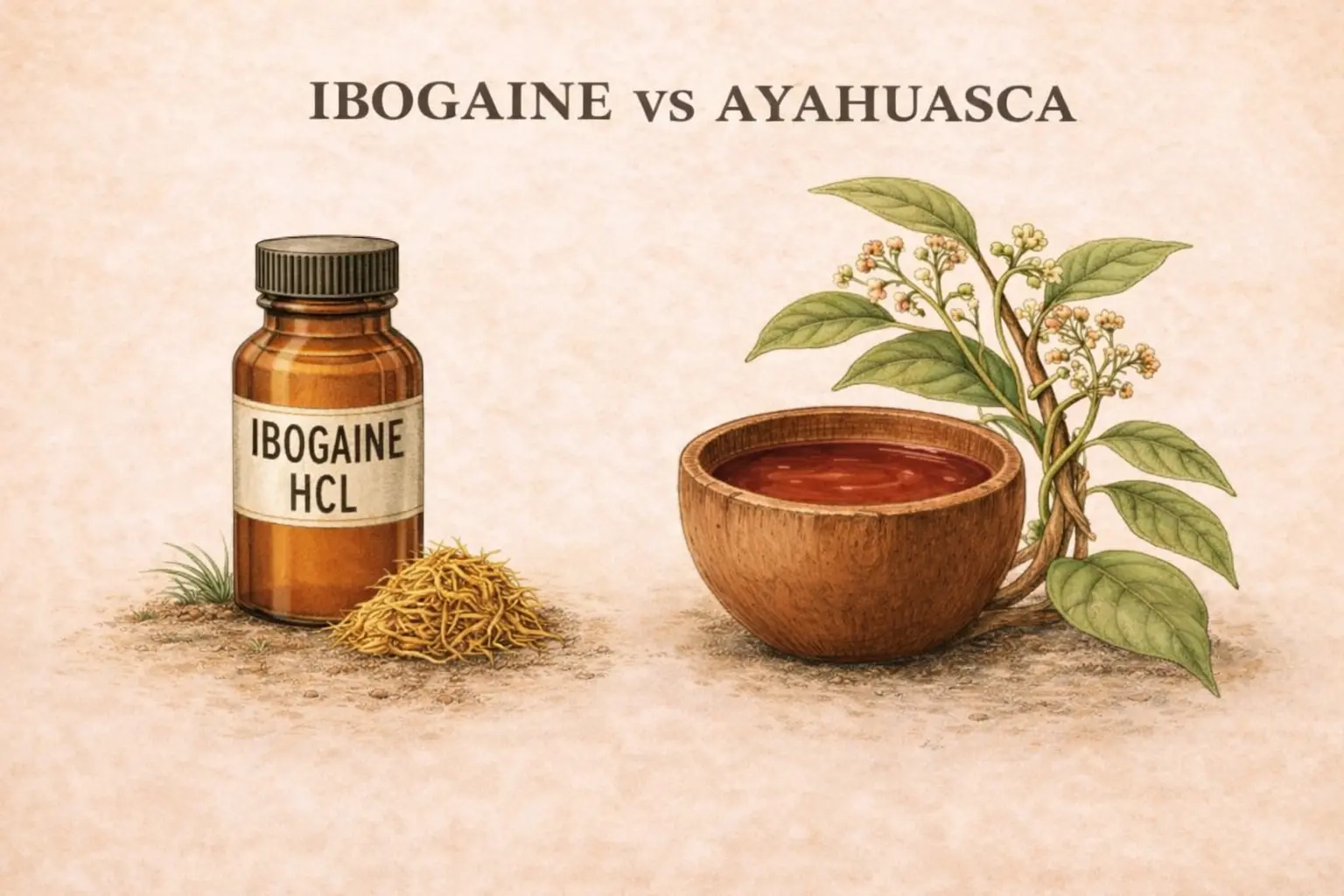
Ibogaine vs Ayahuasca: 7 Critical Differences You Must Understand
Ibogaine resets the brain’s addiction circuitry in a single medically supervised session; ayahuasca opens emotional and visionary space across multiple ceremonies — and understanding the difference between them could be the most important thing you do before choosing either path.
At a Glance
At a Glance | |
Duration | Ibogaine: 18–36 hours | Ayahuasca: 4–6 hours |
Active compound | Ibogaine (alkaloid) | DMT + MAOI beta-carbolines |
Best evidence for | Opioid addiction, PTSD | Depression, trauma healing |
Cardiac risk | High (ECG + CYP2D6 required) | Low in healthy individuals |
Legal status (US) | Schedule I; TX $50M trial funding | Schedule I; UDV/Santo Daime exemption |
Quick Comparison
Ibogaine | Ayahuasca | |
Active compound | Ibogaine (isolated alkaloid) | DMT + MAOI beta-carbolines |
Duration | 18–36 hours | 4–6 hours per ceremony |
Best clinical use | Opioid addiction, PTSD, TBI | Depression, trauma, emotional healing |
Ceremony | Medical clinic, supervised | Ceremonial container, facilitator |
US legal status | Schedule I (no exemption; TX trial funding approved) | Schedule I (UDV/Santo Daime exemption) |
Full Answer
Ibogaine and ayahuasca are both plant-derived medicines with compelling clinical evidence and serious safety considerations — but they are not interchangeable. Ibogaine is an isolated alkaloid from West Africa that acts simultaneously on the brain’s opioid, glutamate, dopamine, and serotonin transporter systems, producing a neurobiological reset lasting 18 to 36 hours. Ayahuasca is an Amazonian brew that primarily activates 5-HT2A serotonin receptors, producing a 4 to 6-hour visionary and emotionally immersive experience. Ibogaine has the strongest clinical evidence for opioid addiction and PTSD. Ayahuasca has the stronger evidence base for treatment-resistant depression and trauma processing. Both are Schedule I controlled substances in the United States, and both require rigorous medical screening before use.
1. What Are Ibogaine and Ayahuasca?
The most important distinction in this entire comparison: ibogaine is not the same as iboga, and that difference changes everything about what it can do and how safely it can be administered.
Iboga is a sacred whole-plant tradition from the Bwiti people of Gabon and Cameroon, containing hundreds of alkaloids consumed across multi-day initiation ceremonies. Ibogaine is a single molecule extracted from that plant’s root bark, present at roughly 0.3 to 0.4% concentration.
In clinical settings today, most ibogaine is semi-synthesized from voacangine, a compound extracted from Voacanga africana, where it occurs at approximately 1% concentration — a more abundant and sustainable source. In 2025, UC Davis researchers demonstrated a 7-step, gram-scale total synthesis of ibogaine from pyridine, a widely available industrial chemical, which may eventually eliminate plant-sourcing dependency entirely (Nature Chemistry, 2025; UC Davis, 2025).
What this means practically: ibogaine can be precisely dosed in a controlled clinical environment. Iboga cannot. The distinction matters enormously for safety, reproducibility, and the kind of medical oversight that serious treatment requires.
Ibogaine’s mechanism is genuinely unusual. It modulates opioid receptors, NMDA glutamate receptors, sigma receptors, and the serotonin transporter simultaneously. A 2026 comprehensive scoping review in Molecules describes this convergence as a neurobiological “reset” — a reconfiguration of addiction-related circuitry accompanied by a window of enhanced neural plasticity. No other plant-derived compound has been described as producing a comparable combination of actions (Molecules scoping review, 2026).
Ayahuasca is not a single plant. That distinction shapes everything that follows.
The brew combines the Banisteriopsis caapi vine with Psychotria viridis leaves. The leaves contain DMT (dimethyltryptamine), the primary psychoactive compound. The vine contains beta-carboline alkaloids — harmine, harmaline, and tetrahydroharmine (THH) — that act as monoamine oxidase A inhibitors (MAOIs).
DMT taken orally without the vine is destroyed in the gut before it reaches the brain. The vine solves this: its MAOIs disable the enzyme responsible for that breakdown long enough for DMT to survive digestion, enter the bloodstream, and produce its effect. Neither plant is active alone.
Both are plant medicines used in the ibogaine vs ayahuasca comparison. Their mechanisms, duration, therapeutic targets, and risk profiles are fundamentally different.
For a deeper look at the whole iboga plant tradition and how it compares to ayahuasca ceremonially, see our guide to iboga vs ayahuasca. And if you are newer to this field, learn more about plant medicine before deciding between specific treatments.
2. Key Differences: Ibogaine vs Ayahuasca Side-by-Side
Same legal category, completely different chemistry, duration, risk profile, and best clinical use — the overlap ends at ‘plant medicine.’
Every row in this table is supported by the clinical and pharmacological evidence reviewed throughout this guide.
Factor | Ibogaine | Ayahuasca |
Origin | West Africa (Tabernanthe iboga) | Amazon Basin (B. caapi + P. viridis) |
Active compound | Ibogaine (isolated alkaloid) | DMT (dimethyltryptamine) + MAOI beta-carbolines |
Mechanism | Multi-target: opioid, NMDA, sigma, SERT (non-competitive) | Primarily 5-HT2A serotonin agonist + MAO-A inhibition |
Duration | 18–36 hours; noribogaine active 2–7 days | 4–6 hours per ceremony |
Sessions needed | Typically 1–3 lifetime | Repeated over months or years |
Best evidence for | Opioid addiction, PTSD, TBI | Depression, trauma processing, emotional healing |
Cardiac risk | High (ECG + CYP2D6 genotype required) | Low in healthy individuals |
Purging | Less common; ataxia typical | Nausea and vomiting in ~62% of participants |
Setting | Medical clinic with continuous monitoring | Ceremonial container with facilitator |
Legal status (US) | Schedule I federally; TX $50M trial funding approved | DMT is Schedule I; religious exemptions exist |
Approx. cost | $5,000–$15,000 (clinic) | $1,000–$5,000 (retreat) |
Two things stand out from this comparison. First, ibogaine’s active metabolite noribogaine has a half-life of 24 to 49 hours, which means cardiac risk extends well beyond the psychoactive experience itself. Second, ibogaine’s mechanism is structurally unique: no other plant-derived compound acts across opioid receptors, NMDA receptors, sigma receptors, and the serotonin transporter simultaneously (Molecules scoping review, 2026).
3. Ibogaine vs Ayahuasca for Addiction Recovery
Ibogaine does not just interrupt cravings. Emerging evidence suggests it may also begin repairing the neurological damage that addiction creates.
This is where the ibogaine vs ayahuasca comparison becomes most consequential — and where the most widespread misinformation circulates.
Ibogaine has the strongest direct clinical evidence of any plant medicine for opioid and stimulant dependence. In the largest published ibogaine clinical series, 191 patients (102 opioid-dependent, 89 cocaine-dependent) received oral ibogaine HCl under medical supervision. Withdrawal severity dropped sharply within 36 hours. Opioid and cocaine craving scores fell significantly at discharge and at one month (p<0.0001 across all subscales). For opioid patients, Beck Depression Inventory scores dropped from 16.5 to 4.5 at one month (Mash et al., 2018).
A 12-month observational study found ASI drug use scores declined more than 80% in completers, with 12 of 14 participants reporting reduced or ceased opioid use (Noller et al., 2018).
One important correction belongs here. Claims of a “90% success rate” for ibogaine appear frequently online. No published study supports that figure.
The actual data across all ibogaine studies: approximately 80% of participants report elimination or drastic reduction of acute withdrawal symptoms. Between 30 and 50% achieve short-term opioid cessation. The 80% figure describes withdrawal relief — not long-term abstinence — and should not be conflated with a “success rate.” All studies to date are observational, not randomized controlled trials (Davis et al., 2017; Brown and Alper, 2017; Mash et al., 2018; Noller et al., 2018).
Why does ibogaine produce these effects? The mechanism goes deeper than receptor binding.
A 2025 review in Frontiers in Pharmacology describes ibogaine’s induction of GDNF (glial cell-derived neurotrophic factor) as a unified mechanism for restoring reward system fidelity across multiple disorders. GDNF is a protein that supports the survival and function of dopamine neurons — the same neurons most damaged by chronic opioid and stimulant use.
A 2024 preclinical study in Frontiers in Neuroscience found ibogaine significantly upregulated CNP and MBP, proteins involved in remyelination of white matter damaged by chronic opioid use.
Ibogaine addresses both the chemistry of withdrawal and the underlying neural architecture that addiction degrades.
Ayahuasca for addiction has a different profile. The strongest evidence is for alcohol and tobacco reduction, where observational studies show meaningful decreases following ceremonial engagement. Its mechanism — 5-HT2A activation producing intense emotional and introspective experiences — tends to surface the psychological roots of addictive behavior rather than interrupting its neurochemistry directly.
Sequential use is discussed in practitioner communities: ibogaine first for detox and neurological reset, then ayahuasca months later for emotional processing and integration. There is no clinical evidence validating this sequence, and combining them simultaneously would be dangerous (see Safety section). But the clinical logic is coherent. Ibogaine addresses the body’s physical dependence. Ayahuasca addresses the story underneath it.
4. Mental Health: Depression, PTSD, and Trauma
Ibogaine compresses months of trauma processing into a single session. No other compound in the psychiatric literature has produced comparable effect sizes for PTSD.
The MISTIC protocol (magnesium-ibogaine therapy) produced the most striking psychiatric outcome data published in this field. A 2024 Nature Medicine study tracked 30 Special Operations veterans with predominantly mild traumatic brain injury. At one-month follow-up, PTSD symptoms had reduced by 88% (Cohen’s d=2.54), depression by 87% (d=2.80), and anxiety by 81% (d=2.13). Disability ratings improved from 30.2 to 5.1 — from mild-to-moderate disability to essentially none (Cherian et al., 2024).
These are among the largest effect sizes ever recorded in a psychiatric intervention.
How does this happen? A 2026 qualitative study in NPJ Mental Health Research analyzing the same veteran cohort found ibogaine produced what researchers called “accelerated, self-guided psychotherapy.” Participants re-encountered traumatic memories in a dream-like oneiric state, reappraised them with reduced fear, and experienced surges of forgiveness and renewed purpose. Higher mystical-experience scores correlated directly with greater PTSD symptom reduction (Olash et al., 2026).
The individual guides their own process in a neurologically altered state. The medicine creates the conditions; the person does the work.
Ibogaine for depression is a different picture. BDI depression scores fell significantly in multiple addiction treatment studies (Mash et al., 2018; Noller et al., 2018). A 2022 case report in the Brazilian Journal of Psychiatry documented improvement in a patient with bipolar depression using sub-psychoactive ibogaine microdosing (PMC9375667, 2022). But ibogaine has no dedicated randomized controlled trial for depression as a primary diagnosis.
Ayahuasca has a stronger evidence base on this specific point. A 2019 randomized placebo-controlled trial found significant antidepressant effects within one week in treatment-resistant depression (Palhano-Fontes et al., 2019).
The honest framing: ibogaine is the clearer choice for PTSD and opioid-related depression. Ayahuasca is the clearer choice for treatment-resistant depression without an addiction component. For PTSD combined with addiction — particularly in veterans — ibogaine’s combined neurological and psychological reset may be uniquely suited.
5. Safety, Risks, and Medical Screening
Ibogaine’s cardiac risk window does not end when the psychoactive experience does — it extends for days, and most preventable deaths have occurred in settings without continuous monitoring.
This information is educational and does not constitute medical advice. Always consult a qualified healthcare provider before considering either treatment.
Ibogaine carries a real and well-documented cardiac risk. Understanding it is not optional.
The mechanism: ibogaine blocks hERG potassium channels, which regulate cardiac repolarization. This causes QT interval prolongation — a delay in the heart’s electrical reset cycle that can trigger life-threatening arrhythmias. Alper et al. (2012) reviewed 19 deaths associated with ibogaine ingestion between 1990 and 2008, six of which cited cardiac complications. A 2016 case report in Therapeutic Advances in Psychopharmacology documented a 40-year-old man who suffered cardiac arrest and brain death during ibogaine treatment.
Two factors make ibogaine’s cardiac risk uniquely complex.
First, CYP2D6 genotype. Ibogaine is metabolized by the liver enzyme CYP2D6. Clearance varies enormously by genotype. A 2024 clinical pharmacology study found clearance was strongly related to CYP2D6 activity (p<0.001), with poor metabolizers facing substantially higher ibogaine exposure and cardiac risk (Knuijver et al., 2024). Genotyping before treatment is not a precaution — it is a prerequisite for safe dosing.
Second, noribogaine’s extended half-life. Ibogaine’s primary active metabolite, noribogaine, has a half-life of 24 to 30 hours in opioid-dependent patients (Glue et al., 2016) and 28 to 49 hours in healthy volunteers (Glue et al., 2015). Noribogaine also prolongs the QTc interval in a concentration-dependent manner — approximately 0.17 ms per ng/mL. Medical monitoring cannot stop when the visionary phase ends.
Ibogaine pre-treatment screening requirements:
- 12-lead ECG (QTc interval < 450 ms)
- CYP2D6 genotyping
- Comprehensive liver function tests
- Electrolyte panel (potassium, magnesium)
- Full cardiac history
- Psychiatric evaluation
- Complete medication and substance use history
- Abstinence from QT-prolonging medications
Absolute contraindications for ibogaine:
- Cardiac conditions — any history of arrhythmia, QT prolongation, or significant heart disease
- Liver disease — ibogaine is hepatically metabolized; impairment increases exposure and toxicity
- Psychiatric contraindications — history of schizophrenia, psychosis, or bipolar disorder with psychotic features
- Serotonergic medications — SSRIs, SNRIs, MAOIs, lithium, tramadol — serious interaction risk
- Pregnancy — contraindicated
Ayahuasca’s risk profile is different in character.
The combination of MAOI beta-carbolines and DMT creates clinically significant interactions with serotonergic medications. SSRIs, SNRIs, MAOIs, lithium, tramadol, and several common psychiatric drugs can cause serotonin syndrome when combined with ayahuasca — a potentially life-threatening condition involving agitation, dangerously elevated temperature, and rapid heart rate.
In the Global Ayahuasca Survey (n=10,836), 62% of respondents reported nausea or vomiting, 18% reported headache, 55% reported challenging psychological or emotional effects, and 2.3% required medical attention. Ayahuasca’s physical safety profile in healthy individuals without medication contraindications is substantially better than ibogaine’s.
Medication screening is non-negotiable for both.
If you are preparing for ayahuasca specifically, the Ayahuasca Framework is a free course that covers what genuine preparation looks like — including what to discuss with your doctor and which medications require careful review before you proceed.
6. Legal Status and Cost
Ibogaine’s legal trajectory is moving faster than any other psychedelic compound — $50 million in state funding committed in 2025 alone, with two additional states following in 2026.
United States: Both ibogaine and ayahuasca’s active compound DMT are classified as Schedule I controlled substances under federal law. Neither is FDA-approved. They cannot legally be prescribed or administered clinically in the US.
That is changing faster for ibogaine than for any other psychedelic compound.
In 2025, Texas Governor Abbott signed SB 2308, creating the IMPACT consortium (Ibogaine Medicine for PTSD, Addiction, and Cognitive Trauma) — allocating $50 million in state funding for multicenter ibogaine clinical trials. The consortium includes UTHealth Houston, UTMB Health, Texas Tech, UT Austin, Baylor College of Medicine, Texas A&M, and seven other institutions. The explicit goal is FDA approval (UTHealth Houston, 2025; Texas Tribune, 2025).
No comparable state funding has been directed at any other psychedelic compound.
In early 2026, West Virginia (96-0 House vote) and Mississippi (111-1 House vote) both passed bills to fund ibogaine FDA development trials, with a focus on opioid use disorder and traumatic brain injury (Marijuana Moment, 2026). A UC Irvine clinical trial (NCT07226570) is currently recruiting to study ibogaine’s effects on brain function in opioid use disorder using fMRI and EEG.
Outside the US: New Zealand is the only country where ibogaine can be legally prescribed — gazetted as a non-approved prescription medicine under the Medicines Act in July 2010 (MAPS/Noller, 2012). Mexico and Costa Rica have no ibogaine scheduling, making them the primary destinations for supervised clinical treatment. Ayahuasca is legal for religious and traditional use in Brazil, Peru, and Colombia, and has religious exemptions in the US for the UDV and Santo Daime.
Costs (as reported by providers; no peer-reviewed pricing source exists for either treatment):
Ibogaine | Ayahuasca | |
Typical cost | $5,000–$15,000 (medical clinic) | $1,000–$5,000 (retreat) |
What’s included | Medical screening, monitoring, 1–3 sessions, integration support | Ceremonial container, 2–5 nights, facilitator, meals |
Travel | Likely required (Mexico, Costa Rica, NZ) | Often required for traditional ceremonies |
Sessions needed | 1–3 lifetime | Multiple over months or years |
Prices vary widely by provider, location, and level of medical supervision.
Provider vetting checklist:
- Does the clinic require a full cardiac workup and ECG before ibogaine treatment?
- Is CYP2D6 genotyping offered or required?
- Is 24-hour cardiac monitoring provided during and after treatment?
- For ayahuasca: does the facilitator conduct medication screening?
- Is integration support (post-treatment psychological follow-up) included or arranged?
7. How to Choose: Ibogaine, Ayahuasca, or Both?
The clinical criteria matter. So does the question underneath them: what kind of process are you actually prepared to enter, and who will hold the container around it?
If you are reading an ibogaine vs ayahuasca comparison at this level of depth, you are probably not just researching. Something has brought you here — a decision you are working toward, a door you are standing in front of. That weight is real, and no framework removes it.
What follows is a set of distinctions to help focus that decision. It is not a personal recommendation. A qualified medical provider should be part of any serious choice involving either substance.
Choose ibogaine if:
- You are in active opioid, stimulant, or cocaine dependence and need an acute detox intervention
- You are a veteran or first responder with PTSD, TBI, or combined PTSD and addiction
- You are prepared for a physically demanding 18 to 36-hour experience with mandatory medical supervision
- You have no cardiac contraindications, liver disease, or QT-prolonging medications
- You can access a reputable supervised clinic, most likely in Mexico, Costa Rica, or New Zealand
Choose ayahuasca if:
- Your primary challenge is depression, grief, emotional trauma, or behavioral addiction (alcohol, cannabis, food)
- You are drawn to a ceremonial, community-based healing context
- You are not in acute physical dependence requiring rapid detox
- You have no serotonergic medication contraindications or history of psychosis
- You are prepared for multiple ceremonies over time, not a single-session reset
Consider sequential use if:
- You have completed ibogaine treatment for addiction and want to continue processing emotional roots
- Adequate time has passed (typically months, not weeks) to allow full integration of the ibogaine experience
- Concurrent use is never appropriate: ibogaine’s SERT inhibition combined with ayahuasca’s MAOI and 5-HT2A activity creates compounded serotonergic risk that could be fatal
There is a non-clinical dimension to this choice that belongs in the picture. Both ibogaine and ayahuasca are understood within their originating traditions as contact with something larger than ordinary consciousness — not merely pharmacological events. That dimension is real to the people who have entered it, and worth taking seriously regardless of one’s prior beliefs about it. The medicine does not care about your framework. It asks only that you come prepared.
If you are moving toward ayahuasca specifically, the Ayahuasca Framework is a free course built around what genuine preparation actually looks like — from understanding the pharmacology to choosing the right facilitator and building an integration practice.
Frequently Asked Questions
Ibogaine is a single isolated alkaloid that acts on the brain’s opioid, glutamate, dopamine, and serotonin transporter systems simultaneously — described in a 2026 Molecules scoping review as producing a neurobiological “reset” that no other plant-derived compound replicates. Ayahuasca is a brew that primarily activates 5-HT2A serotonin receptors, producing an immersive visionary and emotional experience over 4 to 6 hours. Ibogaine resets neural circuitry. Ayahuasca opens emotional and perceptual space. For opioid and stimulant dependence, ibogaine has clearer direct evidence. Studies show it eliminates or drastically reduces acute withdrawal symptoms in approximately 80% of participants, with 30 to 50% achieving short-term opioid cessation (Davis et al., 2017; Mash et al., 2018; Noller et al., 2018). Ayahuasca has stronger evidence for alcohol and tobacco reduction and for the emotional healing that supports long-term recovery. For someone in active opioid withdrawal, ibogaine is the more appropriate first intervention. Ayahuasca may be more valuable in the integration phase that follows. Ayahuasca has a better physical safety profile for healthy individuals without medication contraindications. In the Global Ayahuasca Survey, 2.3% of 10,836 respondents required medical attention. Ibogaine carries documented cardiac risk: 19 deaths were reported between 1990 and 2008, six involving cardiac complications (Alper et al., 2012). Ibogaine’s hERG channel blockade can cause QT prolongation and fatal arrhythmia. CYP2D6 genotyping and ECG are required before treatment (Knuijver et al., 2024). Noribogaine’s half-life of 24 to 49 hours means cardiac monitoring extends days past the psychoactive phase (Glue et al., 2015, 2016). Neither is safe without professional screening and supervision. Both are federally illegal Schedule I substances. Ibogaine and DMT, ayahuasca’s active compound, are both listed. Certain ayahuasca churches (UDV, Santo Daime) have religious exemptions from this classification. For ibogaine, no clinical or religious exemption currently permits legal administration in the US — though Texas has committed $50 million toward clinical trials aimed at FDA approval (SB 2308, 2025), and West Virginia and Mississippi advanced similar legislation in 2026. New Zealand is the only country where ibogaine can currently be legally prescribed. Ibogaine treatment at a supervised medical clinic typically ranges from $5,000 to $15,000, reflecting the cost of pre-treatment cardiac workup, medical monitoring, the treatment session, and integration support. Ayahuasca retreats typically range from $1,000 to $5,000 for a multi-day ceremony. Both figures vary widely by provider, location, and duration of care. Prices as reported by providers — no peer-reviewed pricing source exists for either treatment. Not simultaneously. Ibogaine is a non-competitive serotonin transporter inhibitor (Coleman et al., 2019). Ayahuasca contains MAOIs and a direct serotonin agonist. Combining them creates compounded serotonergic risk that could be fatal. Sequential use — ibogaine first for detox, then ayahuasca months later for integration — is discussed in practitioner communities but has no clinical validation. Any sequential approach requires professional guidance and adequate integration time between experiences. DMT is a component of ayahuasca, not the same thing. Ayahuasca combines a DMT-containing plant (Psychotria viridis) with the Banisteriopsis caapi vine, which contains MAOI beta-carbolines. DMT alone is destroyed by gut monoamine oxidase before it can reach the brain. The MAOIs in the vine disable that enzyme, making the DMT orally active. Without the vine, no psychoactive effect occurs. Ayahuasca is the whole system; DMT is one component of it.Ibogaine vs Ayahuasca FAQ
Conclusion
The ibogaine vs ayahuasca question does not have a universal answer. It has a personal one — shaped by what you are trying to address, what your health allows, and what kind of process you are genuinely ready for.
What the evidence does make clear: ibogaine is the more powerful and direct tool for opioid addiction and PTSD, backed by the strongest clinical data of any plant medicine for those conditions. Ayahuasca has the stronger evidence base for depression and emotional healing. Both carry risks that cannot be managed without professional supervision. And both are attracting institutional attention at a scale — $50 million in Texas alone — that would have been unimaginable five years ago.
If you are weighing this decision, read both sides carefully. For the whole-plant iboga tradition and how it differs from ibogaine, see iboga vs ayahuasca. For a broader grounding in the field, learn more about plant medicine before moving toward any specific treatment.
The choice deserves the best possible information. That is what this guide is for.
References
Here are your references with the URLs converted to hyperlinks on each entry:
- Molecules scoping review (2026). Ibogaine: Therapeutic Potential, Cardiac Safety, and Translational Challenges. PMC12899015.
- Cherian et al. (2024). Magnesium-ibogaine therapy in veterans with traumatic brain injuries. Nature Medicine. PubMed 38182784.
- Olash, Buchanan, Williams et al. (2026). Accelerated recovery using magnesium ibogaine: characterizing the subjective experience. NPJ Mental Health Research. PMC12860795.
- Knuijver et al. (2024). The pharmacokinetics and pharmacodynamics of ibogaine in opioid dependent patients. Clinical Pharmacology. PubMed 38519421.
- Coleman et al. (2019). Serotonin transporter-ibogaine complexes illuminate mechanisms of inhibition and transport. Nature. PMC6750207.
- Frontiers in Pharmacology (2025). Ibogaine’s potential role in supporting reward system recovery.
- Frontiers in Neuroscience (2024). Ibogaine administration following repeated morphine — remyelination markers. PMC11303312.
- Mash et al. (2018). Ibogaine Detoxification Transitions Opioid and Cocaine Abusers. Frontiers in Pharmacology. PMC5996271.
- Brown and Alper (2017). Treatment of opioid use disorder with ibogaine: detoxification and drug use outcomes. American Journal on Addictions. PubMed 28541119.
- Noller et al. (2018). Ibogaine treatment outcomes for opioid dependence — 12-month follow-up. American Journal of Drug and Alcohol Abuse. PubMed 28402682.
- Davis et al. (2017). Subjective effectiveness of ibogaine treatment for problematic opioid consumption. Journal of Psychedelic Studies. PMC6157925.
- Brazilian Journal of Psychiatry (2022). Ibogaine microdosing in a patient with bipolar depression. PMC9375667.
- Nature Chemistry (2025). Efficient and Modular Synthesis of Ibogaine. PMC11952118.
- UC Davis (2025). UC Davis Researchers Achieve Total Synthesis of Ibogaine.
- Alper et al. (2012). Fatalities temporally associated with the ingestion of ibogaine. Journal of Forensic Sciences. PubMed 22268458.
- Therapeutic Advances in Psychopharmacology (2016). Ibogaine-associated cardiac arrest and death: case report and review. PMC4837967.
- Frontiers in Pharmacology (2022). Drug Transporters ABCB1 (P-gp) and OATP — ibogaine/noribogaine pharmacokinetics. PMC8931498.
- Glue et al. (2016). Ascending single-dose safety study of noribogaine in opioid-dependent patients. Clinical Pharmacology in Drug Development. PubMed 27870477.
- Glue et al. (2015). Ascending-dose study of noribogaine in healthy volunteers. Journal of Clinical Pharmacology. PubMed 25279818.
- UTHealth Houston (2025). UTHealth Houston awarded $50 million for ibogaine clinical trials.
- Texas Tribune (2025). Texas $50M ibogaine research.
- Marijuana Moment (2026). West Virginia and Mississippi ibogaine trial bills.
- ClinicalTrials.gov (2025). UCI MIND-OUD ibogaine trial. NCT07226570.
- MAPS/Noller (2012). Ibogaine Treatment in New Zealand.
- Palhano-Fontes F et al. (2019). Rapid antidepressant effects of the psychedelic ayahuasca in treatment-resistant depression: a randomized placebo-controlled trial. Psychological Medicine.
