Ayahuasca and Blood Pressure: What Hypertensive Seekers Must Know Before Ceremony
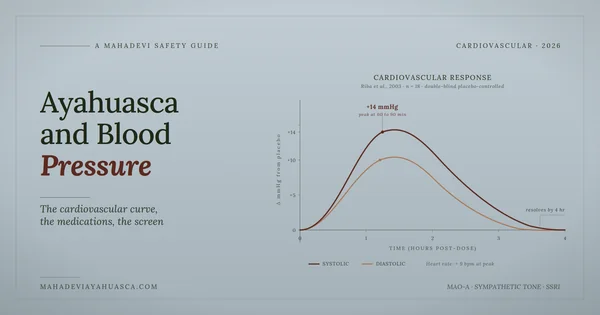
Yes, ayahuasca transiently raises blood pressure. The most rigorous controlled study in humans found a statistically significant diastolic increase of about 9 mmHg above placebo at 75 minutes; the parallel systolic and heart-rate rises were described as moderate and not statistically significant in the same trial (Riba et al., 2003). Earlier work cited in pharmacological reviews has reported larger individual transient rises of around 35 mmHg systolic (Frecska et al., 2016). People with uncontrolled hypertension, those taking SSRIs, SNRIs, or MAOIs, and those with significant heart disease should not drink ayahuasca without medically supervised screening and, in many cases, should not drink at all.
| What changes | Direction | Typical peak (controlled study) | Time course |
|---|---|---|---|
| Systolic BP | ↑ | Moderate, non-significant rise (Riba 2003) | Peaks 60 to 90 min, resolves by ~4 hr |
| Diastolic BP | ↑ | +9 mmHg above placebo at 75 min (statistically significant) | Peaks 60 to 90 min, resolves by ~4 hr |
| Heart rate | ↑ | Moderate, non-significant rise (Riba 2003) | Peaks 60 to 90 min, resolves by ~4 hr |
Ayahuasca is a cardiovascular event. It is also a ceremonial one. The two are not separate facts about the same brew but a single fact: the molecule that opens the inner space also acts on the autonomic nervous system, and the ceremony that holds the inner space also holds the body inside it. Below is what the published research says about the magnitude and shape of that cardiovascular effect, why it happens, who should avoid the medicine entirely, who should approach it only with medical supervision, and how a properly held ceremony protects the body alongside the spirit.
This article is for educational purposes only. The information below covers the cardiovascular pharmacology, medication interactions, and screening logic around ayahuasca. Decisions about adjusting blood-pressure medication require a qualified prescribing physician. Decisions about ceremonial participation require an experienced facilitator. The information below reflects published research and clinical consensus and does not replace either.
Ayahuasca and Blood Pressure: What the Science Shows
Yes, transiently. The shape of the rise is what matters.
The clearest answer comes from a double-blind placebo-controlled trial conducted at Hospital de la Santa Creu i Sant Pau in Barcelona, where 18 experienced volunteers received freeze-dried ayahuasca at three doses with blood pressure and heart rate measured every fifteen minutes for four hours. At the highest ceremonial-strength dose, the only statistically significant cardiovascular finding was a diastolic increase of about 9 mmHg above placebo at 75 minutes. The trial reported moderate but non-significant increases in systolic pressure and heart rate, with all values returning to baseline by the four-hour mark (Riba et al., 2003).
An earlier study by the same research group, cited in Frecska’s pharmacology review, reported a larger acute rise of around 35 mmHg systolic and a pulse increase of 26 bpm, with the magnitude declining in those with prior ceremonial experience (Frecska et al., 2016). Real-world surveillance data adds another layer. The U.S. National Poison Data System recorded hypertension as a reported cardiovascular effect in 16 percent of ayahuasca-related calls between 2005 and 2015, and tachycardia in 34 percent (Heise & Brooks, 2017).
The takeaway is not that ayahuasca is dangerous to every heart. It is that the effect is real, measurable, time-limited, and the body needs to be ready for it. For the broader cardiovascular picture, including arrhythmia and structural heart conditions, see ayahuasca and the heart.
Why Ayahuasca Affects the Cardiovascular System
It is pharmacology. The vine pauses an enzyme, and the body responds to what the enzyme used to do.
Two plants make the brew. Banisteriopsis caapi, the vine, carries the β-carbolines: harmine, harmaline, and tetrahydroharmine. Psychotria viridis, the leaf, carries N,N-dimethyltryptamine, or DMT. Drink either alone and very little happens orally. Drunk together, the β-carbolines reversibly inhibit monoamine oxidase A in the gut and liver, so the DMT survives first-pass metabolism and reaches the brain (Egger et al., 2024). For the broader picture of the brew, the lineages, and the chemistry, see our complete ayahuasca guide.
The same enzyme that breaks down DMT also breaks down norepinephrine, serotonin, and dietary tyramine. When MAO-A is paused for several hours, these molecules accumulate. Sympathetic tone rises. Vessels constrict. Heart rate climbs. Blood pressure follows (Ruffell et al., 2020).
None of this is one-directional. Frecska’s review notes that β-carbolines themselves have vasorelaxant properties at certain doses, which may partially counterbalance the sympathetic surge in some individuals (Frecska et al., 2016). The net cardiovascular signal observed in controlled studies is a transient hypertensive episode followed by full return to baseline. A healthy starting point makes the body equipped to handle it.
The starting point is the question.
Can You Drink Ayahuasca with High Blood Pressure?
Controlled hypertension and uncontrolled hypertension are different conversations.
Serious or uncontrolled hypertension is listed as a direct exclusion criterion in the Catalan Department of Health’s ayahuasca safety guide developed with ICEERS, alongside other cardiovascular conditions (ICEERS, 2019). Clinical research protocols for ayahuasca administration use the same logic. The guidelines drafted by the LEAPS team at the University of São Paulo specifically list hypertensive crisis among the adverse events that screening is designed to prevent (Rossi et al., 2023).
Controlled hypertension is a different conversation, and it is a conversation that has to happen with both a prescribing physician and an experienced facilitator. Baseline blood pressure should be well within target range across multiple readings before ceremony. There should be no history of hypertensive crisis, no significant left ventricular hypertrophy, no recent cardiovascular event. The current medication regimen has to be checked for serotonergic interactions. The dieta has to be honored without exception, particularly the tyramine restrictions.
What this means in practice is that hypertension is not a single yes-or-no flag. It is a stratification. One situation looks like this: mild, well-controlled, asymptomatic, no end-organ damage, on a non-serotonergic regimen, prepared to honor the dieta. A different situation looks like this: recently diagnosed, fluctuating readings, on multiple agents, taking an SSRI for comorbid anxiety. The answer in that second case is almost always to wait, stabilize, and reconsider.
Ayahuasca and Blood Pressure Medications
This is the section most readers came for. The honest version is more nuanced than a simple yes or no.
| Medication class | Interaction risk | Mechanism | Standard washout | Ceremony recommendation |
|---|---|---|---|---|
| SSRIs (fluoxetine, sertraline, escitalopram) | Severe | Excess serotonin via reuptake blockade plus MAO-A inhibition; risk of serotonin syndrome | 2 weeks for short half-life; 6 weeks for fluoxetine | Do not drink without complete washout under medical supervision |
| SNRIs (venlafaxine, duloxetine) | Severe | Same serotonergic mechanism plus norepinephrine effects | 2 to 3 weeks under medical supervision | Do not drink without complete washout |
| MAOIs (phenelzine, tranylcypromine) | Severe | Additive MAO inhibition; hypertensive crisis risk; serotonin syndrome | 4 to 6 weeks | Do not drink without complete washout |
| Tricyclics (amitriptyline, nortriptyline) | Severe | Serotonergic and noradrenergic activity; cardiac conduction effects | 2 to 3 weeks under medical supervision | Do not drink without complete washout |
| Beta-blockers (metoprolol, atenolol, bisoprolol) | Moderate | Can mask the early signs of hypertensive response; abrupt withdrawal can cause rebound hypertension | Do not stop without physician approval | Case-by-case; full physician and facilitator review required |
| ACE inhibitors (lisinopril, enalapril) | Low to moderate | No direct serotonergic interaction; effect on baseline BP control matters | Generally continued | Case-by-case with physician sign-off |
| Calcium channel blockers (amlodipine, diltiazem) | Low to moderate | No direct serotonergic interaction; some agents inhibit CYP3A4 and may affect β-carboline metabolism | Generally continued | Case-by-case with physician sign-off |
| Diuretics (hydrochlorothiazide, furosemide) | Low | No direct interaction; volume depletion may worsen post-purge hypotension | Often paused day-of under medical supervision | Case-by-case; hydration and electrolytes are central |
The serotonergic agents are the high-stakes group. Combining ayahuasca with SSRIs, SNRIs, tricyclics, or pharmaceutical MAOIs raises a real risk of serotonin syndrome, a clinical emergency that can present as hyperthermia, autonomic instability, severe hypertension, and seizures (Callaway & Grob, 1998). A documented serotonin syndrome case has been reported with fluoxetine and ayahuasca taken together (Ruffell et al., 2020). The clinical pharmacology review by Malcolm and Lee adds trazodone, lithium, triptans, dextromethorphan, linezolid, methadone, and St. John’s wort to the contraindicated list, and notes that mild transient diastolic increases of around 9 mmHg are common even outside drug-drug interaction territory (Malcolm & Lee, 2018). For washout windows, half-lives, and how prescribers handle each agent, see our dedicated SSRI and MAOI interaction guide.
A note on washout. Stopping a prescribed antidepressant is a medical decision, not a personal one. Discontinuation has to be tapered, supervised, and timed against the half-life of the specific molecule. Fluoxetine and its active metabolite require longer windows than most other SSRIs. Never stop a prescribed psychotropic without your prescriber’s involvement.
Who Should Not Drink Ayahuasca
Some bodies should not drink, no matter the lineage.
The following are absolute contraindications based on published clinical guidelines and harm-reduction literature:
- Uncontrolled hypertension or recent hypertensive crisis
- Significant heart disease, unstable angina, recent myocardial infarction
- Cardiac arrhythmia, particularly long QT syndrome
- Current use of SSRIs, SNRIs, tricyclics, or pharmaceutical MAOIs without supervised washout
- Schizophrenia spectrum disorders or personal history of psychotic episodes
- Bipolar I disorder, given documented risk of manic switch (ICEERS, 2024) (see ayahuasca and bipolar disorder)
- Pregnancy (ICEERS, 2019)
- Active eating disorder where electrolyte imbalance is present
Relative contraindications, where drinking may be possible with thorough screening, full physician sign-off, and a facilitator who has actually worked with the condition, include controlled hypertension on a non-serotonergic regimen, well-managed Type 2 diabetes, mild renal impairment, and history of mild depression or anxiety not currently on serotonergic medication. Most ceremonial settings will still ask for a discovery call and a written medical history before accepting these participants.
The largest safety dataset to date, the Global Ayahuasca Survey, found that across 10,836 participants from more than fifty countries, 2.3 percent required medical attention for an adverse event, with non-supervised contexts and pre-existing psychiatric diagnoses being the strongest predictors of adverse outcome (Bouso et al., 2022). The numbers are reassuring at the population level. They are not a guarantee at the individual level.
How a Sacred Ceremony Protects the Cardiovascular Body
The container is not decoration. It is part of the medicine’s safety.
The cardiovascular response to ayahuasca is not just about the molecules. It is also about what the nervous system is doing when the molecules arrive. Fear amplifies sympathetic activity. Anxiety raises baseline heart rate. A stranger handing a stranger a foreign brew in a setting that does not feel safe will produce a higher cardiovascular load than the same brew in a setting that feels held.
This is why the dieta exists. The pre-ceremony diet eliminates tyramine-rich foods (aged cheese, cured meat, fermented soy, red wine) for at least one to two weeks before drinking, and often longer in traditional contexts. With MAO-A paused, dietary tyramine no longer breaks down in the gut and can drive sudden hypertensive episodes. The dieta is not symbolism. It is interaction prevention (Malcolm & Lee, 2018).
The ceremonial frame does several other things at once. A skilled facilitator knows what the cardiovascular timeline looks like and can read it. The ceremonial structure regulates the autonomic nervous system through the icaros, the breathing, the darkness, the fact that no one in the room is alone. Pre-ceremony screening, when done seriously, catches the people who should not be in the maloca that night.
None of this replaces medical clearance. None of it substitutes for accurate disclosure of medications and conditions. But the ceremony is part of what makes the medicine relatively safe in skilled hands and unpredictable in unskilled ones.
Cardiovascular Preparation for an Ayahuasca Ceremony
The following protocol is a synthesis of clinical screening guidance and traditional dieta practice. It is not a substitute for individualized medical advice. Bring it to your physician and your facilitator.
30 days before:
- Full physician review of all current medications, including over-the-counter supplements (St. John’s wort, 5-HTP, tryptophan, kratom)
- Baseline blood pressure log: morning and evening readings, daily, recorded
- Resting ECG if there is any cardiovascular history or family history
- Begin SSRI/SNRI taper under prescriber supervision if applicable; longer-half-life agents need earlier starts
- Disclose your full medication list to the facilitator in writing
14 days before:
- Begin tyramine-restricted dieta: no aged cheese, cured or smoked meat, fermented soy, red wine, beer, sauerkraut, kombucha
- No recreational stimulants (cocaine, amphetamines, MDMA)
- Reduce caffeine to a single morning serving
- Sleep target of 7+ hours per night, tracked
7 days before:
- Eliminate alcohol entirely
- Eliminate cannabis
- Eliminate added sugar and processed food
- Hydrate consistently: 2 to 3 liters water per day
- Final BP confirmation against your physician’s target range
Day of:
- Light, plain food earlier in the day; fasting window of at least 4 to 6 hours before drinking
- Continue prescribed BP medications unless your physician has specifically advised otherwise
- Final disclosure to facilitator of any new symptoms, medication changes, or concerns
- Arrive rested, hydrated, and honest
Ayahuasca vs Other Plant Medicines: Cardiovascular Profile
The cardiovascular profile of ayahuasca is distinctive among plant medicines because the MAO-A inhibition compounds the direct effects of DMT. A simplified comparison, with appropriate caveats about the size of the published evidence base for each:
| Medicine | Typical BP effect | MAOI involvement | Primary cardiovascular consideration |
|---|---|---|---|
| Ayahuasca | +10 to 35 mmHg systolic, transient | Yes (β-carbolines) | Drug interactions and tyramine; well-studied in clinical settings |
| Psilocybin | Transient, modest rise | No | Generally well tolerated cardiovascularly in healthy adults; clinical data is more extensive than for the other comparators here (Wong et al., 2023) |
| DMT (smoked or vaped) | Transient rise; very short duration | No | Limited clinical data; effects last minutes rather than hours |
| San Pedro / Huachuma | Limited published data | No | Mescaline-based; published cardiovascular dataset is small |
| Peyote | Limited published data | No | Mescaline-based; ceremonial use long-documented but quantitative cardiovascular studies are sparse |
| Kambo | Variable, sometimes severe | No | Not psychedelic; mechanism is bioactive peptides; documented serious adverse events including renal failure and SIADH (Sacco et al., 2022) |
The point of the table is not that ayahuasca is uniquely dangerous. It is that the cardiovascular profile of ayahuasca is uniquely shaped by the MAO-A mechanism, which means the screening logic and the dieta logic carry weight that they would not carry with most other psychedelic medicines.
Feel deeply.
Show up fully.
Frequently Asked Questions
Does ayahuasca raise blood pressure?
Yes. The most rigorous controlled study recorded a statistically significant diastolic increase of about 9 mmHg above placebo at 75 minutes, with parallel systolic and heart-rate rises described as moderate and non-significant in the same trial (Riba et al., 2003). Earlier work has reported larger transient rises of around 35 mmHg systolic in some participants (Frecska et al., 2016). The effect is real, time-limited, and dose-dependent.
Can you take ayahuasca with blood pressure medication?
It depends on the class. ACE inhibitors and calcium channel blockers are typically continued, with case-by-case physician sign-off. Beta-blockers can mask the cardiovascular signature of an adverse response and require careful review. Diuretics raise the risk of post-purge hypotension and may need to be paused under supervision. Any antidepressant in the SSRI, SNRI, tricyclic, or MAOI class requires a complete washout before drinking.
How long does ayahuasca’s blood pressure effect last?
In controlled clinical trials, blood pressure rose during the first 60 to 90 minutes after drinking, then declined steadily, returning to baseline by approximately the four-hour mark. Heart rate followed the same curve. The cardiovascular effect tracks the pharmacokinetics of DMT and the β-carbolines and does not persist beyond the active period of the ceremony.
Can ayahuasca cause low blood pressure?
Yes, in a different way and at a different time. The acute pharmacological effect is hypertensive, but vomiting and diarrhea (la purga) can cause volume depletion and electrolyte loss, which lowers blood pressure in the hours after the ceremony. This is one reason hydration before, during the recovery window, and the day after is taken seriously in well-run ceremonial settings.
Is ayahuasca safe for someone with controlled hypertension?
Possibly, with full medical screening, physician sign-off, and a facilitator who knows what to watch for. Controlled hypertension on a non-serotonergic regimen, with no end-organ damage and stable readings across multiple measurements, is a different situation from uncontrolled or recently-diagnosed hypertension. The decision belongs to the prescribing physician and the facilitator together, never to the seeker alone.
Should I stop my blood pressure medication before a ceremony?
No, not unless your physician has specifically advised it. Most cardiovascular medications are continued through ceremony. Diuretics are sometimes paused on the day of drinking to manage post-purge fluid balance, but only under medical supervision. Stopping a prescribed BP medication on your own is dangerous and can cause rebound hypertension, especially with beta-blockers.
How much does DMT raise blood pressure?
Smoked or vaped DMT alone produces a transient cardiovascular rise that lasts only minutes, since DMT is rapidly metabolized without an MAO inhibitor. The reason ayahuasca’s cardiovascular signature is more pronounced and longer-lasting is the presence of β-carbolines from the vine, which inhibit MAO-A and extend both the DMT exposure and the sympathetic activation. Quantitative published data on smoked DMT cardiovascular effects is more limited than for ayahuasca.
Do psilocybin mushrooms also raise blood pressure?
Psilocybin produces a transient and generally modest cardiovascular response in healthy adults. It does not contain MAO inhibitors, so the dietary tyramine concerns and serotonergic medication interactions that shape ayahuasca screening do not apply in the same way. Psilocybin clinical trials have generally reported it well tolerated cardiovascularly, though screening for cardiac history is still standard practice.
What is the washout period for SSRIs before ayahuasca?
Most SSRIs require approximately two weeks of washout under prescriber supervision. Fluoxetine is the exception because of its long-half-life active metabolite, norfluoxetine, which typically requires four to six weeks. SNRIs, tricyclics, and pharmaceutical MAOIs each have their own washout windows. Never taper a prescribed antidepressant without your prescriber’s involvement.
What foods should I avoid before drinking ayahuasca?
The traditional dieta excludes tyramine-rich foods because MAO-A inhibition allows dietary tyramine to drive hypertensive episodes. The list typically includes aged cheese, cured or smoked meats, fermented soy products, red wine, beer, sauerkraut, kombucha, and many fermented foods. Most ceremonial centers also restrict alcohol, recreational drugs, added sugar, processed food, and sometimes pork, salt, and spice for one to two weeks before drinking.
Has anyone died from ayahuasca-related hypertension?
Fatalities directly attributable to ceremonial ayahuasca dosing in screened, supervised settings are rare. U.S. Poison Control surveillance data documented three deaths and four cardiac arrests over a ten-year period out of 531 reported exposures, with most serious events occurring in unsupervised contexts and often involving co-ingested substances (Heise & Brooks, 2017). The risk profile is meaningfully different in supervised ceremonial settings with proper screening than in recreational or unscreened settings.
Can ayahuasca be used to treat high blood pressure?
No. There is no clinical evidence to support ayahuasca as a treatment for hypertension. Some pharmacological reviews note vasorelaxant effects of β-carbolines at certain doses, but ayahuasca itself acutely raises blood pressure during the ceremony. Anyone seeking ayahuasca should approach it for its established applications and treat any cardiovascular concerns through standard medical channels.
Conclusion
The cardiovascular response to ayahuasca is real, measurable, and time-limited. It is not, in healthy and properly screened bodies, dangerous. It can become dangerous when the body is not ready, when the medications are wrong, when the dieta is broken, or when the container does not hold.
The work the seeker does before ceremony is not separate from the medicine. It is part of it. The physician who approves the regimen, the facilitator who reads the screening intake, the days of dieta, the disclosed medication list, the baseline readings: none of this is bureaucratic friction in front of a sacred encounter. It is how the encounter stays sacred.
Honor the body. Honor the lineage.
The medicine is wild. The preparation can be precise.