SSRI, MAOI, and Ayahuasca: A Complete Drug Interaction Guide
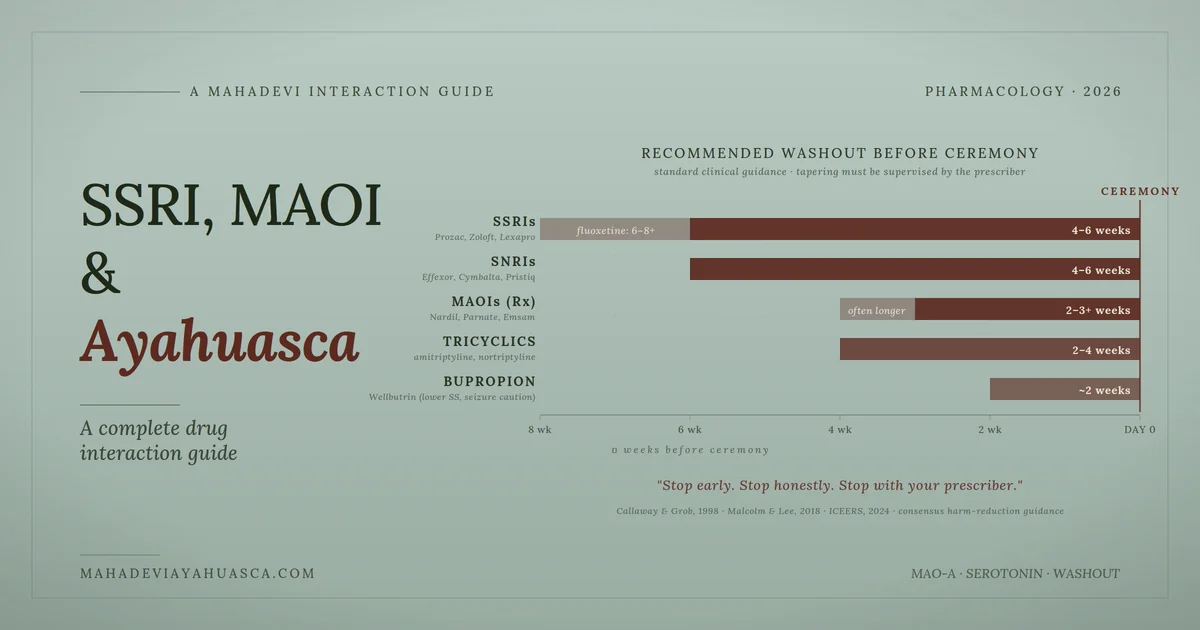
SSRI, MAOI, ayahuasca combinations can trigger serotonin syndrome, a potentially fatal accumulation of serotonin in the central nervous system. The risk extends to SNRIs and any other serotonergic medication, and exists because ayahuasca’s harmine and harmaline alkaloids are themselves reversible MAO-A inhibitors. Stacking them with antidepressants that already raise serotonin can flood the system. Most clinical researchers and reputable retreat centers recommend a medically supervised washout of at least four to six weeks before ceremony, with longer windows for fluoxetine and pharmaceutical MAOIs.
| Drug Class | Common Examples | Risk Level | Typical Washout |
|---|---|---|---|
| SSRIs | Prozac, Zoloft, Lexapro, Celexa, Paxil | High risk, contraindicated | 4 to 6 weeks (fluoxetine: 6 to 8 plus) |
| SNRIs | Effexor, Cymbalta, Pristiq | High risk, contraindicated | 4 to 6 weeks |
| Pharmaceutical MAOIs | Nardil, Parnate, Emsam, moclobemide | Extreme risk, contraindicated | 2 to 3 weeks minimum, often longer |
| Tricyclics and trazodone | Amitriptyline, nortriptyline, imipramine | Moderate to high risk, contraindicated | 2 to 4 weeks |
| Bupropion (Wellbutrin) | Wellbutrin, Zyban | Lower SS risk, seizure caution | 2 weeks with screening |
| Lithium | Lithobid, Eskalith | High risk, seizure concern | Requires medical guidance |
| Other serotonergics | Tramadol, triptans, MDMA, St. John’s Wort, 5-HTP | Contraindicated | 1 to 2 weeks (supplements); medical guidance for prescriptions |
The most preventable harm in modern ayahuasca ceremony is not a weak shaman or a poorly held container. It is unscreened pharmacology. Ayahuasca contains potent monoamine oxidase inhibitors, and tens of millions of people take antidepressants that raise serotonin in the synapse. The two were never meant to meet inside a human body. When they do, the result is a documented medical emergency called serotonin syndrome. The risk is real, the harm is preventable, and almost every serious case in the published literature involves a drug interaction, a screening failure, or both (Bouso et al., 2022).
This article is for educational purposes only. It is not medical advice, a treatment recommendation, or a substitute for psychiatric care. Decisions about your psychiatric medication require a qualified prescriber. Decisions about whether ayahuasca is medically safe for you require a prescriber familiar with your medications, cardiovascular profile, and history. The information below reflects published research and clinical consensus and does not replace either.
SSRI, MAOI, Ayahuasca: Why the Combination Carries Real Risk
The most preventable harm in modern ceremony is not a weak shaman. It is unscreened pharmacology.
A 1998 case report in the Journal of Psychoactive Drugs described the danger directly. A person on fluoxetine drank ayahuasca and developed a severe adverse reaction consistent with serotonin syndrome (Callaway and Grob, 1998). The paper has been the most cited drug interaction reference for ayahuasca for nearly thirty years, and the warning still stands.
The largest survey of ayahuasca use to date, with 10,836 participants across more than fifty countries, found that 2.3 percent of users required medical attention for an adverse event. The strongest predictors of harm were unsupervised settings and pre-existing psychiatric or pharmacological conditions (Bouso et al., 2022).
The number sounds small. The harm is preventable. What follows explains what is actually happening at the level of the enzyme, what to watch for, and how to navigate the washout if antidepressants are part of your story.
How Ayahuasca Itself Acts as an MAOI
Most plant medicines are described by what they make a person feel. Ayahuasca is better described by what it does at the level of the enzyme.
The brew combines two plants. Banisteriopsis caapi, called yagé in Colombia, contributes beta-carboline alkaloids: harmine, harmaline, and tetrahydroharmine. Psychotria viridis (chacruna), or in Colombia and Ecuador Diplopterys cabrerana (chaliponga), contributes N,N-dimethyltryptamine, or DMT.
DMT alone, taken orally, does almost nothing. The body’s monoamine oxidase enzyme degrades it before it reaches the bloodstream. The beta-carbolines from the vine block that enzyme temporarily, allowing oral DMT to cross into systemic circulation and the central nervous system (Egger et al., 2024; Ruffell et al., 2020).
This is the pharmacology of ayahuasca in a single paragraph. Everything else, ceremony, visions, purging, the long arc of integration, follows from this one mechanical hinge. For the broader picture of the brew, the lineages, and the chemistry, see our complete ayahuasca guide.
The relevant point is straightforward. While MAO-A is blocked, anything that raises serotonin or competes for the same enzyme can accumulate to dangerous levels. The harmine in your cup belongs to the same class of molecule a psychiatrist would warn you about if it appeared on a prescription bottle. The plant does not soften its pharmacology because the setting is sacred.
How SSRIs, SNRIs, and Other Antidepressants Affect Serotonin
Now the other side of the equation. SSRIs do one thing simply. They block the reuptake of serotonin from the synaptic cleft, which means more serotonin stays available between neurons. That is what selective serotonin reuptake inhibitor means. SNRIs do the same for serotonin and norepinephrine. Tricyclics block reuptake of multiple monoamines at once. Trazodone, vortioxetine, and other atypical agents reach serotonin systems through their own routes.
Bupropion (Wellbutrin) is the outlier. It works on dopamine and norepinephrine, not serotonin. It is not an MAOI and not a serotonergic agent in the same sense, so the serotonin syndrome risk profile is different. Caution is still warranted, since bupropion lowers the seizure threshold and ayahuasca’s autonomic and emetic effects can compound that vulnerability (Malcolm and Lee, 2018).
Half-life matters. Most SSRIs clear the body within five to seven days of stopping. Fluoxetine is the exception. Its active metabolite norfluoxetine has a half-life of one to two weeks, which is why washout periods for fluoxetine run far longer than for any other SSRI.
This pharmacology helps people. For millions, the small adjustment to the synapse is what allows them to function. The pharmacology that helps them is also the pharmacology that makes ceremony unsafe. Both are true.
Serotonin Syndrome: What It Is, How to Recognize It
A stacked serotonergic agent and a strong MAO-A inhibitor can move a person from mild to severe within hours.
Serotonin syndrome is what happens when too much serotonin accumulates in the central nervous system. Symptoms cluster across three systems: mental status, autonomic, and neuromuscular. They progress quickly.
Mild symptoms include anxiety, restlessness, sweating, mild tremor, dilated pupils, and fast heart rate. Stop the ceremony. Monitor closely. Contact medical support.
Moderate symptoms include agitation, hyperreflexia, sustained clonus (rhythmic muscle jerking), elevated body temperature, and sustained tachycardia. Seek immediate medical attention.
Severe symptoms include hyperthermia above 38.5 degrees Celsius and often above 41, severe muscle rigidity, seizures, delirium, and coma. This is a medical emergency. Call emergency services immediately.
The window for safe intervention is short. If you are at a ceremony and notice escalating tremor, severe agitation, sustained muscle jerking, or a sudden spike in body temperature, go to a hospital. Tell the emergency physician what you took. They will not judge you. They will give you cyproheptadine, fluids, and benzodiazepines, and they will save your life (Malcolm and Lee, 2018; dos Santos et al., 2017).
The reverse fact is also true. Ayahuasca on its own, in healthy people without serotonergic medications, does not produce serotonin syndrome at typical ceremonial doses (ICEERS, 2024). The brew has been consumed by millions of people across centuries. The risk is created by the combination, not by the medicine alone.
Which is why the next question matters. Which medications, specifically, sit in which risk band.
Antidepressants and Ayahuasca: A Drug-by-Drug Reference
The picture is cleanest at the level of the individual medication. The table below is a working reference, not an exhaustive one. If your medication is not listed, the safe assumption is that it requires medical supervision and an honest conversation with your facilitator before any decision.
| Class and Examples | Mechanism | Risk with Ayahuasca | Notes |
|---|---|---|---|
| SSRIs Fluoxetine (Prozac), sertraline (Zoloft), escitalopram (Lexapro), citalopram (Celexa), paroxetine (Paxil) | Block serotonin reuptake | High risk, contraindicated | Documented serotonin syndrome case with fluoxetine. Washout under prescriber supervision. |
| SNRIs Venlafaxine (Effexor), duloxetine (Cymbalta), desvenlafaxine (Pristiq) | Block serotonin and norepinephrine reuptake | High risk, contraindicated | Same risk class as SSRIs. Discontinuation syndrome is significant for venlafaxine. |
| Pharmaceutical MAOIs Phenelzine (Nardil), tranylcypromine (Parnate), selegiline (Emsam), moclobemide | Inhibit MAO-A and/or MAO-B | Extreme risk, fully contraindicated | Compounds the same enzyme inhibition. Long supervised washout required. |
| Tricyclics and trazodone Amitriptyline, nortriptyline, imipramine, clomipramine, trazodone | Block multiple monoamine systems | Moderate to high risk, contraindicated | Affects serotonin among other systems. |
| Bupropion Wellbutrin, Zyban | Dopamine and norepinephrine reuptake inhibition | Lower SS risk, seizure caution | Not serotonergic in the same sense. Lowered seizure threshold matters with the autonomic load of ceremony. |
| Lithium Lithobid, Eskalith | Mood stabiliser, mechanism partially understood | High risk, seizure concern | Lowers seizure threshold. Not safe to combine. |
| Other serotonergic agents Tramadol, methadone, dextromethorphan, triptans, MDMA, St. John’s Wort, 5-HTP, tryptophan | Various serotonergic actions | Contraindicated | Each adds serotonergic load. Disclose all OTC and recreational use. |
The interaction landscape changes as new medications enter the market. The safe rule does not change. Disclose every prescription, every supplement, every recent recreational substance to your facilitator. The absence of a warning here does not mean the absence of a risk.
Tapering and the Washout Window: How Long Before Ceremony
The honest answer: long enough that the medication and its active metabolites have cleared your system, with medical supervision throughout.
| Medication | Typical Half-Life | Recommended Pre-Ceremony Washout | Source |
|---|---|---|---|
| Sertraline (Zoloft) | About 26 hours | 4 to 6 weeks, supervised | Malcolm and Lee, 2018 |
| Escitalopram (Lexapro) | About 27 to 32 hours | 4 to 6 weeks, supervised | Malcolm and Lee, 2018 |
| Citalopram (Celexa) | About 35 hours | 4 to 6 weeks, supervised | Malcolm and Lee, 2018 |
| Paroxetine (Paxil) | About 21 hours | 4 to 6 weeks, supervised; expect discontinuation syndrome | Malcolm and Lee, 2018 |
| Fluoxetine (Prozac) | 1 to 4 days; norfluoxetine 7 to 15 days | 6 to 8 weeks minimum, often longer | Callaway and Grob, 1998; Malcolm and Lee, 2018 |
| Venlafaxine (Effexor) | About 5 hours; ODV about 11 hours | 4 to 6 weeks, supervised; significant discontinuation syndrome | Malcolm and Lee, 2018 |
| Duloxetine (Cymbalta) | About 12 hours | 4 to 6 weeks, supervised | Malcolm and Lee, 2018 |
| Pharmaceutical MAOIs | Varies (irreversible inhibition) | 2 to 3 weeks minimum; clinician must reassess | Ruffell et al., 2020 |
| Tricyclics | Varies (often 12 to 36 hours) | 2 to 4 weeks, supervised | Malcolm and Lee, 2018 |
| Bupropion (Wellbutrin) | About 21 hours | 2 weeks with seizure-risk screening | Malcolm and Lee, 2018 |
| St. John’s Wort, 5-HTP, tryptophan | Varies | 1 to 2 weeks minimum | ICEERS, 2024 |
If you are tapering off antidepressants for the first time, that is a process that deserves its own care, separate from any ceremonial plan. Discontinuation syndrome is real, particularly with paroxetine and venlafaxine. Brain zaps, mood instability, sleep disruption, the return of symptoms the medication was managing. Pacing the taper matters more than meeting any retreat date.
A note that belongs here. People come to plant medicine for depression more often than for any other reason in the published global surveys (Sarris et al., 2021; Palhano-Fontes et al., 2019). I came for the same reason in 2017. Treating ayahuasca as a cure for depression is one of the most painful misreadings of what this medicine is. It can help. But depression rarely lifts in a single ceremony, and the hope-crash that follows when it does not is its own injury.
If you are reading this from inside that kind of depression, do not start the washout conversation alone. Bring your psychiatrist. Bring a therapist. The medicine is real. The work that surrounds it is what makes the medicine able to help.
Preparing Safely: Screening, Dieta, and What to Tell Your Facilitator
The traditional dieta and the modern MAOI dietary restriction are pointing at the same physiological window.
Once the medical team is in place and the washout window is mapped, the next layer is the body. The traditional ayahuasca dieta restricts aged cheese, cured meats, fermented foods, alcohol, and certain other items in the days before ceremony. Most modern guides describe these restrictions as cultural or energetic. The pharmacological reality is more interesting. Many of these foods are high in tyramine, the same compound that drives the hypertensive crisis associated with pharmaceutical MAOIs.
Indigenous Amazonian healers worked out empirically what Western pharmacology described mathematically four hundred years later. Both communities arrived at the same answer.
Before any ceremony, disclose the following to your facilitator:
- Every prescription medication, current and within the past six months.
- Every supplement, especially St. John’s Wort, 5-HTP, SAM-e, kava, kratom.
- Recreational substance use, current and recent.
- Any history of seizures, cardiovascular disease, hypertension, or arrhythmia.
- Any personal or family history of psychosis, schizophrenia, or bipolar disorder with manic episodes.
- Pregnancy or current breastfeeding.
- Recent or planned surgery.
A facilitator who does not ask about your medications in detail before ceremony is not a safe facilitator. The screening is not paperwork. It is the structure that makes the work possible.
Three Moments Where the Risk Becomes Real
Knowing the pharmacology is one thing. Recognizing the human moments where the risk actually lands is another. Three patterns recur in the case literature and in the screening calls our team takes every week.
The recent prescription. A guest fills out the intake honestly six weeks before retreat. Two weeks before travel, a primary care doctor prescribes a low-dose SSRI for situational anxiety, and the guest does not think to update the form. They arrive at retreat already on Lexapro for ten days. This is the most common screening failure. The fix is not pharmacological. It is a second screening conversation forty-eight hours before the first ceremony.
The forgotten supplement. A guest discloses every prescription medication and forgets the St. John’s Wort they take for low mood. Or the 5-HTP they bought online. Or the tryptophan stacked in their pre-workout. These count. They count exactly the same as a prescription. Your facilitator needs the supplement bottle list, not just the pharmacy list.
The pre-retreat washout that did not happen. A guest plans the washout, then a stressful event ten days out drives them back to the medication for two days, and they come anyway. The body knows. The molecule does not care about the calendar. Postponing a retreat is uncomfortable. A medical emergency in the maloca is worse for everyone.
Each of these is fixable with one honest conversation. None of them are fixable in the ceremony itself.
Working with Practitioners Who Understand Both Worlds
The right people for this work hold two literacies at once. They know the pharmacology well enough to recognize the contraindications. They know the lineage well enough to honor what the medicine is.
If you are on antidepressants and exploring whether ayahuasca might be part of your path, build your team before you build your plan. Your prescribing clinician needs to be in the conversation. So does a therapist or integration coach who understands plant medicine work. So does the facilitator who will hold the space for you. None of the three replaces the other two.
At MahaDevi, the screening process begins with a medical questionnaire and a discovery call before any commitment is made. Our medical advisory team reviews complex cases. On site, a registered nurse is available for participants whose risk profile warrants closer attention, and our protocol does not allow a participant to sit on a given night if their physical state is in question. None of this is paperwork. It is what allows the medicine to do its work.
Feel deeply.
Show up fully.
Frequently Asked Questions
Can you take ayahuasca while on SSRIs?
No. Combining ayahuasca with SSRIs creates a real risk of serotonin syndrome via two simultaneous mechanisms: ayahuasca’s MAO-A inhibition and the SSRI’s reuptake blockade. Every reputable provider screens for this and requires a medically supervised washout before ceremony.
How long do you have to be off antidepressants before drinking ayahuasca?
Most SSRIs and SNRIs require a washout of four to six weeks under medical supervision. Fluoxetine (Prozac) requires longer, six to eight weeks at minimum, because its active metabolite has a much longer half-life. Pharmaceutical MAOIs require at least two to three weeks. These are starting points, not prescriptions. The actual schedule belongs to you and your prescribing clinician.
Is Wellbutrin (bupropion) safe to combine with ayahuasca?
Bupropion does not act on serotonin, so the serotonin syndrome risk is much lower than with SSRIs. The concern with bupropion is the lowered seizure threshold combined with ayahuasca’s autonomic load. Discuss this carefully with both your prescriber and your facilitator. It is not a clear yes.
Can ayahuasca cause serotonin syndrome on its own?
At typical ceremonial doses, in healthy people without serotonergic medications, ayahuasca alone does not produce serotonin syndrome. The risk is created by the combination of ayahuasca’s MAO-A inhibition with another serotonergic agent.
Why is ayahuasca itself called an MAOI?
The beta-carboline alkaloids in Banisteriopsis caapi (harmine, harmaline, tetrahydroharmine) are reversible inhibitors of monoamine oxidase A. This is the same enzyme system targeted by pharmaceutical MAOIs prescribed for depression. The mechanism is what allows DMT in the brew to be orally active. It is also what creates the drug interaction profile.
What should I tell my retreat facilitator about my medication history?
Everything. Every prescription, every supplement, every recreational substance from the past six months, your full psychiatric and cardiovascular history, and any personal or family history of psychosis or bipolar disorder. The screening only works if the information going into it is complete.
What is a safe washout if I am on Lexapro?
Escitalopram has a half-life of about 27 to 32 hours. Most clinicians and reputable retreat centers recommend a four to six week washout, supervised by your prescriber, before ceremony. Discontinuation should be paced. Stopping cold can cause discontinuation syndrome and a return of the symptoms the medication was managing.
What is a safe washout if I am on Prozac?
Fluoxetine is the longest washout among the SSRIs because its active metabolite norfluoxetine has a half-life of seven to fifteen days. Six to eight weeks is the minimum most clinicians recommend, and longer windows are common. Plan the retreat date around the washout, not the other way around.
Can I do ayahuasca if I am on lithium?
Lithium combined with serotonergic agents is associated with seizures and serotonin toxicity in the published literature. This is not a combination any reputable retreat will accept without medical guidance, and most will decline regardless. Discontinuing lithium is a decision that requires a psychiatrist, not a facilitator.
Is it legal to participate in an ayahuasca ceremony in the United States?
DMT is a Schedule I controlled substance under U.S. federal law. Two religious organizations, the União do Vegetal and Santo Daime, hold legal exemptions established through court rulings, including the 2006 Supreme Court decision in Gonzales v. O Centro Espírita Beneficente União do Vegetal. Outside of those exemptions, ayahuasca remains federally illegal in the United States. Many participants travel to countries where the medicine has different legal status.
Conclusion
Ayahuasca and antidepressants do not mix. The reason is pharmacological, not cultural. The vine blocks the same enzyme your antidepressant is working around. The two were never meant to share a bloodstream.
The path through is not complicated. It is specific. A medically supervised washout. Honest disclosure to your facilitator. A team that holds both literacies, the clinical and the ceremonial.
If any of this applies to your situation, the conversation belongs in a room with your prescriber and your facilitator before any commitment is made. Not at retreat. Now.
The medicine is wild. The preparation can be precise.
Related Reading
- Complete ayahuasca guide
- Ayahuasca for depression
- Ayahuasca and bipolar disorder
- Ayahuasca and blood pressure
- Ayahuasca and the heart
- Ayahuasca Safety: Risks, Contraindications, and Drug Interactions Explained
- How to Prepare for Ayahuasca: The Complete Guide
- Medical Considerations for an Ayahuasca Retreat
- Ayahuasca Diet and Dieta: What to Eat and Avoid
- Ayahuasca Integration: What It Is, Why It Matters
