
Trauma-Informed Care: The 4 R’s, 6 Principles, and What It Means for Plant Medicine Healing
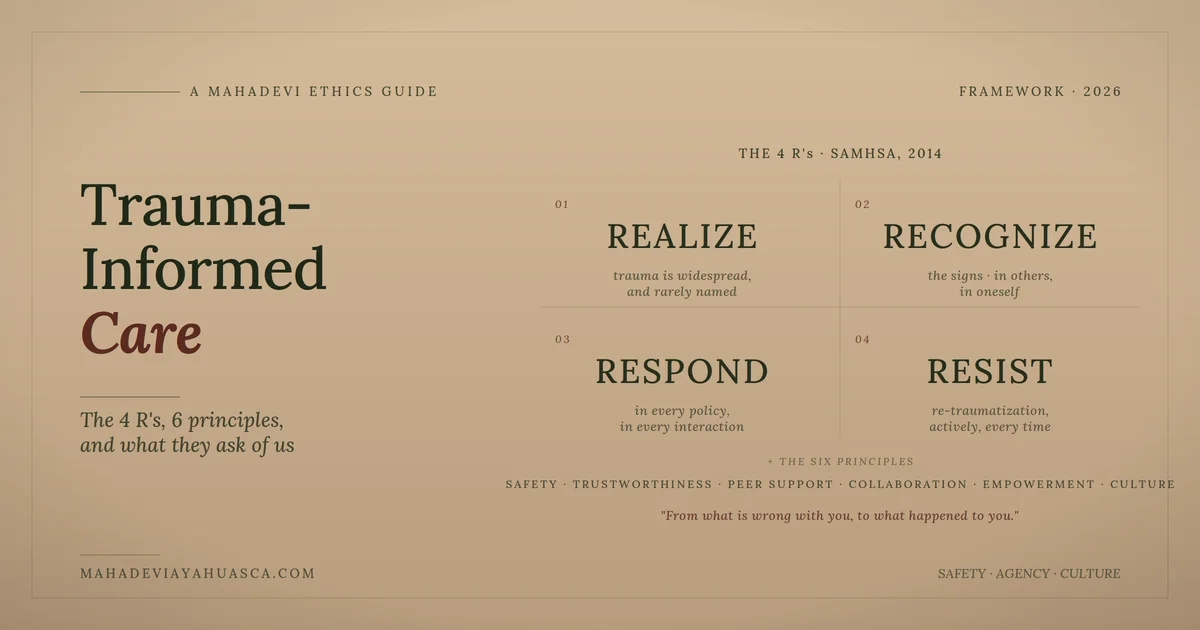
Trauma-informed care is an approach to working with people that assumes trauma is common, recognizes how it shapes behavior, and structures every interaction to avoid re-injury. It was codified by the U.S. Substance Abuse and Mental Health Services Administration around four assumptions (Realize, Recognize, Respond, Resist re-traumatization) and six principles: safety, trustworthiness and transparency, peer support, collaboration, empowerment, and cultural-historical-gender awareness. It applies in hospitals, schools, courts, workplaces, and increasingly, in psychedelic and plant medicine settings, where the combination of vulnerability, altered states, and unregulated facilitators makes the framework not optional but essential.
| Element | What it is | Why it matters in plant medicine settings |
|---|---|---|
| The 4 R’s | Realize, Recognize, Respond, Resist re-traumatization | A facilitator who does not realize trauma is common will misread what surfaces in ceremony |
| Safety | Physical and emotional safety as a baseline, not a feature | Sexual abuse cases in unregulated retreats are documented; safety is the precondition for everything else |
| Trustworthiness | Decisions made transparently; expectations clear in advance | Surprises during ceremony are not “the medicine working.” They are a container failing |
| Collaboration | Power is shared, not held by the facilitator alone | The shaman-as-authority model is exactly the structure that enables abuse |
| Empowerment, voice, choice | Participants retain agency throughout | “Surrender to the medicine” can be a useful instruction or a coercive one. The difference is whether choice remains |
| Cultural and historical awareness | Recognition that trauma includes intergenerational, racial, and colonial dimensions | Indigenous lineages have their own ethics; ignoring them is itself a re-traumatization |
The phrase “trauma-informed” gets used loosely now. Retreat websites claim it. Therapists put it on their bios. Schools write it into mission statements. The framework underneath the phrase is older, more specific, and more demanding than most of the marketing suggests. What follows is what trauma-informed care actually means, where the framework came from, what its operational principles are, and why it carries unusual weight in ayahuasca and plant medicine contexts, where the combination of altered states, charismatic facilitators, and an unregulated industry creates conditions that the framework was built to prevent.
This article is for educational purposes only. Trauma-informed care is a clinical and organizational framework, not a treatment in itself. Decisions about trauma treatment require a qualified mental health clinician. Decisions about ceremonial participation in any plant medicine require an experienced, screened-by-you facilitator. The information below reflects published research, the framework codified by SAMHSA, and clinical consensus, and does not replace either of the above.
What Trauma-Informed Care Actually Means
The shift is from one question to another. From “what is wrong with you” to “what happened to you.”
Before the framework had a name, clinicians working in psychiatric inpatient units, addiction services, child welfare, and shelter systems noticed the same thing. Many of the people in their care had survived something. Sexual violence. Combat. Childhood neglect. Witnessing harm to people they loved. The behaviors that brought them into the system (substance use, self-harm, dissociation, aggression, withdrawal) often turned out, on closer look, to be adaptations. Strategies the nervous system had developed under conditions where those strategies kept the person alive.
The dominant clinical question at the time was diagnostic. What is wrong with this person. The shift, articulated through the 1990s and 2000s by clinicians including Sandra Bloom, Maxine Harris, and Roger Fallot, then formalized by the U.S. Substance Abuse and Mental Health Services Administration (SAMHSA) in its 2014 framework, was to a different question entirely. Not what is wrong. What happened. The reframe sounds small. It changes everything downstream.
Trauma-informed care is not a treatment. It is not a modality. It is a way of organizing every interaction, every policy, every physical environment, in light of the assumption that trauma is common in the populations being served and that systems built without that assumption tend to harm the people they are trying to help.
The CDC-Kaiser Adverse Childhood Experiences study, the largest body of research on the prevalence of childhood trauma, has been replicated dozens of times in different populations. What it consistently finds is that childhood adversity is not rare. A majority of adults have at least one significant adverse childhood experience. A meaningful minority have four or more, which is associated with substantially elevated risk of cardiovascular disease, addiction, depression, and early death. Trauma is not a niche concern. It is a public health condition.
That is the foundation. Universal precaution. Treat everyone you work with as if they may be carrying something. Build the room for the version of the person who is. Most people, on most days, will not need every accommodation the framework offers. The accommodations have to be there anyway.
The 4 R’s of Trauma-Informed Care
A practitioner who skips any of the four is not yet trauma-informed, regardless of what their website says.
SAMHSA’s 2014 framework distilled the orientation into four assumptions that any trauma-informed organization must hold. They are usually rendered as the 4 R’s.
Realize. Understand the widespread impact of trauma. Know that the person sitting across from you may be carrying it whether or not they have named it. Realize that trauma affects individuals, families, communities, and entire generations, and that recovery paths are real but rarely linear.
Recognize. Be able to identify the signs and symptoms of trauma in the people you work with, in their family members, in your colleagues, and in yourself. Hypervigilance. Dissociation. Difficulty trusting. Substance use. Trouble sleeping. Strong reactions to small triggers. Recognition is not diagnosis. It is the capacity to see the pattern when it shows up.
Respond. Integrate knowledge about trauma into policies, procedures, and practices. This is the operational layer. It means screening intake forms that ask about trauma history. Staff trained to handle disclosures without panic. Physical environments that do not retraumatize, and language that does not assume the worst.
Resist re-traumatization. Actively work to avoid practices and conditions that recreate the original injury. This includes seclusion and restraint in psychiatric care, intrusive questioning in social services, harsh discipline in schools, and the kinds of coercive interpersonal dynamics that show up in poorly run retreat settings. The negative form of the principle matters as much as the positive ones. A great deal of what trauma-informed care requires is what not to do.
The 4 R’s are not a checklist. They are a stance. An organization that has translated all four into operational practice, from the first phone call through the discharge paperwork, is trauma-informed. An organization that has done one or two is not.
The 6 Principles of Trauma-Informed Care
Where the 4 R’s name the orientation, the principles name what to actually do.
SAMHSA’s framework specifies six principles that translate the 4 R’s into the actual texture of an organization. Maxine Harris and Roger Fallot’s earlier formulation used five. The two map closely. The differences are useful.
| SAMHSA’s 6 principles (2014) | Harris & Fallot’s 5 principles (2001) | What it looks like in practice |
|---|---|---|
| Safety | Safety | Physical environments people can leave. Emotional environments where they will not be punished for what they share |
| Trustworthiness and transparency | Trustworthiness | Decisions are made openly. Expectations are stated clearly in advance. Promises are kept or amended in conversation, not abandoned silently |
| Peer support | (Not separately named) | People who have been through what you are going through are part of the help you receive, not as therapists but as witnesses |
| Collaboration and mutuality | Choice / Collaboration | Power is leveled where possible. Decisions are made with the participant, not for them |
| Empowerment, voice, and choice | Empowerment | The participant retains agency at every stage. The right to slow down, ask questions, and stop is real and exercisable |
| Cultural, historical, and gender issues | (Implied but not named) | The full range of identities is recognized; the work accounts for race, gender, indigenous heritage, queerness, disability, and the historical wounds carried by groups, not only individuals |
The two additions SAMHSA made (peer support; explicit cultural-historical-gender awareness) are not minor. Peer support recognizes that some forms of help can only come from someone who has stood where you are standing. Cultural awareness recognizes that trauma is not only individual. Whole peoples carry it. Whole communities carry it. Treating the person without seeing the structure they live inside is a kind of erasure.
What unites all six principles is the assumption of agency. The trauma-informed organization treats the person in front of it as the active agent in their own recovery, not the object of expert intervention. The shift in posture is the work.
Why It Matters: Re-Traumatization and the Cost of Getting It Wrong
The systems built to help can themselves wound. The framework exists because they often do.
Re-traumatization is the term for what happens when a person seeking help encounters a system whose practices recreate the conditions of the original injury. A childhood abuse survivor stripped, restrained, and held down in a psychiatric emergency room. A refugee questioned about their assault in front of a roomful of strangers. Foster-history children disciplined for “non-compliance” when they freeze in response to a raised voice. The original wound is not closed. The system reopens it.
The harms of re-traumatization are well documented in the psychiatric and child welfare literature. Patients subjected to seclusion and restraint frequently disengage from treatment entirely. Trust in helping institutions, once broken, is hard to rebuild. The most vulnerable populations, those who arrived already injured, are the ones who lose the most when the system fails to see what it is doing.
This is the practical case for the framework. Not philosophy. Not orientation. Outcomes. Trauma-informed organizations have lower rates of seclusion and restraint, higher patient and staff satisfaction, better treatment retention, and fewer adverse incidents. The principles are not soft. They are the operational difference between systems that heal and systems that wound a second time.
What carries the framework beyond mainstream healthcare into psychedelic and plant medicine settings is the recognition that the same dynamic plays out there, often more sharply. An altered state is its own vulnerability. A charismatic facilitator carries authority that lay relationships do not. No regulatory body exists to appeal to in most jurisdictions. The conditions for re-traumatization in unregulated retreats are not theoretical. They are documented.
Trauma-Informed Care in Practice: What It Looks Like Across Settings
The principles look different in different rooms. The orientation does not.
In healthcare, trauma-informed practice looks like intake forms that ask about trauma history without forcing disclosure, exam rooms with doors that lock from the inside, providers who explain what they are about to do before they touch a patient, and protocols for handling distress that do not default to physical restraint.
In schools, it looks like discipline policies that recognize behavior as communication, classroom environments that account for sensory regulation, teachers trained to recognize the difference between defiance and dysregulation, and referral systems that connect families to community resources rather than punishment.
In workplaces, it looks like policies on bereavement, harassment, and accommodation that assume difficult things have happened to employees outside of work and continue to happen during it. It looks like managers trained in basic recognition. It looks like benefits structures that allow for therapy, leave, and flexible hours when needed.
In social services and the courts, it looks like interview protocols designed to minimize re-traumatization during disclosure, advocates who can sit with survivors through legal processes, and case management that does not require people to repeatedly retell their story to every new staff member they encounter.
The common thread is operational, not philosophical. A trauma-informed setting is one where the framework has been translated into the specific decisions, environments, and procedures of that setting. A poster in the lobby does not count.
Trauma-Informed Care and Ayahuasca: The Unique Application
The medicine is reaching populations the framework was built for. The framework rarely reaches the medicine.
People come to ayahuasca for many reasons. The ones who come for trauma are increasingly visible in the research. A 2023 mixed-methods case series of U.S. military combat veterans with PTSD reported that 71.4 percent of evaluable participants (5 of 7, per the published correction) showed reliable or clinically significant reductions in PCL-5 symptom severity following a three-day ayahuasca intervention, sustained at follow-up (Weiss et al., 2023). The leading mechanistic hypothesis for ayahuasca’s effect on traumatic memory involves DMT’s activation of the sigma-1 receptor combined with β-carboline MAO inhibition, allowing the kind of memory destabilization and reconsolidation that long-form trauma therapy aims for (Inserra, 2018). A 2023 systematic review of ayahuasca’s therapeutic effects through 2022 found consistent evidence of benefit for depression, anxiety, substance use disorders, and PTSD (Duarte et al., 2023). For the broader PTSD evidence, see our ayahuasca for PTSD guide.
Promising signals. Real research. Population most affected, in many cases, by the very wounds the framework was built to address.
What follows here is the question of container. Of how the medicine is held. Because the same combination of altered states, vulnerability, and authority that gives ayahuasca its therapeutic potential also creates exactly the conditions trauma-informed care exists to safeguard against.
The largest international study of ayahuasca outcomes, with 6,877 drinkers analyzed for context effects, found that variables including community support, integration quality, and the strength of the experience were positively associated with mental health outcomes, while extreme acute fear and difficulties integrating were negatively associated. Setting was not incidental. It was a primary determinant of whether the medicine helped (Perkins et al., 2021). The Global Ayahuasca Survey of 10,836 users likewise found that adverse mental health effects in the weeks and months following use, while reported by a majority, were considered part of a positive growth process by approximately 88 percent of those who experienced them, with non-supervised contexts associated with higher risk profiles (Bouso et al., 2022).
Set and setting are not metaphors. They are operational variables. A trauma-informed retreat operationalizes them through screening, consent, ratios, and integration. An untrained or commercial operation often operationalizes them through marketing and luck.
Harms when the container fails are not abstract. A BBC investigation into sexual abuse by ayahuasca facilitators documented multiple women assaulted by celebrated healers, including ones with public honors and large international clienteles, while in vulnerable psychedelic states (Maybin & Casserly, 2020). Chacruna Institute’s Ayahuasca Community Guide for the Awareness of Sexual Abuse emerged as a direct response to a pattern repeated across decades and countries (Chacruna Institute, 2024). These are not isolated incidents in an otherwise functional industry. They are structural outcomes of a system that operates without the principles trauma-informed care names. For more on what bad-trip dynamics look like and how to navigate them, see our guide to ayahuasca bad trips.
The principles map almost cleanly onto what a well-run ayahuasca container looks like. Safety means thorough medical and psychiatric screening before acceptance, low facilitator-to-participant ratios, women holding space alongside men, and physical environments where participants can move and rest as needed. Trustworthiness means clear communication of dose, duration, what to expect, and what is not on offer, before money changes hands. Collaboration means decisions made with the participant rather than declared from above. Empowerment, voice, and choice means the right to skip a ceremony, drink less, or stop entirely without judgment or social pressure. Cultural awareness means honoring the lineage the medicine comes from, with reciprocity to the indigenous communities who carry it, and accountability to the ethical principles those communities have articulated (Celidwen et al., 2022).
Clinical guidance for safety in ayahuasca administration in formal settings has begun to formalize what these principles look like in protocol form, including standardized exclusion criteria, screening tools, and management protocols for psychiatric and medical adverse events (Rossi et al., 2023). Harm reduction guidance from ICEERS, commissioned by the Catalan Department of Health, has done similar work for ceremonial settings outside the clinic (ICEERS, 2019). The protocols exist. The question is which retreats use them and which only claim to.
How to Vet a Trauma-Informed Ayahuasca Retreat
The discovery call is where the principles become visible. Or where their absence does.
If you are considering ayahuasca with trauma history in the picture, the work of choosing a retreat is itself part of the trauma-informed process. The questions below are translations of the framework into the specific terrain of plant medicine. A good retreat will welcome them. A poor one will deflect.
- Screening. What is their medical and psychiatric screening process? Do they require disclosure of all medications, including SSRIs, SNRIs, and any other serotonergic agents? Do they have explicit exclusion criteria for active suicidality, schizophrenia spectrum conditions, bipolar I, severe cardiovascular disease, and current pregnancy? A center that does not have firm exclusion criteria is not screening; it is admitting.
- Medication washout. SSRIs and other serotonergic medications combined with the MAOI compounds in ayahuasca pose a serious risk of serotonin syndrome (Callaway & Grob, 1998) (Ruffell et al., 2020). A trauma-informed retreat will require a medically supervised washout in coordination with the prescribing clinician. A retreat that says “you’ll probably be fine” is not a trauma-informed retreat.
- Lineage. Does the center work within a named ceremonial lineage with traceable training? Or is the practice assembled from workshop attendance and self-study? Lineage is not a guarantee. But its presence allows for accountability that its absence does not.
- Facilitator-to-participant ratio. What is it? Numbers vary by tradition, but a retreat where one or two people hold space for thirty participants in altered states cannot, structurally, be trauma-informed. The math does not work.
- Gender composition of the team. Is there a woman holding space? In mixed-gender groups, this is not optional. The literature on sexual abuse in retreat settings is unambiguous about why.
- Code of ethics. Do they publish one? Does it cover physical contact, romantic and sexual conduct, financial relationships, and the consequences of violations? Is there a body, internal or external, to which complaints can be brought?
- Integration. Is integration support included in the program, before and after? Is it offered by people qualified to do trauma-informed work, or is it a group call run by the facilitator? The largest qualitative integration survey of 1,630 ayahuasca drinkers describes integration as challenging, long-term, and communal, often spanning months to years (Cowley-Court et al., 2023). A weekend retreat with no integration follow-up is not a complete program.
- What happens if it goes wrong. What is the protocol for an acute psychiatric or medical emergency? Is there medical care accessible? Has the team trained for adverse events? What happens after? Vague answers here are answers in themselves.
The framework does not require a retreat to be perfect. No retreat is. The framework requires that the principles have been translated into the actual operations of the place, that the people running it can talk about their practice in operational detail, and that they treat questions about safety as legitimate rather than as a sign of bad-faith inquiry.
Feel deeply.
Show up fully.
Frequently Asked Questions
What is the primary goal of trauma-informed care?
The primary goal is to avoid re-traumatization while supporting recovery. The framework starts from the assumption that the systems people turn to for help often replicate the conditions of the original injury, and that this is preventable. Operationally, the goal is to translate the four assumptions and six principles into every interaction, policy, and physical environment, so that the person seeking help can do so without being wounded a second time.
What are the 4 R’s of trauma-informed care?
Realize the widespread impact of trauma. Recognize its signs and symptoms in clients, families, staff, and yourself. Respond by integrating that knowledge into policies and practices. Resist re-traumatization by actively avoiding conditions that recreate the original injury. The 4 R’s were codified by SAMHSA in 2014 and form the orientation that all six principles of trauma-informed care operate within.
What are the 6 principles of trauma-informed care?
Safety. Trustworthiness and transparency. Peer support. Collaboration and mutuality. Empowerment, voice, and choice. Cultural, historical, and gender awareness. The six principles, articulated by SAMHSA in 2014, build on the earlier five-principle framework developed by Maxine Harris and Roger Fallot in 2001. The two principles SAMHSA added (peer support and explicit cultural-historical-gender awareness) reflect the recognition that recovery is communal and that trauma includes intergenerational and structural dimensions.
Who developed trauma-informed care?
The framework draws on multiple sources. Maxine Harris and Roger Fallot articulated an early five-principle model in 2001. Sandra Bloom developed the related Sanctuary Model in psychiatric settings. The CDC-Kaiser Adverse Childhood Experiences research, beginning in the late 1990s, provided the epidemiological foundation. SAMHSA codified the consolidated framework in its 2014 Concept of Trauma and Guidance for a Trauma-Informed Approach. The framework continues to evolve, with growing attention to cultural and historical trauma in particular.
What does trauma-informed care emphasize in crisis management?
Trauma-informed crisis management emphasizes de-escalation over restraint, choice over coercion, and the active reduction of conditions that recreate the original injury. In psychiatric settings, this has meant measurable reductions in seclusion and restraint use. In any crisis, the orientation is the same: stabilize without recreating powerlessness, listen without forcing disclosure, and remember that what looks like resistance is often a survival pattern doing exactly what it was built to do.
What role does peer support play in trauma-informed care?
Peer support is the recognition that some forms of help can only come from someone who has stood where the person seeking help is standing. The peer is not a clinician. They are a witness. SAMHSA elevated peer support to a named principle in its 2014 framework precisely because the clinical literature kept showing that lived experience contributes something professional training cannot replicate. In trauma recovery specifically, peer support reduces isolation, models that recovery is possible, and provides a relational context where shame loosens.
Is trauma-informed care evidence-based?
The framework as a whole is best described as practice-supported rather than RCT-validated. Specific components have strong evidence: the harms of re-traumatization in psychiatric care, the prevalence findings of the ACE Study, and the outcomes associated with peer support and reduction of seclusion and restraint. Treating the integrated framework like a pharmaceutical to be tested in a single trial misses what it is. Trauma-informed care is an organizational orientation, not a discrete intervention. Evidence accumulates at the level of the systems that adopt it.
Can trauma-informed care principles be applied to ayahuasca ceremonies?
They can, and they should. Ayahuasca ceremonies place participants in vulnerable altered states under the authority of facilitators who in most jurisdictions operate without licensure or regulatory oversight. The conditions trauma-informed care exists to safeguard against (asymmetric power, conditions ripe for re-traumatization, settings where survivors of past harm are at unique risk) are exactly the conditions of an unvetted retreat. Operationalized, this looks like rigorous medical and psychiatric screening, mandatory medication disclosure and washout protocols, low facilitator-to-participant ratios, mixed-gender holding teams, published codes of ethics, and integration support before and after the ceremony.
What are the warning signs of a retreat that is not trauma-informed?
No medical or psychiatric screening, or screening that asks no follow-up questions. Casual handling of medication interactions, particularly SSRIs. A single charismatic figure positioned as the sole authority. No published code of ethics, or one that cannot be discussed in detail. High participant-to-facilitator ratios. Pressure to drink more or to override hesitation. Absence of women on the holding team in mixed-gender settings. No integration support, or integration that is a single group call. Resistance to questions about any of the above.
Is ayahuasca safe for someone with PTSD or complex trauma?
For some people, in supervised settings with trauma-informed facilitators and adequate integration, ayahuasca has produced clinically significant symptom reduction. For others, particularly those with active suicidality, comorbid bipolar I, schizophrenia spectrum conditions, or current SSRI use without supervised washout, the answer is to wait, stabilize, and reconsider. The safety of the experience depends as much on who is holding the space as on what is in the cup. The companion piece on ayahuasca and trauma covers the typology and screening considerations in greater depth.
How is trauma-informed care different from trauma therapy?
Trauma therapy is a specific clinical intervention delivered by trained clinicians (EMDR, prolonged exposure, somatic experiencing, cognitive processing therapy, and others) aimed at processing and resolving traumatic material. Trauma-informed care is the organizational orientation that holds the room around any kind of intervention, clinical or not. A school can be trauma-informed without offering trauma therapy. A trauma therapist can practice within an organization that is not trauma-informed, often at significant cost. The two are complements, not substitutes.
How do I get trained in trauma-informed care?
SAMHSA, the National Council for Mental Wellbeing, the National Child Traumatic Stress Network, and the Trauma Informed Oregon initiative all provide free or low-cost foundational training. Several universities offer graduate certificates, and some state licensure bodies are beginning to require trauma-informed continuing education. For practitioners working with plant medicine, additional training through psychedelic-specific programs (CIIS, Fluence, the MAPS-affiliated training tracks) covers the application of the framework to non-ordinary states of consciousness specifically.
Conclusion
The framework is not a label. It is a stance translated into operations.
It says: assume what may have happened. Build the room for it. Do not become the next chapter of the wound. Across hospitals and schools and shelters, this orientation has reduced harm in measurable ways. In psychedelic and plant medicine settings, where the asymmetries of power and altered state are at their sharpest, the framework is not a refinement. It is the precondition.
The reader who arrived here researching ayahuasca for trauma already knows what is at stake. Medicine that reaches what talk cannot is real. Research worth taking seriously is real. Harms when the container fails are also real. Trauma-informed care is the language for telling the difference.
The principles are not soft. The principles are the work.
References
Maybin S, Casserly J. (2020). ‘I was sexually abused by a shaman at an ayahuasca retreat.’ BBC News.