
In most cases, during an ayahuasca ceremony the medicine is poured somewhere between eight at night and midnight, depending on the tradition.People usually arrive a few hours before that, and it is better when they do. Not because anyone is enforcing a rule. It is simply what works. A couple of hours in the space beforehand is enough to settle, to get a feel for the room and the people in it, to pick up the basic etiquette and learn where things are, and to stop being a visitor in a place you are about to spend the whole night in.
Most people picture the night beginning when they drink. It usually begins earlier than that, and a good part of what decides how the night goes has already happened by the time the cup reaches you.
Inside that stretch there is structure. The structure is old, it is deliberate, and very little of it is improvised. This post walks through it in order.
An ayahuasca ceremony is also longer than almost anyone expects. In the Peruvian traditions it tends to run about six hours. In the Colombian traditions it runs eight, sometimes as many as twelve, and it often ends with the sun coming up.
Ayahuasca Ceremony: Two structures, and they are not the same night
Before the hours make sense, this distinction has to be on the table, because it gets missed constantly.
The first is the local structure. This is ceremony as it is held by the people the medicine comes from, in Putumayo, in Iquitos, in Pucallpa, and in the regions around them. People arrive two or three hours early. They sit by the fire, or in a room, and they talk. Introductions happen on their own. Someone gives a quick word on the rules, the etiquette, where things are. That is most of it. There is no formal preparation practice, no scheduled meditation, nothing on a timetable.
It works, because nearly everyone in that room grew up inside it. They know what is coming. They know how to sit with it, and they know what to do when it gets hard.
Most foreigners do not, and that setup is largely unknown to anyone who is not from these regions. A person who flew in from another country and another life does not carry that background, and a quick word by the fire will not hand it to them.
The second is the retreat structure. The ceremony inside it is the same ceremony. What changes is everything around it. Screening beforehand, real preparation, a proper talk before the medicine is poured, facilitators awake and watching the room through the night, and support afterward.
That difference is worth being precise about. A retreat doing this properly has not modernized the ceremony and has not restructured anything the taita does. The prayer, the blessing, the songs, the order of the night, all of it is left exactly where it was found. What gets added is the support around the night, so that someone arriving from the outside can actually meet it.
The ayahuasca ceremony is not the thing that changed. What changed is how much a person is carried before and after it.
This page follows the retreat structure, because that is the one most people reading this will sit in.
The ayahuasca ceremony night at a glance
The retreat structure, in order.
| When | What happens |
| Three hours before | Arrival at the maloka. Rules, etiquette, seats, water, toilet, how to ask for help. |
| Two hours before | Guided meditation, or the fire. Settling. |
| One hour before | The ceremony leader’s talk. Group questions, then one on one. |
| The opening | Prayer and song. The medicine is blessed and poured. Then silence. |
| 30 to 60 minutes after the cup | The onset for most people. First purges for some. |
| 45 minutes to an hour in | Icaros begin in the Peruvian traditions. Harmonica, chanting and the waira from about an hour in the Colombian. |
| An hour and a half to two hours in | The second cup is offered. After that, medicine roughly once an hour to an hour and a half. |
| Two to three in the morning | Peruvian ceremonies close. People rest, or sit and talk. |
| Half past two to four | The sustained stretch of music in Colombian ceremonies. |
| Around four in the morning | The sanación, in Colombian ceremonies that hold one, then more music after it. |
| Six in the morning | Colombian ceremonies often reach first light. Some go past it. |
Before you arrive to an Ayahuasca Ceremony
Nothing in the night works if this part is skipped.
Before anyone drinks, they should already know what the ceremony involves, who is leading it, what medicine is being served, and what the risks and the benefits actually are. Medical screening belongs here, weeks out, not at the door. Someone should have asked about your medications, your heart, your psychiatric history and your family’s, and they should have asked before you booked a flight.
There is a second part to it that gets less attention. In a well-run retreat, by the time the first ceremony comes, people have already spent time together. They know the facilitators by name. They have eaten at the same table, asked their questions out loud, and heard other people ask theirs.
That is not hospitality. It changes the ceremony. A room of strangers quietly bracing against each other is a different room from one where people have already relaxed. The medicine works on what is in the room.
The medicine works on what is in the room.
The three hours before the medicine
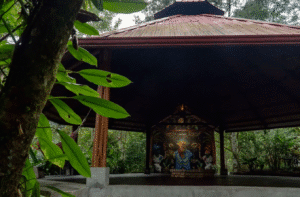
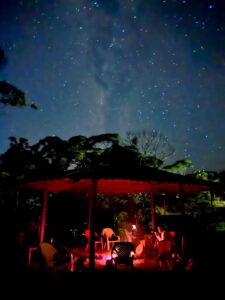 People arrive at the maloka, the ceremonial house, about three hours before the medicine is poured.
This first hour is practical and deliberately unmysterious. The rules are given. The etiquette is explained. How to ask for help and who to ask. How the facilitators will be watching the room through the night. Where the ceremonial space ends and where it does not.
Everyone is shown their place for the night. Where they will sit, where their bucket is, where the water is, where the toilet is.
Every question gets answered here, including the ones people feel stupid asking.
There is a reason this happens in the light, hours early. At three in the morning, deep in it, nobody is going to work out where the bathroom is. The body needs to already know.
Two hours before an ayahuasca ceremony
A simple guided meditation is offered. Nothing elaborate. Breath, attention, settling.
In our maloka, a lot of people go to the fire instead and sit with it. Fire gazing does something that instruction cannot, and people find their way to it without being told.
Either way, the work is the same. The nervous system is being brought down before the medicine takes it somewhere else.
One hour before an ayahuasca ceremony
The ayahuasca ceremony leader speaks.
This is the introductory talk, and it is the first time the shape of the night gets named out loud by the person holding it. He answers the group’s questions. Then there is time for one-on-one.
The private conversations matter more than the group talk. Some things nobody is going to say in front of a room. A diagnosis. A request. A specific fear with a name on it. That gets said quietly, off to the side, and the taita carries it into the ceremony with him.
The ceremony begins when the medicine is blessed
Everything before this was preparation. The ayahuasca ceremony starts here.
 The opening
 The opening
In Peruvian settings the opening usually falls between eight and ten at night. In Colombian settings it tends to come later, between ten and midnight, and the night runs longer from there.
Every tradition has a formal opening. Prayer and singing. The medicine is blessed. Then people are called up, one at a time, to receive it.
Most people spend a moment with the cup before they drink. Nobody teaches this and almost everybody does it. Whatever you came with gets said into the cup, or thought into it, or simply held there for a second.
Then it is drunk, and you go back to your place, and you wait.
When the last person has been served, the room goes quiet. In the Peruvian tradition that silence is followed by darkness. In the Colombian tradition there is a fire and there are candles, though most of the space is still dark. The fire is built before the medicine is poured and it is kept all night.
The onset of an Ayahuasca Ceremony
Most people feel the medicine somewhere between thirty minutes and an hour after drinking.
How fast depends on the strength of the brew, on the intention the ceremony leader carries into it, and on you. How clean your system is going in. What you have been eating. What you did with the dieta in the weeks before.
Every cup is different. Sometimes the onset and the peak arrive almost on top of each other. Sometimes there is a long slow corridor between them.
What people commonly feel first:
- Nausea
- Light headedness
- Breath going shallower
- A change in how the body reads temperature
- A change in how time passes
- Geometry, color, visuals with structure to them
- A pull inward, toward your own interior
- Lightness in the body
If it has not arrived yet, the answer is to wait. Nobody should be handed more medicine to chase it, and nobody should decide on their own that the pour was too small. An hour, an hour and a half, and the picture usually looks different.
The second cup
A second cup is usually offered, and the reason to take it is to go deeper.
When it comes varies. It depends on the strength of the brew, on whether it is someone’s first time, and on the ceremony leader’s read of the room, and it is different every night. As a rough shape, the second cup tends to come somewhere between an hour and a half and two hours after the first.
After that, medicine is generally available roughly once every hour to an hour and a half through the rest of the night. People take a second cup, a third, sometimes more.
How much is right is not a question to answer by yourself. It depends on the lineage, and it depends on which medicine is being served that night, and those are things the people holding the ceremony know and you do not.
So the move is simple. If you want more, raise your hand and ask a facilitator. Tell them you would like to drink a bit more. They will take it to the ceremony leader, and come back and tell you whether it is the right moment. You do not walk up to the table and serve yourself, and you do not have to work the timing out alone.
The purge
During an ayahuasca ceremony, some people will purge in the first minutes. Some purge an hour in, or two, or three. Some do not purge at all on their first night. None of that is a right or a wrong answer.
The purge is the body’s response to the state it is in while it is working with the medicine. That is all it is, and it is why the timing is so different from one person to the next.
It is also not one thing. It comes as vomiting. It also comes as tears, as sweating, as shaking, as yawning, as the bowels or the bladder emptying, as the ears popping.
Practically, there is a bucket in front of you and the bucket is what you use. A toilet is close by. If you need to get to it and you are not steady on your feet, you ask for help and someone walks you there. Nobody is impressed by you managing it alone.
What the purge is doing is clearing space so the work can be done.
That matters most in trauma work, because trauma is not only held as memory. It is held in the body. Bessel van der Kolk gave that idea the sentence everyone now uses. The body keeps the score.
The purge is the body handing some of it back.
Water, and why you drink less of it than you expect
The guidance on water catches people off guard, so it is worth saying plainly.
You are generally not meant to drink water during the ceremony.
After an ayahuasca ceremony purge you can take a small amount. Enough to rinse, gargle and wash your mouth out, and a little to drink. If you are genuinely dehydrated, have some. Just do not drink a lot of it.
The reason is straightforward. Water dilutes the medicine and it takes up the room the medicine is supposed to be working in. The point is to let it do its work rather than wash it down.
The middle of the night
By the second and third hour most people are in the deepest part of it.
This is the part that cannot be usefully described, and I am not going to pretend otherwise. What can be described is the room. It is quiet. Someone is crying. Someone is at their bucket. Someone has been sitting perfectly still for forty minutes. A facilitator moves through the space slowly, checking, not interrupting.
Nobody is left alone in it. That is the entire job of the people holding the room.
Ayahuasca Ceremony – The music: icaros, harmonica and the waira
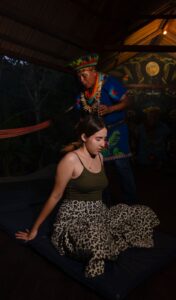
In the Peruvian traditions the singing starts early. Within about forty five minutes to an hour of the first cup the icaros begin. The icaros are the medicine songs, most associated with the Shipibo, and in that tradition they are the main instrument of the healing itself. They are sung and sometimes whistled, often very close to the person they are meant for. The singing runs close to continuous through the night. The song is doing something. It is not background.
In the Colombian yagé tradition it works differently. From about an hour in you start to hear harmonica, chanting and singing, and the waira, or the chakapa, the bundle of leaves used for blessing and for cleaning, moving over a person.
But it comes and it goes. There is more fire in a Colombian ceremony and less continuous singing than in a Peruvian one. Long stretches are silence and firelight, and then the music returns.
These are two musical traditions and not two competitors. Both are doing the same job. They give the night a shape, and they give the person something to hold while they are inside it. After hours in the dark with no reference point, a human voice is a reference point.
The peak
The peak is not a fixed point on a clock, and it is not the same experience twice.
For some people it is ontological, the kind of thing that rearranges what they thought reality was. For some it is intensely personal and specific. An old memory opened. A relationship seen clearly for the first time. Grief that finally moves after years of sitting still.
For some it is both in the same night. There is no standard version of it, and comparing notes in the morning tends to confirm that rather than resolve it.
Around four in the morning: the sanación
In the Colombian tradition the late part of the night of an ayahuasca ceremony has its own shape. The sustained stretch of music tends to run from around half past two until about four. Then comes the sanación.
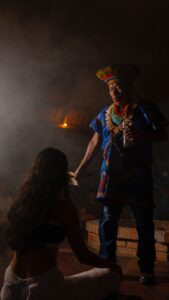
The word means healing. In practice the taita works with people one at a time. You are called up, or he comes to you, and you sit in front of him. There is song over you, the waira, smoke, sometimes water. It is direct, it is personal, and it is usually short.
After the sanación there is often more music before the night closes.
Not every ceremony has a sanación. It depends on the night, on the taita, and on what the medicine is doing in the room. Do not arrive expecting one, and do not read anything into its absence.
How the Ayahuasca Ceremony night ends
Peruvian ceremonies usually close around two or three in the morning. There is a formal closing, in the same way there was a formal opening, and the space is shut properly by the person who opened it. After that people rest, or sit and talk.
Colombian ceremonies run longer, eight hours and sometimes as many as twelve. They often go until six, until the light comes back, and some go past that. The fire that was built before the first cup is still going when the birds start.
That last stretch is one of the most valuable parts of the night, and it is the part nobody puts in a documentary. The intensity has gone. People start talking. Someone laughs for the first time in eight hours. Things that would take months to say in ordinary life get said by the fire in ten minutes.
Then it is morning, and people sleep.
Why people end up needing less medicine, not more
This one runs against what most people assume before they start.
The longer someone works with ayahuasca, the less of it they tend to need.
It is not unusual for a person to drink more cups in their early ceremonies and fewer of them a year later. Sensitivity increases as the system gets cleaner, and a cleaner system connects to a smaller amount.
There is a direct relationship between how clean you are going in and how much medicine it takes to reach you. What you ate, what you drank, what you have been putting in your body in the weeks before all sit on that scale.
Other things move it too. Breathing rather than bracing. Arriving in a posture of acceptance instead of resistance. Those sound soft and they are not. They are a large part of why two people who drank the same amount from the same pot report completely different nights.
Cooked and cold brew
Typically in an ayahuasca ceremony, the ayahuasca is cooked. The vine and the leaf are boiled together for hours, sometimes across a couple of days, and reduced down.
Crudo, the cold brew preparation, is made without fire. It is the older method, and it is closer to the original recipe than the cooked version most people are served.
MahaDevi is one of the only retreats in the world that serves both and alternates between them across the ceremonies of a retreat. That is not a small difference. Cooked and cold brew are not the same medicine to sit with, and having both across a run of nights gives a person something they will not find elsewhere.
The morning after an Ayahuasca Ceremony
The ceremony is over and the work is not.
What comes through in the night has a shelf life. The clarity is vivid for a few days and then ordinary life starts pulling at it. What you do in the weeks afterward is what decides whether the night becomes a change or an intense memory.
That is the whole argument for integration, and it is the part most people underestimate before they go and none of them underestimate after.
What no one can tell you in advance
Everything above is the container. What happens inside an ayahuasca ceremony is not predictable, and anyone who tells you otherwise is selling something.
The structure is knowable. The hours are knowable. Where the water is, when the fire gets built, when the music starts, who is watching the room. That is what this page is for.
What the medicine does with you inside that structure is yours. Two people can drink from the same pot on the same night and have nothing in common to report in the morning.
The people who do best are almost never the ones who arrived with the most vivid expectation. They are the ones who knew where the water was, trusted the person pouring, and let the night be longer than they wanted it to be.
If you are weighing a first ayahuasca ceremony, the rest of the container matters as much as the night itself. You can see how we run it, who leads it, and what the days around the ceremony look like on our ayahuasca retreat page.
