
Crudo: the Cold-Brew Preparation of Yagé (Ayahuasca) in the Colombian Putumayo
A regional, uncooked preparation of the Amazonian brew distinct from the conventional cooked decoction.
Crudo (Spanish for "raw") is a cold-brew, uncooked preparation of yagé, the name used in Colombia for the Amazonian psychoactive brew more widely known as ayahuasca. Where the conventional brew is a decoction produced by boiling the Banisteriopsis caapi vine with a DMT-containing admixture for many hours,[1] crudo is made by macerating freshly harvested plants in cold water without fire. It is associated with the Putumayo region of the southern Colombian Amazon, the heartland of the yagé tradition, and is described by practitioners there as a gentler preparation. Because it is neither cooked nor preserved, crudo is highly perishable and is consumed close to where the plants grow.
Terminology: yagé and ayahuasca
The terms yagé (also spelled yajé) and ayahuasca refer to the same family of brew prepared from the Banisteriopsis caapi liana combined with a plant containing N,N-dimethyltryptamine (DMT).[3] "Ayahuasca," a Quechua word, predominates in Peru and Ecuador; "yagé" is the term used across much of Colombia and is tied to the specific lineages and practices of the Colombian Amazon.[4]
Botanical composition and pharmacology
All yagé is built on Banisteriopsis caapi, which contains the β-carboline (harmala) alkaloids harmine, harmaline, and tetrahydroharmine. These compounds act as reversible inhibitors of the enzyme monoamine oxidase-A (MAO-A); by temporarily suppressing the gut enzymes that would otherwise break down DMT, they render DMT orally active.[1][2][9] Tetrahydroharmine additionally acts as a mild serotonin reuptake inhibitor.[10]
A notable regional distinction sets Colombian yagé apart from the brews of Peru and Brazil. In Peru and Brazil the DMT admixture is typically Psychotria viridis ("chacruna"), whereas in Colombia the admixture is characteristically Diplopterys cabrerana, known locally as chagropanga, chagra, or oco-yagé.[3][4] Analyses report that D. cabrerana leaves carry a higher and broader range of N,N-DMT than P. viridis — roughly 0.17–1.75% versus 0.1–0.61% by dry mass — and additionally contain 5-MeO-DMT; it is almost always the admixture used to prepare yagé in Colombia.[4][12]
The conventional preparation: cooked decoction
In most of the Amazon, yagé and ayahuasca are prepared as a decoction: the pounded vine and the admixture leaves are simmered in water over a fire, often for between four and twelve hours and across several reductions, to extract and concentrate the alkaloids into a thick, potent liquid.[1][3] The cooked decoction keeps longer than fresh plant material and is the form most often described in the scientific and ethnographic literature.[1]
Crudo: the cold preparation
Crudo departs from the decoction in a single decisive way: no fire is used. Freshly harvested B. caapi and its admixture are cleaned, pounded, and steeped in cold water, and the resulting liquid is strained and drunk without ever being boiled. Because the harmala alkaloids of B. caapi are water-soluble,[2] a cold maceration can draw them from the plant, though generally less efficiently than prolonged boiling; consistent with this, crudo is described within the Putumayo tradition as milder and gentler on the body than cooked yagé.
Two practical consequences follow from the absence of cooking. First, crudo must be made from fresh plants and consumed quickly: without the preservation that boiling affords, it ferments within a short time and cannot be stored or transported. Second, it is therefore effectively bound to the place where the plants grow — in practice, the Putumayo and neighbouring areas of the Colombian Amazon — and does not travel, unlike the cooked decoction that is carried between regions.
A first-hand account: preparation in the Camsá lineage
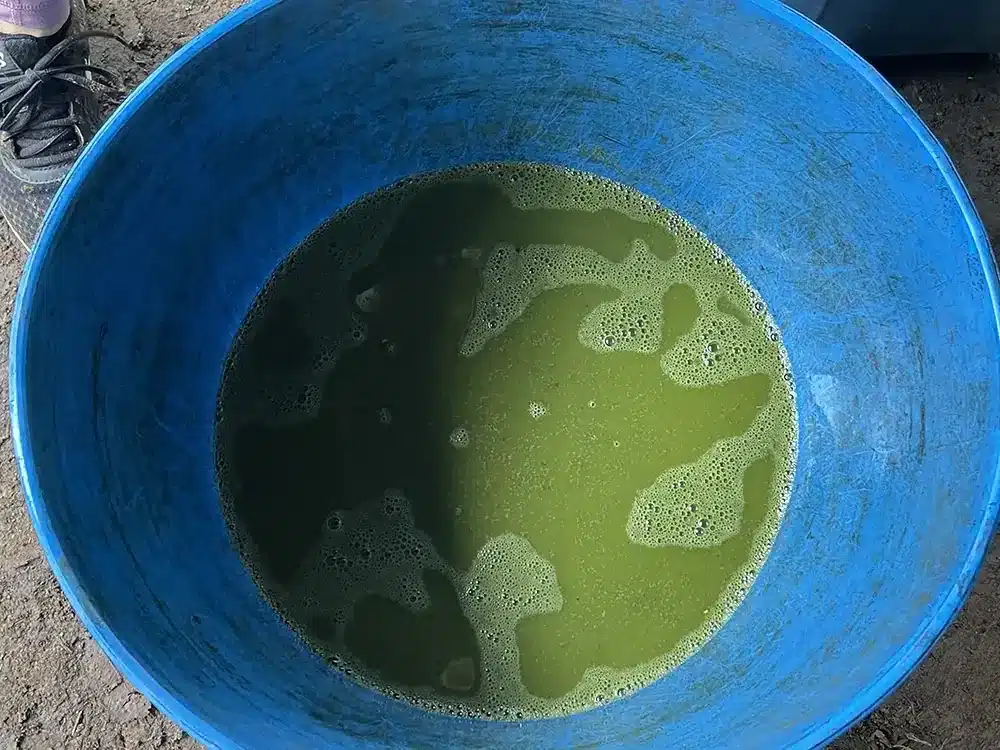
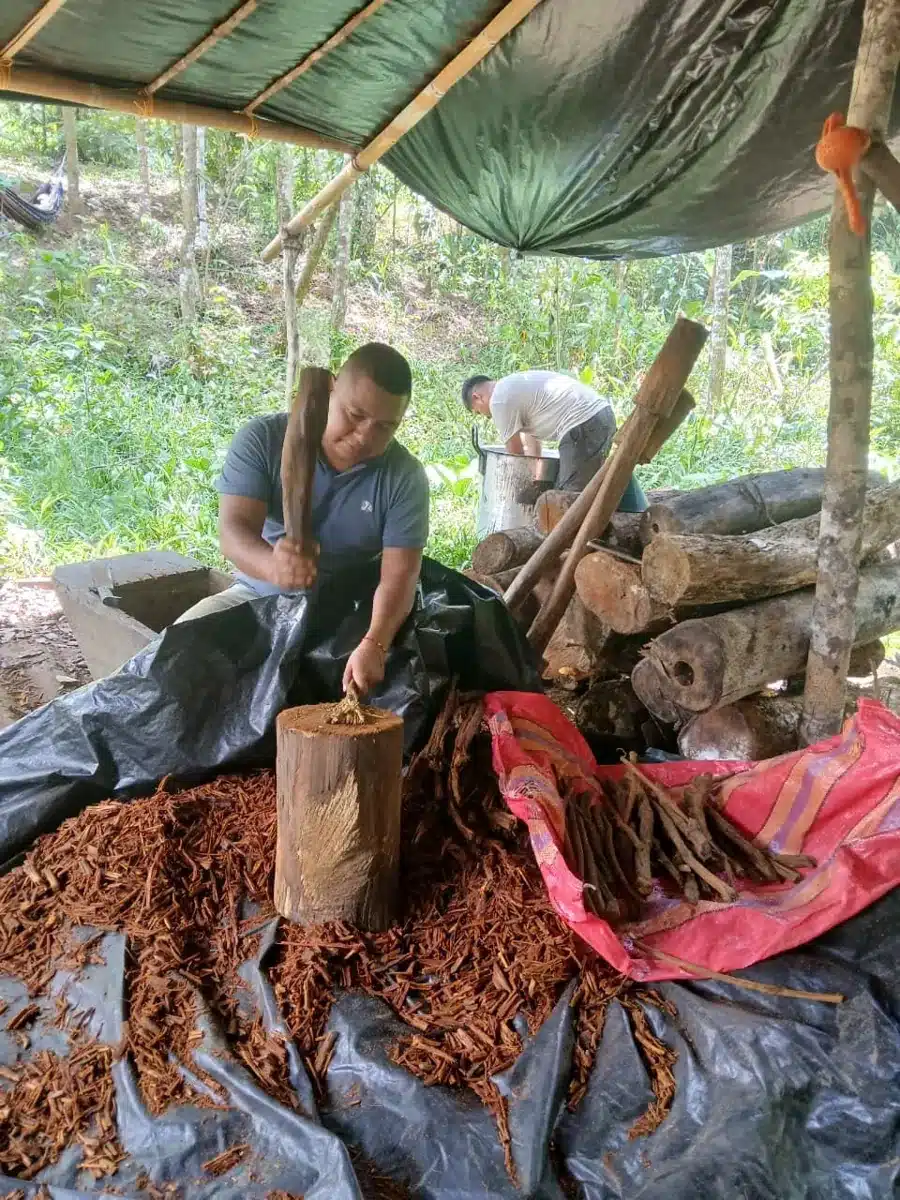
The following describes crudo as prepared by Taita Miguel Mavisoy of the Camsá lineage in the Putumayo. The method uses no fire and is markedly labour-intensive. Fresh yagé (Banisteriopsis caapi) vine and chagra (Diplopterys cabrerana) leaves are cultivated and gathered. The vine is washed and its outer bark is removed; it is then chopped into small pieces and pounded by hand in a wooden mortar — a stage that can take many hours of physical work, considerably more than a cooked preparation requires. The pounded vine is set aside while the chagra leaves are mashed separately with a little water until they are reduced to a fine, moist pulp. The vine and chagra are then combined, covered with water, and left to steep for approximately eight to twelve hours. The next day the softened plant mass is squeezed and strained by hand, and the liquid pressed out is the finished medicine.
Crudo is best understood as one practice within the broader yagé tradition rather than a universal method: not all taitas prepare it, and it is used in particular contexts and by particular lineages.
Cultural and regional context
The Putumayo region — centered on the town of Mocoa and the Sibundoy Valley — is the heartland of the Colombian yagé tradition. The brew has been used for centuries by several indigenous peoples of the area, among them the Inga, Kamëntsá (Camsá), Cofán, Siona, and Coreguaje, whose ceremonial healers are known as taitas.[5][6] The yagé practices of the Sibundoy Valley peoples — including the long apprenticeship of the taita through successive yagé visions under senior guidance — are documented in depth in the ethnographic literature.[6][11] The Inga and Kamëntsá have shared the Sibundoy Valley for centuries and hold yagé at the center of their ceremonial and cultural life.[5]
In 1999 these same five peoples — Cofán, Inga, Siona, Coreguaje, and Kamëntsá — founded UMIYAC (Unión de Médicos Indígenas Yageceros de la Amazonía Colombiana, the Union of Indigenous Yagé Healers of the Colombian Amazon), formalized in the Yurayaco Declaration, to protect the yagé tradition, its practitioners, and the territories where the medicine grows.[8]
Legal and heritage status in Colombia
No Colombian statute specifically authorizes or prohibits yagé. Its ceremonial use is protected indirectly through the constitutional autonomy of indigenous peoples: Article 246 of the 1991 Constitution recognizes indigenous authorities' right to exercise their own justice and customary practices within their territories, which encompasses traditional medicine such as yagé.[7] Colombia has also moved to recognize the tradition's cultural value; the knowledge associated with yagé-using shamanic cultures of the Colombian Amazon ("Yuruparí") has been treated as intangible cultural heritage at the national level and by UNESCO.[7]
See also
Ayahuasca vs Yagé · The Kamëntsá (Camsá) yagé lineage · The Kamëntsá (Camsá) people · Legal status of ayahuasca in Colombia · Yagé and the medicine of the Putumayo · Banisteriopsis caapi (the vine)
References
- Brito-da-Costa, A. M., et al. (2020). "Toxic Effects of Ayahuasca... Decoction: Analytical Methods, Pharmacology." Pharmaceuticals. PMC8880227. link
- "The pharmacological interaction of compounds in ayahuasca: a systematic review." (2021). PMC7678905. link
- "Ayahuasca." Wikipedia. link
- "Banisteriopsis caapi, Psychotria viridis and Diplopterys cabrerana." Microcosms Sacred Plants. link
- "Kamëntšá people." Wikipedia. link
- Taussig, M. (1987). Shamanism, Colonialism, and the Wild Man: A Study in Terror and Healing. University of Chicago Press.
- Labate, B. C. "Legal Status of Ayahuasca (Yagé) in Colombia: Considerations from Three Primary Sources." link
- "The Yurayaco Declaration of UMIYAC (Unión de Médicos Indígenas Yageceros de la Amazonía Colombiana)." Ayahuasca.com. link
- dos Santos, R. G. (ed.). The Ethnopharmacology of Ayahuasca. ICEERS / Transworld Research Network. link
- Brierley, D. I., & Davidson, C. (2020). "Toxicokinetics... DMT, Harmine, Harmaline and Tetrahydroharmine." PMC7690791. link
- Ramírez de Jara, M. C., & Pinzón Castaño, C. E. (1992). "Sibundoy Shamanism and Popular Culture in Colombia." In E. J. M. Langdon & G. Baer (eds.), Portals of Power: Shamanism in South America (pp. 287–303). University of New Mexico Press. link
- "Diplopterys cabrerana." Wikipedia (alkaloid / DMT content). link