
Banisteriopsis caapi: the Vine at the Base of Yagé and Ayahuasca
The Amazonian liana whose β-carboline alkaloids make the brew orally active.
Banisteriopsis caapi is a perennial Amazonian vine of the family Malpighiaceae and the foundation of the brew known as yagé in Colombia and ayahuasca across much of the western Amazon. The vine carries β-carboline (harmala) alkaloids that inhibit the enzyme monoamine oxidase; this is what allows the DMT contributed by a second, admixture plant to become orally active. Native to the rainforests of Colombia, Ecuador, Peru, and Brazil, it is often called simply caapi or the "vine of the soul."[1]
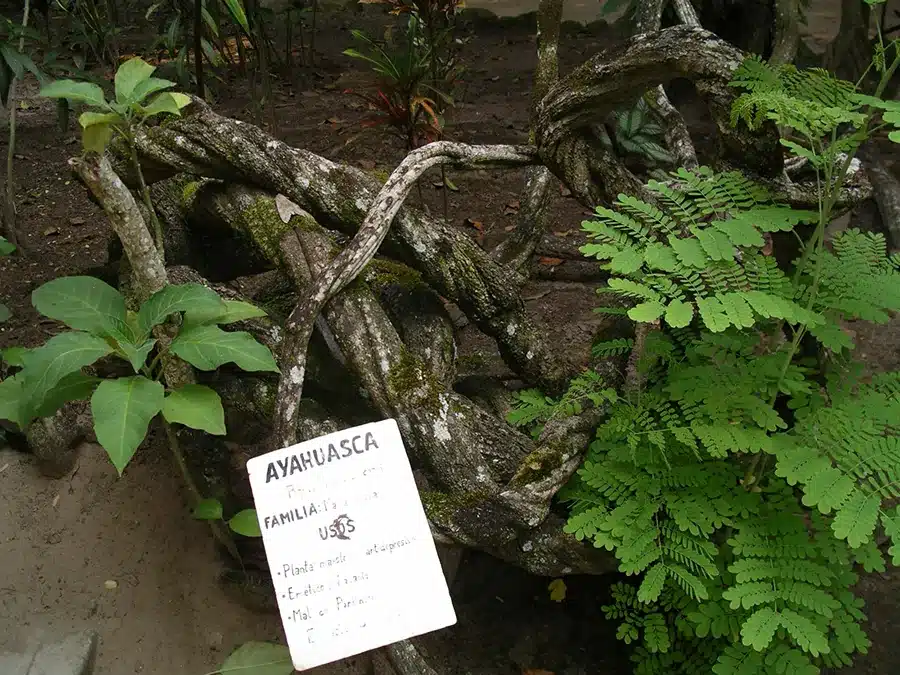
Botany and range
Banisteriopsis caapi is a large, woody, twining liana of the Malpighiaceae family, native to the Amazon basin of Colombia, Ecuador, Peru, and Brazil.[1][4] It climbs high into the forest canopy and is recognised by the characteristic knots or nodes along its stems. The vine is the constant, defining ingredient of yagé and ayahuasca; the brew is always built on caapi, to which a DMT-bearing plant is added.[1]
Alkaloids and pharmacology
The active constituents of B. caapi are β-carboline alkaloids — chiefly harmine, harmaline, and tetrahydroharmine (THH) — present together at roughly 0.05 to 1.95 percent of the vine's dry weight, with wide natural variation between plants.[2] Harmine and harmaline are reversible inhibitors of monoamine oxidase-A (MAO-A). By temporarily suppressing the gut enzymes that would otherwise break down N,N-dimethyltryptamine (DMT), they render the DMT from the admixture plant orally active; tetrahydroharmine additionally acts as a mild serotonin reuptake inhibitor.[1][2] Beyond their role in the brew, these same β-carbolines have drawn scientific interest in their own right: in laboratory studies the caapi alkaloids have been found to stimulate adult neurogenesis in vitro.[3]
Varieties and cultivars
Cultivators and traditional users recognise a number of forms of the vine, distinguished by stem characteristics and colour. Two botanically described varieties are caupuri, noted for pronounced knots along the stem, and tucunacá.[1] Among cultivated strains, "cielo" (a yellow form often described as gentler) and "trueno" (a darker form said to be stronger) are widely known names in circulation, though such trade names are not formal botanical categories. Alkaloid content varies considerably with variety, growing conditions, and whether a plant is wild or cultivated.[2]
Cultivation and harvesting
Much of the caapi used in ceremony is cultivated by the healers and communities who work with it, rather than gathered from the wild.[1] Studies of alkaloid profiles have found that wild vines can carry higher concentrations of harmine than cultivated ones, and that content differs by region, underscoring how variable the plant is.[2] Mature vines are cut into sections for preparation; because the active compounds are concentrated in the woody stem, it is the stem, rather than the leaves, that is used.
Preparation
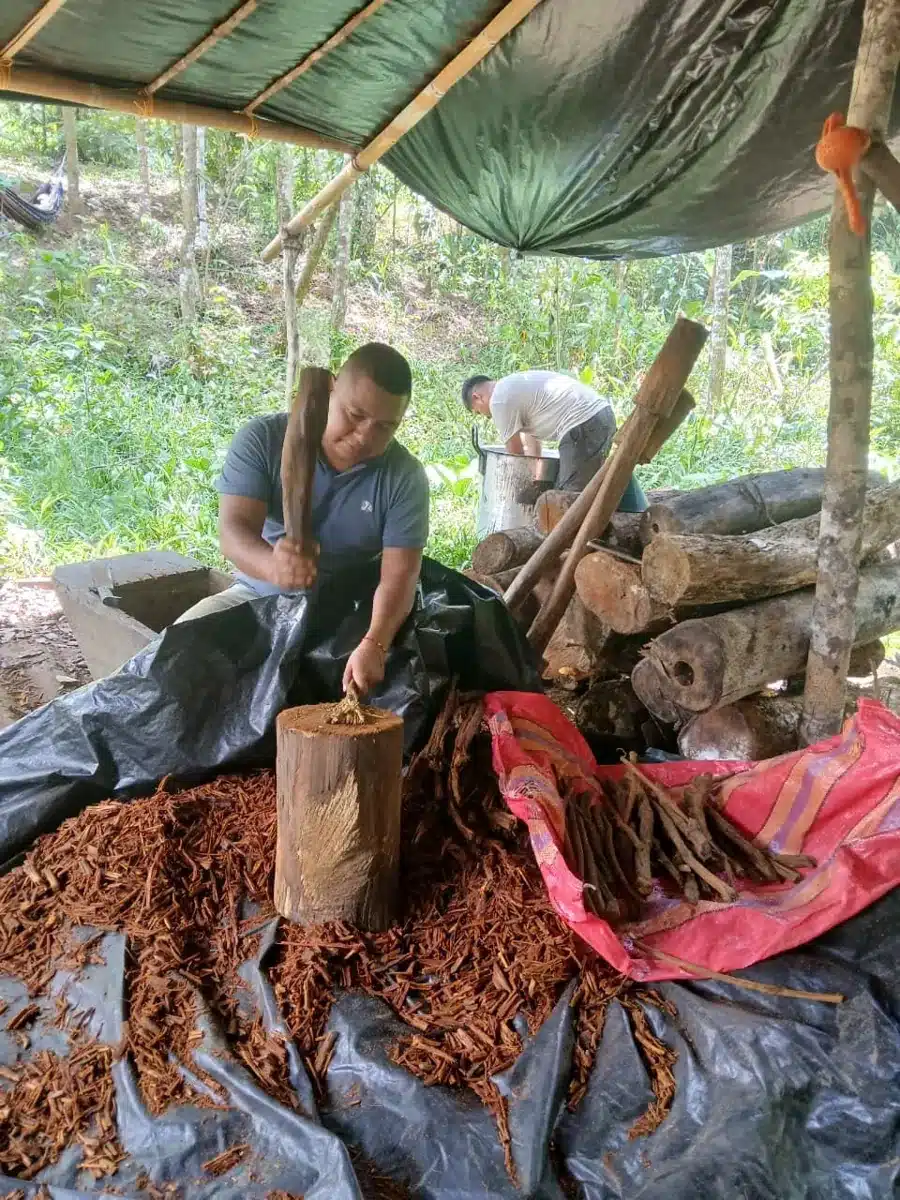
Across the Amazon the first step in preparing the vine is the same: the stem is cleaned and then pounded — traditionally with a wooden or stone mallet — until it breaks down into soft, fibrous strands, exposing far more surface area for extraction.[5] From this point the methods diverge. In the most widespread method the pounded vine is combined with a DMT-bearing admixture and simmered for many hours into a concentrated decoction. In parts of the Colombian Putumayo the vine is instead steeped in cold water without fire to make crudo, a fresh cold-brew preparation. The admixture plant differs by region as well: in Colombia it is characteristically Diplopterys cabrerana (chagra), whereas Psychotria viridis (chacruna) predominates in Peru and Brazil.[1]
Cultural significance
For the indigenous peoples of the western Amazon, B. caapi is not merely a pharmacological ingredient but a teacher and a being in its own right; this is reflected in names such as the "vine of the soul." In the Colombian Putumayo the vine is central to the yagé tradition carried by peoples such as the Kamëntsá and Inga, whose healers cultivate it and prepare it within long-established ceremonial frameworks.[1]
See also
Crudo (cold-brew yagé) · The Kamëntsá (Camsá) people · Ayahuasca vs Yagé
References
- "Banisteriopsis caapi." Wikipedia. link
- "Biodiversity of β-Carboline Profile of Banisteriopsis caapi and Ayahuasca, a Plant and a Brew with Neuropharmacological Potential." PMC7411993. link
- Morales-García, J. A., et al. (2017). "The alkaloids of Banisteriopsis caapi... stimulate adult neurogenesis in vitro." Scientific Reports. PMC5509699. link
- "Banisteriopsis caapi." Tropical Plants Database, National Tropical Botanical Garden (NTBG). link
- "Ayahuasca as a Decoction Applied to Human: Analytical Methods, Pharmacology and Potential Toxic Effects." PMC8880227. link