
Ayahuasca and Bipolar Disorder: An Honest Look at Risk, Safety, and the Path Forward
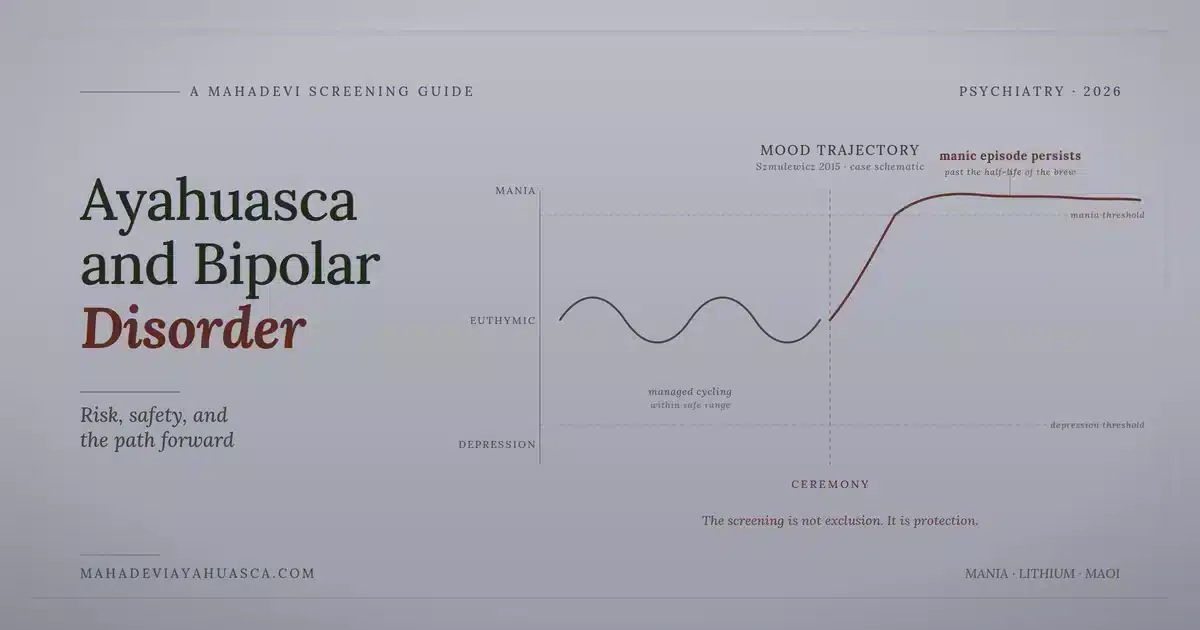
For most people with bipolar I or bipolar II, ayahuasca is not safe to take in ceremony. Documented case evidence describes ayahuasca triggering manic episodes with psychotic features in people with bipolar disorder (Szmulewicz et al., 2015), and the systematic review literature explicitly recommends against ayahuasca use for individuals with bipolar disorder with manic history (dos Santos et al., 2017). Ayahuasca’s MAO-inhibiting compounds also interact dangerously with several psychiatric medications, including lithium and serotonergic antidepressants (Malcolm & Lee, 2018). Reputable retreats screen for bipolar disorder and typically decline applicants who carry the diagnosis. The screening is not exclusion. It is protection.
| Bipolar context | Ceremony recommendation | Why |
|---|---|---|
| Bipolar I, with prior manic or psychotic episodes | Do not drink | Documented manic-switch and psychosis risk; explicit contraindication in published literature |
| Bipolar II, with hypomanic history | Do not drink without sustained stability and full psychiatric review | The MAOI mechanism can precipitate mood elevation in predisposed individuals |
| Cyclothymic disorder | Approach only with extreme caution and full clinical review | Mood instability is a known risk factor; data is limited |
| On any mood stabilizer or antidepressant | Do not drink without supervised medical washout | Serotonin syndrome and additional pharmacological interactions documented |
| Family history of bipolar but no personal diagnosis | Disclose fully; proceed only with thorough screening | Family history is a recognized risk factor in case-report literature |
If you have bipolar disorder and you are reading this because the medicine is calling you, you are not the first. The longing to sit with ayahuasca is real, and the diagnosis does not make it less real. What follows is the honest version of why a careful answer matters. Ceremonial ayahuasca, in the bodies and minds for which it was intended, is medicine. In a brain wired for cyclical mood instability, the same compounds that loosen rigid patterns can also loosen the regulation that keeps a mood from sliding into mania or psychosis. The sections below walk through the mechanism, the documented risks, the medication interactions, what responsible retreats actually screen for, and the sacred pathways that remain available for seekers in this position.
This article is for educational purposes only. It is not medical advice, a treatment recommendation, or a substitute for psychiatric care. Decisions about bipolar disorder treatment require a qualified mental health professional. Decisions about whether ayahuasca is medically safe for you require a prescriber familiar with your psychiatric medications, mood history, and family history. The information below reflects published research and clinical consensus and does not replace either.
Ayahuasca and Bipolar Disorder: Why They Rarely Belong Together
Screening is not gatekeeping. It is the medicine taking care of the seeker.
The ayahuasca tradition has always operated through screening. In Shipibo and other Amazonian lineages, the curandero or onanya assesses each participant before ceremony, and not every person who arrives drinks every night. The contemporary harm-reduction literature has codified what the lineages already practiced: certain conditions are absolute contraindications, and bipolar disorder with a history of mania is among them (dos Santos et al., 2017).
The reason is structural. Bipolar disorder is, at its biological core, a vulnerability to extreme mood states. The brain’s regulatory mechanisms can shift abruptly into mania, hypomania, or depressive episodes, sometimes triggered by external factors and sometimes seemingly without cause. Ayahuasca acts on the same neurochemical systems that bipolar treatment is designed to stabilize. The medicine that softens rigid patterns in a stable nervous system can dysregulate one already prone to instability.
This is why the right answer for most people with bipolar is not “drink with extra caution.” The right answer is: the ceremony, in this body, in this season, is not the path. There may be a different path, and the rest of this piece maps it. The “no” is care, not rejection.
What Ayahuasca Does in the Brain, and Why That Matters for Bipolar
Two plants. One enzyme paused. A cascade the bipolar brain is uniquely vulnerable to.
The brew is built from two plants. Banisteriopsis caapi, the vine, carries the β-carbolines harmine, harmaline, and tetrahydroharmine. Psychotria viridis, the leaf, carries N,N-dimethyltryptamine, or DMT. Drunk together, the β-carbolines reversibly inhibit monoamine oxidase A in the gut and liver, which allows oral DMT to reach the brain, where it activates serotonin 5-HT1A, 5-HT2A, and 5-HT2C receptors and triggers downstream neuroplastic effects (Egger et al., 2024). For a fuller account of the brew, the lineages, and the chemistry, see our complete ayahuasca guide.
That is the standard description. Here is what it means for bipolar specifically.
MAO-A is one of the body’s primary tools for breaking down serotonin, dopamine, and norepinephrine. When MAO-A is paused, all three monoamines accumulate. The 5-HT2A receptor activation that creates the visionary state in healthy users is the same kind of receptor activity implicated in psychotic experience. The dopaminergic and serotonergic systems modulated by ayahuasca are the same systems whose dysregulation underlies bipolar mood episodes (Rossi et al., 2022).
For a stable nervous system, this cascade produces what the published literature documents: rapid antidepressant effects, increased neuroplasticity, default mode network modulation, somatic release. For a brain wired for bipolar mood cycling, the same cascade can push the system across a threshold the regulation was not equipped to hold. The mechanism that helps unipolar depression is the same mechanism that can precipitate mania in someone with bipolar I.
This is not a minor risk profile difference. It is the central reason ayahuasca’s promising signals in depression research do not translate to bipolar populations.
The Documented Risks: Mania, Psychosis, and Serotonin Syndrome
The case literature is small but specific. The pattern it describes is consistent.
The most-cited published account of mania following ayahuasca involves a 30-year-old man who developed a full manic episode with psychotic features within two days of completing a four-day ayahuasca ritual in Brazil. He met DSM-5 criteria for bipolar I, with the manic episode persisting beyond the half-life of β-carbolines. The clinical authors concluded that ayahuasca’s antidepressant MAOI properties can precipitate mania in predisposed individuals, and noted the patient’s prior hypomanic episode and family history of bipolar I as recognized vulnerability factors (Szmulewicz et al., 2015).
The systematic review literature on ayahuasca and psychosis estimates psychotic episodes as rare in supervised religious-use populations, with rates of approximately 0.0032 to 0.096 percent of União do Vegetal servings. Critically, the review notes that in most documented cases of ayahuasca-related psychosis, the affected individuals had a personal or family history of psychotic or manic disorders. The review’s recommendations are unambiguous: individuals with schizophrenia, schizophreniform disorder, psychotic mania, psychotic depression, or bipolar disorder with manic history should not use ayahuasca (dos Santos et al., 2017).
Serotonin syndrome is the third documented risk. The β-carbolines in ayahuasca are reversible MAO-A inhibitors, and combining them with serotonergic medications (SSRIs, SNRIs, tricyclics, trazodone, lithium, tramadol, St. John’s wort) can produce a clinical emergency presenting as autonomic instability, hyperthermia, severe hypertension, and seizures (Callaway & Grob, 1998). A documented serotonin syndrome case has been reported with fluoxetine and ayahuasca taken together (Ruffell et al., 2020). For washout windows by drug class, see our SSRI and MAOI interaction guide; for the broader psychosis literature, see ayahuasca and psychosis risk and ayahuasca and schizophrenia.
The largest global safety dataset, the Global Ayahuasca Survey of 10,836 participants from over fifty countries, found that pre-existing psychiatric diagnoses and non-supervised ceremonial contexts were the strongest predictors of adverse outcomes (Bouso et al., 2022).
Ayahuasca and Bipolar Medications: What Interacts and Why
Most adults living with bipolar disorder are on at least one medication, and many on two or more. The interaction landscape is not optional reading.
| Medication class | Examples | Interaction with ayahuasca | Risk severity |
|---|---|---|---|
| Lithium | Lithium carbonate | Listed as contraindicated in clinical pharmacology review of MAOI-related interactions; serotonergic activity contributes to serotonin syndrome risk | Severe |
| SSRIs | Sertraline, escitalopram, fluoxetine | Excess serotonin via reuptake blockade plus MAO-A inhibition; documented serotonin syndrome case reports | Severe |
| SNRIs | Venlafaxine, duloxetine | Same serotonergic plus noradrenergic mechanism | Severe |
| Tricyclics | Amitriptyline, nortriptyline | Serotonergic and noradrenergic activity plus cardiac conduction effects | Severe |
| Anticonvulsant mood stabilizers | Lamotrigine, valproate, carbamazepine | Direct ayahuasca-specific interaction data is limited; conservative practice treats abrupt withdrawal as a separate risk and avoids combination without supervised review | Caution; case-by-case |
| Atypical antipsychotics | Quetiapine, olanzapine, aripiprazole, risperidone | Direct ayahuasca-specific interaction data is limited; serotonin receptor activity overlaps with the medicine’s mechanism, raising theoretical concern | Caution; case-by-case |
| Benzodiazepines | Lorazepam, clonazepam | No major direct pharmacological interaction; do not stop without medical supervision because of withdrawal risk | Low for interaction; high for unsupervised discontinuation |
Two principles run through every row. First, never stop a prescribed psychiatric medication without your psychiatrist’s involvement. Abrupt discontinuation of mood stabilizers, antidepressants, or antipsychotics can itself precipitate mood episodes regardless of any ceremony involved. Second, the absence of direct interaction data for some medications (particularly the anticonvulsant mood stabilizers and atypical antipsychotics) is not evidence of safety. It reflects the limits of published research (Malcolm & Lee, 2018).
How Responsible Retreats Screen for Bipolar
A center that does not screen carefully for bipolar is not a center to trust with anything else.
The harm-reduction guidance commissioned by the Catalan Department of Health and developed with ICEERS lists psychiatric conditions as direct exclusion criteria for ayahuasca participation, alongside cardiovascular conditions, epilepsy, pregnancy, and active spiritual emergencies (ICEERS, 2019). The clinical screening protocols developed by the LEAPS research team at the University of São Paulo include systematic exclusion criteria designed specifically to reduce risk of psychiatric manifestations including manic and psychotic episodes (Rossi et al., 2023).
What a thorough pre-ceremony screening will ask:
- Have you ever been diagnosed with bipolar I, bipolar II, cyclothymic disorder, or any psychotic disorder?
- Have you ever experienced a manic, hypomanic, or psychotic episode, with or without diagnosis?
- Is there a family history of bipolar disorder, schizophrenia, or psychotic illness in first-degree relatives?
- What psychiatric medications are you currently taking? Doses, durations, prescriber.
- What antidepressants, mood stabilizers, or antipsychotics have you taken in the past two years?
- When was your most recent mood episode, and how long did it last?
- Are you currently in stable mental health treatment, and is your treatment team aware of this inquiry?
- Have you experienced any changes in sleep, energy, thought speed, or risk-taking in the past three months?
A retreat that conducts this screening seriously, asks for written disclosure, and is willing to decline applicants is operating ethically. A retreat that accepts every applicant who pays is not. The vetting process before booking is the most important window into how the retreat actually treats the medicine and the people who come to it (ICEERS, 2024).
The Sacred Path Forward for Seekers with Bipolar
The longing for the medicine is real. There are paths that honor it without the brew.
The call to plant medicine usually surfaces because something in the seeker is already moving. The longing is real, and a “not now” or “not this medicine” does not require abandoning the path. The Amazonian tradition itself recognizes this. In Peruvian-Amazonian practice, the dieta (the disciplined retreat with specific master plants, observing alimentary, sexual, and social restrictions) is more commonly practiced than ayahuasca alone in remote communities, and is often considered to go deeper than ayahuasca in its bodily and energetic restructuring effects (Berlowitz et al., 2022)(O’Shaughnessy & Berlowitz, 2021). The dieta does not require ayahuasca to be a real spiritual discipline.
For seekers with bipolar, several pathways carry the spirit of the work without the pharmacological risk:
- Sustained mood stability work. Establishing and maintaining stability for at least 12 to 24 months under psychiatric care, with a stable medication regimen, is not a delay tactic. It is the ground from which any future spiritual work, psychedelic or not, will be more sustainable. Stability is itself a sacred achievement for a bipolar nervous system.
- Trauma-informed psychotherapy alongside psychiatric care. Modalities such as Internal Family Systems, somatic experiencing, EMDR, and psychodynamic work can reach the same territory ayahuasca opens, on a slower timeline that the bipolar nervous system can metabolize. See our trauma-informed care framework for what that looks like in practice.
- Plant tradition study without the brew. The lineage of vegetalismo includes apprenticeship, dieta with master plants that are not psychoactive, breathwork, and the direct study of icaros and ceremonial practice. Many seekers find that learning the tradition is itself the entry into it.
- Breathwork and somatic practices. Holotropic breathwork, conscious connected breathing, qigong, and trauma-sensitive yoga can produce non-ordinary states without pharmacology. For some bipolar seekers these practices need their own caution and supervision, but they are options the brew is not.
- Integration-trained therapists who work with seekers without the ceremony. The peer-reviewed integration literature describes models like Psychedelic Harm Reduction and Integration that work with seekers regardless of whether a ceremony has occurred. The work of integration is available before any ceremony, and for seekers with bipolar this work may be the medicine itself (Gorman et al., 2021).
- Community and lineage relationship. Reading, study, attending non-ceremonial gatherings, building relationship with traditions and teachers: none of this requires drinking. The relationship to the medicine begins long before the cup, and it can be meaningful in itself.
None of these are consolation prizes. They are the path, walked at a pace that honors the seeker’s actual nervous system rather than overriding it.
When (If Ever) Ayahuasca Might Be Reconsidered: A Careful Framework
The framework below is not a green light. It is a description of the conditions under which the conversation could begin to be a different conversation.
For most people with bipolar I and bipolar II, the answer remains no even under the strictest possible conditions. The mechanism does not change because the seeker is patient. What can change, in some cases, is the risk profile, and a careful framework looks roughly like this:
- Sustained mood stability for at least 24 months without manic, hypomanic, or psychotic episodes
- Comprehensive evaluation by a psychiatrist who knows the case in depth and is informed about ayahuasca pharmacology
- Any medication taper, if considered, completed under careful psychiatric supervision over months, not weeks
- Documented confirmation that no current medication poses an interaction risk
- A trauma-informed integration therapist already engaged before any ceremony
- A retreat with rigorous screening, traceable lineage, low facilitator-to-participant ratio, and structured integration support before and after
- Honest, written disclosure of the full diagnosis and history to the retreat, never withheld
- Acceptance that even with all of the above, the answer from the retreat may still be no
This framework is not an invitation. It is a description of what the most careful version of yes might look like for a small subset of bipolar seekers, and even that careful yes is something that has to be worked toward over time rather than reached for in a single decision.
Feel deeply.
Show up fully.
Frequently Asked Questions
Can people with bipolar disorder do ayahuasca?
For most people with bipolar I or bipolar II, the published literature recommends against ayahuasca participation. Documented case evidence describes manic episodes with psychotic features in people with bipolar disorder following ceremonial use, and systematic review guidance explicitly contraindicates ayahuasca for individuals with bipolar disorder with manic history. Reputable retreats screen for the diagnosis and typically decline applicants who carry it.
Can ayahuasca trigger mania?
Yes. A peer-reviewed case report documents a manic episode with psychotic features developing within two days of a four-day ayahuasca ritual in a man with previously undiagnosed bipolar I disorder. The clinical authors attributed the switch to ayahuasca’s MAO-inhibiting properties acting on a predisposed nervous system. The risk is highest in those with personal or family history of mood or psychotic disorders.
Can ayahuasca cure bipolar disorder?
No. There is no clinical evidence that ayahuasca treats or cures bipolar disorder, and any source claiming otherwise is misrepresenting the research. Bipolar disorder is a chronic condition that requires sustained psychiatric care. Ayahuasca’s mechanism of action is, if anything, more likely to destabilize mood in bipolar populations than to regulate it.
Is microdosing ayahuasca safe for someone with bipolar?
Microdosing ayahuasca has been studied very little in any population, and not at all in bipolar populations specifically. The pharmacological mechanism (MAO-A inhibition plus serotonergic activation) is the same at sub-perceptual doses as at ceremonial doses, which means the same theoretical risks for mood destabilization apply. The honest answer is that there is no published evidence base supporting safety in bipolar, and the conservative position is to avoid it.
Can someone with bipolar attend any part of an ayahuasca retreat?
Some seekers with bipolar attend retreats as supporters, observers, or in non-ceremonial roles where this is offered, focusing on the dieta, the community, the teachings, and the integration practices without drinking the brew. Whether this is available depends on the specific center. The discovery call is where to ask. A center that operates with integrity will be transparent about what is and is not appropriate for bipolar participants.
What happens if someone with bipolar drinks ayahuasca without disclosing the diagnosis?
The risks include manic switch with or without psychotic features, prolonged mood destabilization, serotonin syndrome if undisclosed medications are present, and adverse outcomes that the facilitator team is not prepared to manage because the relevant history was withheld. Non-disclosure does not protect the seeker. It removes the protective layer the screening was designed to provide.
How long do ayahuasca’s effects last, and does that matter for bipolar?
The acute ceremonial experience lasts approximately four to six hours, but the documented mania-switch case in the published literature involved a manic episode that emerged after the β-carboline half-life had passed, persisting beyond the pharmacological window. Mood destabilization in bipolar populations can outlast the acute experience by days, weeks, or longer, which is one reason why screening rather than dose-timing is the protective measure.
Are there alternatives to ayahuasca for spiritual healing with bipolar?
Yes, and many of them are part of the same Amazonian tradition. The dieta with non-psychoactive master plants is more commonly practiced than ayahuasca alone in remote Amazonian communities and is often considered to go deeper than the brew alone. Trauma-informed psychotherapy, breathwork, somatic practices, integration coaching, plant tradition study, and sustained mood-stability work are all real paths. The longing for the medicine is real, and there are ways to honor it that do not require putting a vulnerable nervous system at risk.
Can ayahuasca cause psychosis in someone without a prior diagnosis?
Documented psychotic episodes following ayahuasca are rare in supervised religious-use populations, with rates around 0.0032 to 0.096 percent of servings in long-term cohort data. In most documented cases, however, affected individuals had personal or family histories of psychotic or manic disorders that may have been unrecognized at the time. Family history matters, and screening that asks about it matters.
Should I tell my psychiatrist I am considering ayahuasca?
Yes. Even if your psychiatrist is unfamiliar with ayahuasca, the conversation matters. Hidden inquiries lead to hidden risks, and any medication review or future-readiness planning needs to involve the clinician who knows your case. If your current psychiatrist cannot engage without judgment, finding a clinician who can hold the conversation is itself part of the careful work, rather than going underground with the question.
Conclusion
The “no” in this article is not the closing of a door. It is the acknowledgment that the medicine and the body have to meet at the right time, in the right preparation, with the right protections in place. For most seekers with bipolar disorder, those conditions are not currently aligned.
The published evidence is small but consistent. The mechanism is plausible and explains the case literature. The retreats that take this seriously screen carefully because they care about the seeker, not because they are turning anyone away. The path forward exists, and it is real, and for many it goes deeper than the brew alone would have.
Honor the body. Honor the diagnosis. Honor the longing.
The medicine is wild. The seeker is sacred. The boundary is the love.
