
Ayahuasca and Psychosis: What the Research Actually Shows About Risk, Symptoms, and Recovery
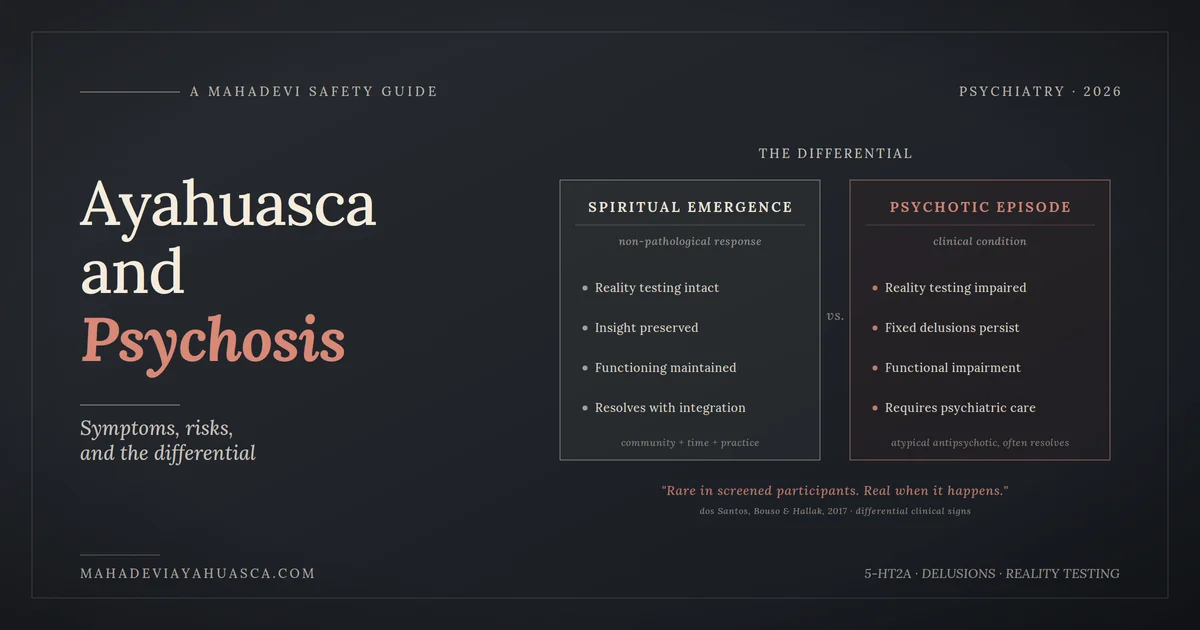
Ayahuasca-induced psychosis is the onset of psychotic symptoms (hallucinations that persist past the acute experience, fixed delusions, paranoia, or disorganized thinking) triggered by drinking ayahuasca, the Amazonian brew that contains the psychedelic compound DMT. Across the existing case literature, these episodes are rare in healthy, properly screened participants (dos Santos, Bouso, & Hallak, 2017). They are substantially more common in people with a personal or family history of schizophrenia, bipolar disorder with psychotic features, or other psychotic illness. Most reported cases respond well to standard psychiatric treatment with atypical antipsychotics. A smaller number become persistent and require longer-term care. Anyone experiencing hallucinations, delusions, or loss of contact with reality that continues beyond the night of ceremony should be evaluated by a psychiatrist promptly.
| Topic | Quick Answer |
|---|---|
| Estimated risk in screened populations | 0.0032% to 0.096% of UDV servings (roughly 3 in 100,000 to 1 in 1,000) (dos Santos et al., 2017) |
| Strongest predictor of risk | Personal or family history of schizophrenia, schizoaffective disorder, or bipolar I with psychotic features |
| Acute experience vs psychosis | Visions during ceremony resolve and reality testing returns; psychosis persists in a sober state with lost insight |
| Treatment | Atypical antipsychotics; most documented cases respond well when treatment is sought promptly (dos Santos et al., 2017) |
| Critical contraindications | Personal or family history of psychotic-spectrum illness or bipolar I; SSRIs, SNRIs, MAOIs, lithium; severe dissociative disorder |
| When to seek psychiatric help | Hallucinations, fixed delusions, severe paranoia, or disorganized thinking continuing in a sober state past the night of ceremony |
Psychosis is the most serious psychiatric adverse outcome documented in the ayahuasca literature, and also one of the most preventable. The relationship between the brew and psychotic illness is concrete, pharmacologically grounded, and largely identifiable in advance through proper screening. What follows below is the published evidence on incidence, the risk factors that matter, the symptom set to watch for, the difference between psychosis and what transpersonal psychiatry calls spiritual emergence, and what to do if it happens to you or someone you love.
This article is for educational purposes only. It is not medical advice, a treatment recommendation, or a substitute for psychiatric care. Decisions about psychotic illness, bipolar disorder, or any psychiatric condition require a qualified mental health professional. Decisions about whether ayahuasca is medically safe for you require a prescriber familiar with your psychiatric medications, family psychiatric history, and personal mental health history. The information below reflects published research and clinical consensus and does not replace either.
A Brief Note on What Ayahuasca Is
The vine, the leaf, the brew, and the brain it meets.
This article is written for readers who already have a working sense of what ayahuasca is. If you do not, or if you want the full picture of the brew, the lineages that hold it, the pharmacology, the legal status, and what a real ceremony involves, the most complete reference on the open web is MahaDevi’s complete ayahuasca guide. What follows here assumes the basics and goes deep on a single question: what is the relationship between ayahuasca and psychosis?
In one paragraph: ayahuasca is a brew prepared from the Banisteriopsis caapi vine combined with a DMT-containing plant, most commonly Psychotria viridis in Peru and Brazil or Diplopterys cabrerana in Colombia and Ecuador. The vine contributes beta-carboline alkaloids (harmine, harmaline, and tetrahydroharmine) that inhibit the enzyme MAO-A long enough for orally ingested DMT to survive digestion and reach the brain. Once there, DMT acts primarily on serotonin 5-HT2A receptors, producing the visionary, somatic, and emotional effects ayahuasca is known for. Ceremonies typically last four to six hours and are traditionally led by trained indigenous healers (Egger et al., 2024)(Brito-da-Costa et al., 2020).
That is the engine. The question this article addresses is what happens when that engine is run in a brain that, for reasons the person may not even know, is vulnerable to psychotic illness.
Ayahuasca and Psychosis: What the Term Actually Means
Visions inside ceremony are not psychosis. Symptoms that don’t end with the night are.
Psychosis is a clinical term, not a colloquial one. The National Institute of Mental Health defines it as a condition in which a person loses some contact with reality, typically through hallucinations (perceiving things that are not there) or delusions (holding fixed beliefs that are not true and not amenable to correction by evidence). Psychosis is a symptom rather than a disease in itself, and it can appear as part of schizophrenia, bipolar disorder, severe depression, certain neurological conditions, or substance use (NIMH, 2023).
The acute ayahuasca experience produces visions, altered perception, and shifts in sense of self that can superficially resemble psychotic symptoms. The crucial difference is duration and reality testing. During ceremony, the participant generally retains the awareness that they have drunk a powerful psychoactive substance and that what they are experiencing is bound to that context. The visions resolve. Reality testing returns. This is not psychosis. It is the expected pharmacological action of the medicine.
Ayahuasca-induced psychosis refers to something else: the appearance of psychotic symptoms that persist beyond the acute pharmacological window, that are not understood by the person as drug-related, and that produce functional impairment. The systematic review by dos Santos, Bouso, and Hallak (2017), the most comprehensive published examination of this question, distinguishes between transient psychotic-like phenomena during the acute experience (which are common and not pathological) and true psychotic episodes that emerge during or after ceremony and require psychiatric intervention (which are rare but real) (dos Santos, Bouso, & Hallak, 2017).
Crucially, the same review documented that case-study patients who developed psychotic crises after ayahuasca responded well to treatment with atypical antipsychotics. That is important context. Ayahuasca-induced psychosis, in most documented cases, is a treatable condition when it is recognized early and managed properly.
How Common Is It?
The base rate is low. The data are limited. The honest range is wide.
This is where intellectual honesty matters more than marketing instinct. The honest answer is that the base rate is low, the data are limited, and the range of estimates is wide.
The most frequently cited figure comes from the União do Vegetal, the Brazilian ayahuasca church, where psychotic episodes have been estimated at somewhere between 0.0032% and 0.096% of servings (dos Santos, Bouso, & Hallak, 2017). To put that in perspective: between roughly three in 100,000 and one in 1,000 ceremonies. The wide range reflects the difficulty of measurement. Psychotic events are not always reported, not always attributed to ayahuasca, and not always detected by retreat operators who may not see the participant again.
Two pieces of context matter for interpreting that number.
First, the UDV population is not the general population. Members are screened, ceremonies are held within a structured religious context with experienced leadership, and many participants drink regularly over years rather than once at an unfamiliar retreat. Risk in less controlled settings, including weekend retreats run by lightly trained facilitators, ceremonies attended by people with undisclosed psychiatric history, and single high-dose experiences without preparation, is plausibly higher, though it has not been systematically measured.
Second, baseline psychosis rates in the general population are not zero. The lifetime prevalence of schizophrenia spectrum disorders is roughly 1.2% of U.S. adults (Treatment Advocacy Center, citing RTI International), and the typical age of first psychotic episode is the late teens through early thirties, exactly the age range when many people are also seeking out ayahuasca for personal growth (NIMH, 2024). Some episodes that appear after ceremony would have happened anyway. The medicine is the trigger in some cases, the timing coincidence in others, and the catalyst that brings forward a vulnerability that was already loaded in still others. These three categories are not always cleanly separable in case reports.
What can be said clearly: psychotic episodes after ayahuasca are uncommon in healthy, screened participants. They are substantially more common in people with personal or family histories of psychotic illness. And the difference between “rare” and “rare but devastating when it happens to you” is a real difference that screening exists to manage.
Symptoms and Early Warning Signs
The signs that warrant clinical attention are different in character from a hard ceremony.
The clinical presentation of ayahuasca-induced psychosis tracks the broader symptom set for psychotic disorders, which is helpful because it means general psychiatric screening tools and clinical knowledge apply directly. The NIMH and Cleveland Clinic both describe the core symptoms of psychosis as falling into a few overlapping categories.
Hallucinations are sensory experiences without a corresponding external stimulus. They can be visual (seeing things others do not), auditory (hearing voices, often commenting or commanding), tactile (sensations on the skin), olfactory, or gustatory. After ayahuasca, the relevant sign is not whether visual phenomena occurred during the ceremony, since those are expected, but whether they continue, in a sober state, days or weeks later, in a way the person cannot voluntarily dismiss.
Delusions are fixed false beliefs held with strong conviction despite clear contradicting evidence. After ayahuasca, the most common forms reported in the case literature involve grandiose delusions (believing oneself to have a special mission, divine identity, or unique cosmic role), persecutory delusions (believing one is being watched, followed, or targeted by malevolent forces), and what clinicians call delusions of reference (believing that ordinary events, such as songs on the radio, strangers’ comments, or news stories, contain personal messages directed at the person specifically).
Disorganized thinking appears in speech and behavior. Sentences trail off without resolution. Thoughts jump in ways the person cannot reconnect. Plans become impossible to follow through on. This is harder for the person experiencing it to detect than it is for those around them.
Negative symptoms include flattened emotional expression, reduced motivation, social withdrawal, and decline in self-care.
There is also a particular cluster of warning signs in the ayahuasca context worth flagging directly. The first night after ceremony, someone may struggle to sleep, ruminate intensely on the experience, feel emotionally raw, or have moments of confusion. This is normal and usually resolves within hours to a day or two. The signs that warrant clinical attention are different in character: persistent inability to distinguish what was a ceremony experience from current reality; ongoing belief that one has been given a specific mission that requires immediate dramatic action; voices that continue speaking days after the ceremony; conviction that one has powers, identities, or knowledge that one did not have before, held with no openness to doubt. Any of these in the days or weeks following ceremony is a clinical signal, not a spiritual one.
Who Is Most at Risk?
Risk is not evenly distributed. Most of it is identifiable in advance.
This is the most actionable section of any honest writing on this topic. The risk of psychotic reaction to ayahuasca is not evenly distributed across the population. Some people are demonstrably more vulnerable, and the factors that make them so are largely identifiable in advance through proper screening.
The table below summarizes the risk factors documented in the clinical literature on hallucinogen-induced psychosis and on ayahuasca specifically (dos Santos, Bouso, & Hallak, 2017)(ICEERS, 2024)(Rossi et al., 2023).
Risk-Factor Screening Table
| Risk factor | Why it matters | Recommended action |
|---|---|---|
| Personal history of any psychotic episode | Past episodes substantially increase the risk that a hallucinogen will trigger another | Strongly contraindicated; do not participate |
| Family history of schizophrenia or schizoaffective disorder in a first-degree relative | Genetic loading raises baseline risk; psychedelics may unmask latent vulnerability | Strongly contraindicated; do not participate |
| Family history of bipolar disorder with psychotic features | Same mechanism; mania and psychosis share genetic risk substrate | Strongly contraindicated; do not participate |
| Personal history of bipolar disorder | Risk of triggering mania or mixed psychotic state | Strongly contraindicated; do not participate |
| Currently on SSRIs, SNRIs, MAOIs, lithium, or other serotonergic medications | Risk of serotonin syndrome via MAOI interaction; medication discontinuation also carries psychiatric risk | Do not participate without supervised medical taper and clearance |
| History of severe dissociative symptoms or dissociative disorder | Ceremony can deepen dissociation in ways that are difficult to reverse | Avoid; consult a psychiatrist familiar with non-ordinary states |
| Recent significant trauma or extreme sleep deprivation | Acute stress and sleep loss are themselves risk factors for transient psychosis | Postpone ceremony until baseline is restored |
| Age under 25 with no other risk factors | Brain still completing developmental maturation; first psychotic episodes most often emerge in this window | Proceed only with rigorous screening and reduced dose |
| Heavy cannabis use, especially of high-THC products | Cannabis use is independently associated with psychotic episodes; combination effects are poorly understood | Reduce or eliminate cannabis use well before ceremony; disclose to facilitator |
The screening test that matters here is not a checklist completed for the retreat operator’s records. It is an honest internal accounting, ideally with input from someone who knows your psychiatric and family history. People sometimes minimize family history because they did not personally experience a relative’s illness, or because the relative was never formally diagnosed but “had episodes” or “was institutionalized for a while.” That is the family history that matters. A grandparent who was hospitalized for a “breakdown” in an era when no one named what was happening is still relevant data. Disclose it.
Any retreat that does not ask in detail about your psychiatric history, your medications, and your family history of mental illness is failing the most basic standard of care (Rossi et al., 2023)(ICEERS, 2019). MahaDevi’s Medical Considerations page outlines the specific contraindications used in their screening process, which is reasonable to compare against any program you are considering.
The Pharmacological Mechanism
The medicine doesn’t write the script. It hands the pen to a brain already loaded for it.
How does ayahuasca trigger psychosis in vulnerable people? The honest answer is that the exact mechanism is not fully resolved. There are, however, several well-supported pieces of the picture.
DMT acts primarily as an agonist at serotonin 5-HT2A receptors, with additional activity at 5-HT1A, 5-HT2C, and sigma-1 receptors (Egger et al., 2024). The 5-HT2A receptor is also the main pharmacological target of LSD and psilocybin, and it has been implicated in the neurobiology of schizophrenia for decades. This is not a coincidence. Some atypical antipsychotic medications work in part by blocking 5-HT2A receptors, which is one reason they can be effective in treating ayahuasca-induced psychosis when it occurs (dos Santos, Bouso, & Hallak, 2017).
The ayahuasca brew is unusual among psychedelics because of its MAO-inhibition profile. The vine’s beta-carbolines reversibly inhibit MAO-A, the enzyme that breaks down serotonin, dopamine, norepinephrine, and dietary tyramine. This is what allows oral DMT to reach the brain. It also means that for several hours after drinking, the participant’s monoaminergic system is operating under unusual conditions. Combined with serotonergic medications, this can produce serotonin syndrome, a medical emergency distinct from psychosis but sometimes confused with it (Callaway & Grob, 1998)(Ruffell et al., 2020)(Malcolm & Lee, 2018). For washout windows by drug class, see our SSRI and MAOI interaction guide.
The leading hypothesis for why some people experience persistent psychotic symptoms after ayahuasca is that the medicine does not create the disease de novo but rather unmasks or accelerates an underlying vulnerability that was already present. This is consistent with the consistent finding across case reports that affected individuals very often have a personal or family psychiatric history (dos Santos, Bouso, & Hallak, 2017). A related theoretical framework, the so-called transmethylation hypothesis, proposes that some individuals may have metabolic differences that lead to elevated production of endogenous DMT-like compounds, and that exogenous psychedelics may trigger episodes in such people. This remains hypothetical and contested but is occasionally invoked to explain why some apparently healthy participants develop persistent symptoms.
What can be said with confidence: the pharmacology of ayahuasca interacts in non-trivial ways with the same neurochemistry implicated in psychotic illness. Vulnerable brains are genuinely at greater risk. This is a pharmacological reality, not a cultural belief.
Other Psychiatric Risks Worth Knowing About
Psychosis is not the only psychiatric adverse effect that has been documented in association with ayahuasca, and it is worth naming the others briefly so they are not confused with each other.
Mania and hypomania. People with undiagnosed bipolar disorder may experience their first manic episode after ayahuasca. This can include grandiose thinking, decreased need for sleep, pressured speech, impulsive decisions, and elevated mood that does not normalize. Mania and psychosis can co-occur and are sometimes hard to distinguish clinically. See our deeper guide on ayahuasca and bipolar disorder for the full picture, and on ayahuasca and schizophrenia for the schizophrenia-spectrum considerations.
Hallucinogen Persisting Perception Disorder (HPPD). HPPD is a non-psychotic condition in which a person experiences ongoing visual disturbances after psychedelic use, including visual snow, trails, halos, intensified colors, and geometric patterns at the edges of vision. It is distinguished from psychosis by the preserved insight that what the person is seeing is a perceptual artifact rather than reality (Martinotti et al., 2018)(Hermle et al., 2012). HPPD has been associated primarily with LSD but has also been reported following DMT and ayahuasca use. It is rare and often misdiagnosed as substance-induced psychosis.
Severe and prolonged anxiety. Some participants experience post-ceremony anxiety that lasts weeks or months, sometimes meeting criteria for an anxiety disorder. This is a less dramatic but more common adverse outcome than psychosis.
PTSD-like symptoms from the experience itself. A ceremony that goes badly, a “bad trip” with overwhelming fear, helplessness, or perceived threat, can leave traumatic residue. Acute extreme fear during the experience and integration difficulties afterward were the variables most associated with mental health harms in a survey of 6,877 international ayahuasca drinkers (Perkins et al., 2021). For deeper coverage see our guides on the ayahuasca bad-trip framework and the trauma-informed care framework.
Depression. Although ayahuasca shows promising antidepressant effects in clinical trials (Palhano-Fontes et al., 2019), some participants experience worsened depression following ceremony, particularly when integration support is inadequate.
Spiritual Emergence vs. Psychosis: How to Tell the Difference
Two states that look similar from the outside need very different responses.
This is one of the most consequential distinctions in the entire field of psychedelic integration, and it is one that gets very little careful attention. Ayahuasca can occasion experiences of ego dissolution, encounters with non-ordinary intelligences, mystical states, and shifts in identity that are profound, disorienting, and sometimes lasting. In transpersonal psychiatry, these are sometimes called spiritual emergence or, when more turbulent, spiritual emergency. The clinical risk is that genuine psychosis can be mistaken for spiritual emergence by retreat staff who do not want to consider that something has gone wrong, while authentic spiritual experiences can be mistaken for psychosis by clinicians with no framework for non-ordinary states.
The two are not the same, and in most cases they can be distinguished by paying attention to a few specific markers.
For more on the integration and post-ceremony depression questions specifically, see our guide on ayahuasca for depression.
Spiritual Emergence vs. Psychosis: Comparison Table
| Dimension | Spiritual emergence | Psychosis |
|---|---|---|
| Insight retained | Person knows the experience is non-ordinary and bound to a specific context | Person believes the content is literal external reality |
| Functional impairment | Can usually maintain self-care, relationships, and basic life activities | Inability to work, eat, sleep, or maintain relationships |
| Response to grounding | Stabilizes with rest, food, time in nature, and human contact | Symptoms persist or worsen regardless of grounding efforts |
| Quality of distress | Awe, reverence, sometimes overwhelm, but with movement | Fear, paranoia, agitation that does not resolve |
| Time course | Acute phase resolves within days; integration unfolds over months | Symptoms persist and may escalate without clinical treatment |
| Coherence | Person can articulate the experience, even if imperfectly | Speech and thought become disorganized or fragmented |
| Openness to other perspectives | Can hold the experience alongside other interpretations | Fixed conviction; unwilling or unable to consider alternatives |
| Sleep | Disrupted briefly, then returns | Severely disrupted for extended periods |
| Risk to self or others | Low | Can become significant, particularly with command hallucinations or persecutory delusions |
The right response to genuine spiritual emergence is integration support, time, community, and patience. The right response to psychosis is psychiatric evaluation and, in most cases, medication. Confusing the two, in either direction, causes harm.
If you are uncertain which category a friend or loved one is in after ceremony, the safer assumption is the clinical one. Spiritual emergence does not become more dangerous if you involve a psychiatrist. Psychosis becomes much more dangerous if you do not.
What to Do During and After
Time is not on the side of waiting.
During ceremony. A trained facilitator should be watching for signs of acute distress: severe disorientation that does not respond to grounding, voices that the person believes are external commands, paranoid certainty about other participants, or any behavior suggesting risk to self or others. The first response is one-on-one grounding with a calm, experienced person: slow breathing, eye contact, simple verbal anchoring. Most acute distress resolves with this. If it does not, and the person remains genuinely disconnected from reality as the medicine wears off, that is a clinical situation, not a ceremonial one.
Immediate aftermath, hours to days. If symptoms of psychosis are present and do not resolve as the medicine wears off (persistent hallucinations in a sober state, fixed delusional beliefs, severe paranoia, command auditory hallucinations, inability to recognize loved ones), psychiatric evaluation is needed. In the United States, the 988 Suicide and Crisis Lifeline can be reached by calling or texting 988, and provides guidance for mental health crises generally, not only suicide-related ones (NIMH, 2023). In acute medical or behavioral emergencies (threats of violence, suicidal intent, physical danger), call 911 or local emergency services.
The instinct to “wait it out” or “let the medicine integrate” can be appropriate for difficult but non-psychotic experiences. It is dangerous when applied to actual psychotic symptoms. Untreated first-episode psychosis tends to have worse long-term outcomes than psychosis treated promptly. Time is not on the side of waiting.
Longer-term recovery. Most documented cases of ayahuasca-induced psychosis respond well to atypical antipsychotic medication, sometimes only a short course (dos Santos, Bouso, & Hallak, 2017). Coordinated specialty care (CSC) programs for first-episode psychosis are available in many U.S. states and combine medication, psychotherapy, family support, and occupational support. The NIMH-supported Recovery After an Initial Schizophrenia Episode (RAISE) initiative has demonstrated that early, comprehensive treatment substantially improves outcomes in first-episode psychosis (NIMH, 2024).
For people whose symptoms resolve without lasting psychiatric diagnosis, the work of integration becomes important. Therapists trained in psychedelic integration, particularly those familiar with non-ordinary states of consciousness and the specifics of ayahuasca, can be essential. ICEERS maintains training and resources in this area, and MahaDevi’s Preparation and Integration page describes the integration support model used by reputable retreat operators.
How to Reduce the Risk
Most cases are preventable. Each preventable failure has a name.
The overwhelming majority of ayahuasca-induced psychosis cases involve at least one of the following: undisclosed psychiatric history, contraindicated medication, lack of pre-ceremony screening, or a ceremonial container without trained facilitation. Each of these is preventable.
If you are considering ayahuasca, the work begins long before the ceremony.
Be honest with yourself and your facilitator about your psychiatric history and your family’s. The screening process is not a barrier to your healing. It is part of it. A retreat that lets you in despite known contraindications is not doing you a favor.
Disclose every medication, supplement, and recreational substance you use. SSRIs, SNRIs, MAOIs, lithium, tryptophan, St. John’s wort, MDMA, amphetamines, dextromethorphan, and triptans all interact dangerously with ayahuasca’s MAOI compounds (Callaway & Grob, 1998)(Ruffell et al., 2020). Tapering off psychiatric medications requires medical supervision and time, typically weeks, sometimes longer. This is not optional and not negotiable.
Choose a ceremonial context with experienced leadership and proper screening. The container matters. Set and setting are not aesthetic choices; they are mechanisms that affect outcomes (Perkins et al., 2021). A retreat with rigorous screening, a high facilitator-to-participant ratio, traceable indigenous lineage, clear emergency protocols, and genuine integration support is structurally safer than one without these things. MahaDevi’s Ethical Code describes one such standard; comparable transparency from any retreat operator is a reasonable thing to ask for and to verify.
If you are under 25 with no other risk factors, weigh the additional consideration that this is the developmental window in which first psychotic episodes most often emerge. This does not mean ayahuasca is necessarily inappropriate. It does mean the screening should be especially thorough.
If your gut tells you something is off about a retreat or facilitator, listen to it. Discernment about who you trust to hold you in a vulnerable state is one of the most important pieces of this entire process.

Feel deeply.
Show up fully.

Frequently Asked Questions
Can ayahuasca cause psychosis in someone with no mental health history?
The honest answer is rarely, but yes, it has been documented. The vast majority of cases involve identifiable risk factors, but a small number of psychotic episodes have been reported in people with no known personal or family psychiatric history (dos Santos, Bouso, & Hallak, 2017). This is part of why even thorough screening cannot eliminate risk entirely.
How long does ayahuasca-induced psychosis last?
The duration varies widely. Some episodes resolve within hours or days as the acute pharmacological effects wear off. Others persist for weeks or months and require psychiatric treatment. A small number become chronic and meet criteria for a primary psychotic disorder. Most documented cases in the systematic literature responded well to atypical antipsychotic medication when treatment was sought promptly (dos Santos, Bouso, & Hallak, 2017).
What are the early warning signs after ceremony?
Hallucinations or voices that continue in a sober state more than a day after ceremony. Fixed beliefs about special missions, divine identity, or persecution that are held with no openness to doubt. Severe ongoing paranoia. Inability to sleep for more than 24 hours despite trying. Speech and thinking that becomes disorganized or fragmented. Withdrawal from family and friends combined with intense rumination.
Is there a connection between DMT and schizophrenia?
The neurobiology of schizophrenia involves the same 5-HT2A serotonin receptor system that DMT activates, and some researchers have proposed that endogenous DMT-like compounds may play a role in psychotic symptoms. This is the so-called transmethylation hypothesis, and it remains contested. What is clearer is that exogenous DMT, particularly in the form of ayahuasca, can trigger psychotic episodes in vulnerable people, and that family history of schizophrenia is a strong risk factor (dos Santos, Bouso, & Hallak, 2017).
Can ayahuasca cure psychosis or schizophrenia?
No. There is no evidence that ayahuasca treats psychotic disorders, and people with diagnosed psychotic illness are at substantially elevated risk of harm from it. Ayahuasca shows promise in clinical research for depression, PTSD, and addiction (Palhano-Fontes et al., 2019)(Duarte et al., 2023), but psychotic disorders are a contraindication, not an indication.
How do I find a therapist for psychedelic integration?
ICEERS, MAPS, and the Multidisciplinary Association for Psychedelic Studies maintain integration provider directories. A therapist who is genuinely qualified to support psychedelic integration will have specific training in non-ordinary states of consciousness, an understanding of the pharmacology, and ideally lived experience of the modalities they are working with. General talk therapy without this background can be inadequate or, occasionally, counterproductive.
How can I help a loved one who seems psychotic after a ceremony?
Stay calm and present. Do not argue with delusional content or try to talk them out of it; this typically intensifies distress. Help them sleep, eat, and stay safe. Contact a psychiatrist or, if symptoms are severe or escalating, take them to an emergency department or call 988. Be honest with the medical providers about what was used and when. Ayahuasca’s beta-carbolines may still affect drug interactions for some hours after the experience.
Conclusion
Ayahuasca is a powerful medicine. The same pharmacological depth that makes it potentially transformative for some people makes it genuinely dangerous for others. Both of those things are true, and they are true at the same time. The retreat industry has a structural incentive to emphasize the first and minimize the second; serious participants and honest writing have an obligation to hold both.
If you are healthy, properly screened, and working with experienced facilitators in a thoughtful container, the risk of psychotic reaction is low. If you have a personal or family history of psychotic illness, are taking serotonergic medication, or are considering attending a retreat that does not screen carefully, the risk is meaningfully higher and worth taking seriously.
Screening is the single most preventable failure point in this entire conversation. The work of choosing well, including the right time, the right setting, and the right people, is part of the medicine. So is being honest, with yourself and with the people responsible for your care.
References
Hermle L, Simon M, Ruchsow M, Geppert M. (2012). Hallucinogen-persisting perception disorder. Therapeutic Advances in Psychopharmacology, 2(5), 199 to 205.
National Institute of Mental Health. (2023). Understanding Psychosis.