Ayahuasca Bad Trip: A Complete Guide to Causes, Risks, and Recovery
An ayahuasca bad trip is a frightening or destabilizing experience inside a ceremony, marked by intense fear, paranoia, confronting visions, or a felt sense that the nervous system has been pushed past what it can hold. Most resolve as the brew wears off. A smaller number leave lasting impact. The risk is not random. It tracks with dose, mindset, the quality of the setting, the experience of the facilitator, drug interactions, and pre-existing mental health vulnerability. Honest preparation, a vetted ceremonial container, real medical and psychiatric screening, and serious post-ceremony integration are what move the odds.
| Dimension | Difficult Trip | Traumatic Trip |
|---|---|---|
| Felt quality | Frightening, intense, sometimes unbearable in the moment | Felt as injury to the self or nervous system |
| Aftermath (days to weeks) | Tender, contemplative, often grateful in retrospect | Intrusive memories, hypervigilance, sleep disruption, dissociation |
| Integration trajectory | Resolves with time, support, and practice | Requires clinical support; can develop into PTSD-like presentation |
| Frequency in literature | Common; majority view as growth-promoting | Rare; concentrated in unsupervised or unscreened settings |
The phrase “bad trip” does not appear in the academic literature. The terms that do are challenging experience and adverse mental health effect, and they describe a wider band of outcomes than the casual phrase suggests.
The largest international survey of ayahuasca users, with 10,836 participants across more than fifty countries, found that around 88 percent of those who reported challenging mental health effects after ceremony viewed the experience as part of a positive growth process (Bouso et al., 2022). That smaller group, the ones who did not, are who this article is most carefully written for.
This article is for educational and harm-reduction purposes only. It is not medical advice, a treatment recommendation, or a substitute for psychiatric care. Decisions about whether ayahuasca is medically safe for you require a prescriber familiar with your psychiatric medications, cardiovascular profile, and family history. Decisions about where to drink belong to you and a serious facilitator who screens you properly. The information below reflects published research and ceremonial best practice and does not replace either. If you are in psychiatric crisis, contact a qualified professional immediately.
What Is an Ayahuasca Bad Trip?
Most people who have a hard ceremony do not have a bad trip. They have a difficult one.
In ceremony, the brew comes on within twenty to sixty minutes and the visual and emotional landscape begins to shift. Sometimes that shift moves through fear. The body floods with adrenaline. Visions sharpen and turn confronting.
A repressed memory surfaces with no warning. Time stops behaving. The reader who arrives at this article has usually felt some version of that, or knows someone who has, or is trying to decide whether to risk it.
“Bad trip” is the catch-all phrase for any of those moments, sometimes spelled iowaska bad trip in casual usage. The phrase is imprecise. Inside the literature and inside serious ceremonial communities, two distinctions matter more.
A difficult experience is intense, frightening, sometimes unbearable in the moment, and metabolizable afterward. It is the norm. It is what the medicine does when it works.
A traumatic experience is different. The nervous system registers the ceremony itself as the wound. The aftermath looks like post-traumatic stress: intrusive memories, hypervigilance, dissociation, sleep disruption that does not pass. It is rarer. It is real. The piece distinguishes between the two throughout, because the prevention plan and the recovery plan diverge from there.
If you want a primer on the brew itself before reading further, our overview of ayahuasca covers Banisteriopsis caapi, Psychotria viridis, the DMT and MAOI pharmacology, and the structure of a ceremony. This guide assumes that ground and goes straight to the harder questions.
Do Ayahuasca Bad Trips Really Exist?
Both halves of the conversation hold a piece of the truth.
Inside Amazonian and ceremonial communities, the framing tends to be that the medicine shows you what you need. There is no bad content, only difficult content. Inside Western clinical communities, the framing tends to be that the nervous system can be injured by an overwhelming psychedelic experience, and pretending otherwise costs people their stability.
Both halves hold a piece of the truth.
The ceremonial framing is grounded in lived knowledge of how the brew tends to work when the container is right. Decades of accounts describe people meeting their grief, their rage, their fear, and emerging clearer. In that container, what looks like a bad trip from outside is often a known stage of a known process.
The clinical framing names what gets missed when this is the only frame. Some people walk into ceremony with conditions the facilitator never asks about. Some take the brew while still on serotonergic medication. Some are pushed past their consent by a strong dose given without titration. The medicine is wild. The container is what catches it. When the container fails, the experience is genuinely bad in a way no reframe should soften.
So yes. Bad trips exist. Most hard trips are not bad ones. The difference comes down to what was inside the cup, who was holding the room, and who was sitting in it.
What Causes a Bad Ayahuasca Trip?
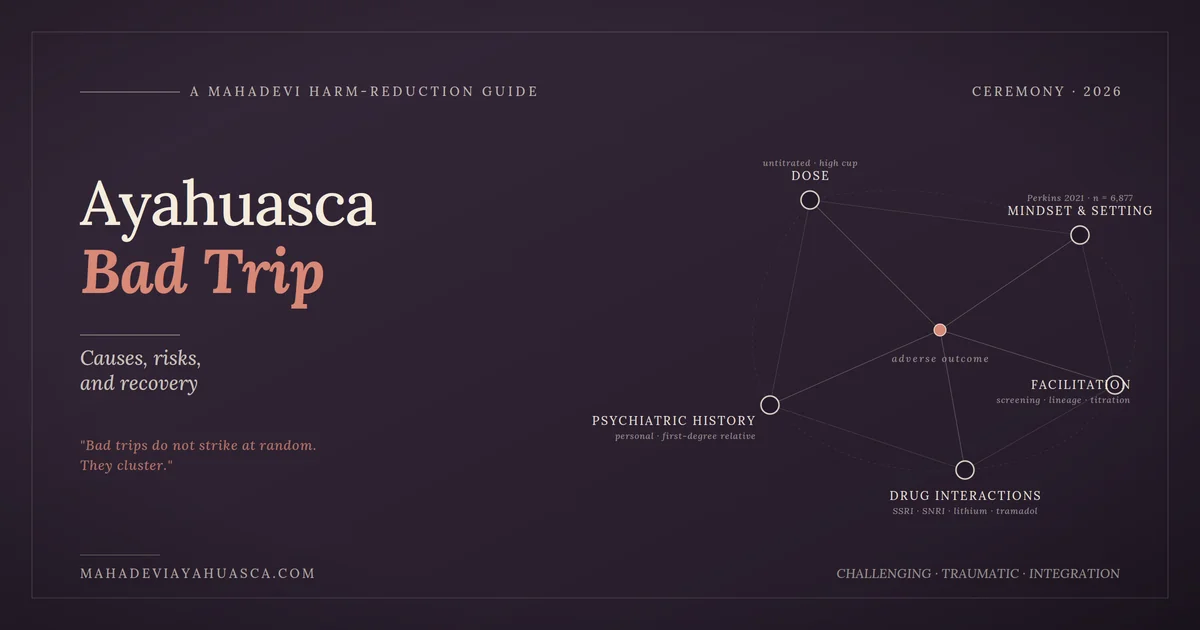
Bad trips do not strike at random. They cluster.
The bad outcomes in the literature share a pattern. Five factors do most of the work, and each is in principle controllable.
Dose. Ayahuasca is unstandardized. One maestro’s brew can be three or four times stronger than another’s. A first cup that lands at the top of the dose range produces a longer, harder, less navigable experience. Reputable ceremonial settings titrate. Tourist-track settings sometimes do not.
Mindset and setting. The largest survey of context variables in ayahuasca, with 6,877 participants, found that acute extreme fear during ceremony and integration difficulties afterward both tracked closely with the quality of the surrounding setting (Perkins et al., 2021). A separate survey of 2,751 ritual participants showed that ceremonial setting quality was inversely correlated with scores on the Challenging Experience Questionnaire, with leadership and social cohesion as the strongest moderators (Pontual et al., 2022). Setting is not décor. Setting is the safety equipment.
Facilitation. The presence of a skilled, trained ceremonial leader changes the entire risk profile. The Bouso adverse-effects analysis identified non-supervised context and pre-existing psychiatric diagnoses as the two strongest predictors of adverse mental health outcomes after ceremony (Bouso et al., 2022).
Drug interactions. The β-carbolines in Banisteriopsis caapi are reversible MAO-A inhibitors. They potentiate the orally inactive DMT in Psychotria viridis and they also potentiate every other serotonergic compound a person walks in carrying. SSRIs, SNRIs, MDMA, dextromethorphan, tramadol, lithium, and St. John’s wort all raise the risk of serotonin syndrome (Malcolm & Lee, 2018). A documented case of serotonin syndrome occurred when ayahuasca was combined with fluoxetine (Ruffell et al., 2020). For washout windows by drug class, see our SSRI and MAOI interaction guide.
Mental health vulnerability. Personal or family history of psychotic, manic, or bipolar disorders raises the risk of a destabilizing episode triggered by the ceremony (dos Santos et al., 2017). This is the area where honest disclosure on intake matters most, and where vague answers cause the most preventable harm. For deeper guides see ayahuasca and psychosis risk and ayahuasca and bipolar disorder.
| Cause | Mechanism | How to Mitigate |
|---|---|---|
| High or untitrated dose | Stronger DMT load and longer MAO inhibition produce a more confronting, less navigable experience | Choose a setting that titrates and offers a half-cup option for first-timers |
| Unprepared mindset | Untreated stress, unspoken intentions, ambivalence, or unprocessed grief amplify acute fear | Honest pre-ceremony reflection; a preparation conversation with the facilitator |
| Poor setting | Loud, chaotic, unfamiliar, or unsafe environments increase challenging-experience scores | Vetted retreat with established ceremonial space, music tradition, and community of facilitators |
| Untrained facilitator | No screening, no titration, no in-ceremony support when intensity escalates | Verify lineage, training, screening process, medical access, and integration follow-through before booking |
| Drug interactions | MAO-A inhibition potentiates serotonergic medications, raising risk of serotonin syndrome | Coordinate a proper washout window with the prescribing clinician well before any ceremony |
| Psychiatric vulnerability | Latent psychotic, bipolar, or dissociative conditions can be triggered by the experience | Honest disclosure of personal and family psychiatric history; choose a retreat that takes that history seriously |
The Real Dangers and Side Effects of Ayahuasca
The medicine is generally well-tolerated in healthy people in good settings. That sentence is doing a lot of work.
Acute physical effects are common and mostly transient. The Bouso 2022 analysis found that 69.9 percent of participants experienced acute physical adverse effects, with vomiting (the purga) the most frequent, while only 2.3 percent required medical attention afterward (Bouso et al., 2022). A randomized double-blind trial of three ayahuasca doses in healthy users found a statistically significant diastolic blood pressure rise of about 9 mmHg above placebo at 75 minutes after the high dose; the parallel systolic and heart-rate rises were reported as moderate and non-significant, with all values resolving by four hours (Riba et al., 2003). For most healthy adults the cardiovascular signature looks like a hard workout that lasts a couple of hours. For deeper coverage see ayahuasca and blood pressure and ayahuasca and the heart.
For people with cardiovascular disease, the same numbers are not benign. Ayahuasca is not recommended for anyone with significant hypertension or unstable cardiac conditions (ICEERS, 2019). A ten-year analysis of US poison-control calls related to ayahuasca exposure reported 41 cases with major clinical manifestations, three fatalities, four cardiac arrests, seven respiratory arrests, twelve seizures, and 92 ICU admissions out of 531 total calls (Heise & Brooks, 2017). The dataset is small. The signal is real.
Pregnancy is a direct exclusion. Animal models at four times the typical human dose produced maternal mortality and fetal anomalies, and the dieta of restraint that surrounds traditional ayahuasca use has historically excluded pregnant women for the same reason modern guidance does (Motta et al., 2018).
Psychiatric outcomes need the most nuance. Adverse mental-health effects in the weeks and months after ceremony were reported by 55.9 percent of survey participants, and around 88 percent of those people viewed those effects as part of a positive growth process (Bouso et al., 2022). The number that should not be glossed over is the small minority for whom the experience landed as harm, not growth. Psychotic episodes specifically are rare. The best estimates from religious-use cohorts place them between 0.0032 and 0.096 percent of servings, and they almost always occur in people with personal or family psychiatric history (dos Santos et al., 2017).
In April 2025 the U.S. Embassy in Lima issued a health alert advising American citizens not to ingest ayahuasca or kambo while in Peru, citing several deaths and severe illness among U.S. citizens that year (U.S. Embassy Lima, 2025). The advisory is worth taking seriously. So is the question of why the deaths happened. In almost every traceable case the ceremony failed at the level of the container, not the molecule.
Who Should Avoid Ayahuasca? (Contraindications)
For some people the answer is straightforwardly no. Honest screening is the kindness.
A serious facilitator screens for a defined list of conditions and medications. ICEERS’ practitioner guide, commissioned by the Catalan Department of Health, names the categories an honest intake should ask about: cardiovascular disease, serious hypertension, psychiatric conditions including a personal or family history of psychosis or bipolar disorder, epilepsy, pregnancy, and active spiritual emergencies (ICEERS, 2019). Anyone in those categories should not drink.
Medication interactions are where most preventable harm happens. β-carbolines in ayahuasca inhibit MAO-A, which means almost every drug that touches the serotonin system becomes pharmacologically loaded inside the body for the duration of the ceremony and for days afterward. Most people underestimate how wide the interaction profile actually is.
| Substance Class | Risk Level | Mechanism |
|---|---|---|
| SSRIs (fluoxetine, sertraline, paroxetine, escitalopram, citalopram) | Severe | Combined serotonin uptake inhibition and MAO-A inhibition can precipitate serotonin syndrome |
| SNRIs (venlafaxine, duloxetine) | Severe | Same serotonergic mechanism; potentially life-threatening |
| MAOIs and RIMAs (phenelzine, moclobemide) | Severe | Compounded MAO inhibition; hypertensive crisis and serotonin syndrome risk |
| Tricyclic antidepressants | Severe | Serotonergic and noradrenergic potentiation |
| Lithium | Severe | Significantly elevated serotonin syndrome risk |
| St. John’s wort | Severe | Serotonergic herbal supplement; same syndrome risk |
| MDMA | Severe | Combined MAO inhibition and serotonin release; documented fatalities with harmala-tryptamine combinations |
| Triptans (sumatriptan and related migraine drugs) | Severe | Serotonergic agonism; serotonin syndrome risk |
| Dextromethorphan, tramadol, methadone | Severe | Serotonergic activity in addition to opioid effects |
| Stimulants (amphetamines, methylphenidate, cocaine) | Severe | Compounded sympathomimetic load on a system already under MAO inhibition |
| Tyramine-rich foods (aged cheese, cured meat, fermented soy, certain wines) | Moderate | Hypertensive reaction; basis of the traditional dieta |
| Cannabis | Low to Moderate | No direct pharmacological emergency; can intensify anxiety and confusion in ceremony |
A washout window is required for any of the severe-risk medications, and the length of the window depends on the half-life of the specific drug. Fluoxetine, for example, has a long active metabolite and may require five to six weeks. Other SSRIs require shorter windows but never zero. The washout itself is a medical decision, not a personal one. Stopping psychiatric medication abruptly carries its own risks, and the right move is to coordinate with the prescribing clinician well before any planned ceremony date (Callaway & Grob, 1998).
A documented case of switch to mania after a four-day ayahuasca retreat in a previously undiagnosed bipolar man underscores why the bipolar question is non-negotiable on intake (Szmulewicz et al., 2015). Standardized clinical guidelines for ayahuasca administration now include explicit exclusion criteria for psychotic and bipolar disorders, severe cardiovascular disease, and uncontrolled medical conditions (Rossi et al., 2023).
How to Prevent a Bad Trip Before the Ceremony
Most of the work happens before you ever sit down in the maloca.
The pattern in the literature and in serious ceremonial communities is consistent. The people who have stable, integrable experiences tend to have done a few specific things before they ever drink.
- Vet the facility, not the marketing. A reputable retreat will require a written medical and psychiatric intake, will require a medication washout coordinated with your prescriber, will offer pre-ceremony preparation conversations, and will offer post-ceremony integration support. A facility that takes payment without asking the medical questions is the warning sign. Charge does not equal quality. The question to ask is not how comfortable the lodge is. The question is what the intake form looks like.
- Do the medical washout properly. This is the single most preventable cause of serious harm. Combining ayahuasca with a serotonergic medication is dangerous. The window required depends on the medication, and the answer comes from a clinician, not a retreat coordinator (Callaway & Grob, 1998). If a retreat is willing to seat you while still on an SSRI, that retreat is willing to seat anyone.
- Follow the dieta. Traditional Amazonian preparation includes dietary restrictions for one to two weeks before ceremony: no pork, no aged cheese, no alcohol, no recreational drugs, often no salt, sugar, or sex. The pharmacological reason is that the same MAO-A inhibition that makes oral DMT active also makes tyramine-rich foods risky (Malcolm & Lee, 2018). Tradition has a broader reason. Dieta is itself a healing practice that prepares the body and the attention.
- Prepare your mind. The setting research is unambiguous. A clear, unhurried week leading into ceremony, with sleep, time outdoors, and at least one honest conversation about your intention, materially reduces the probability of an extreme-fear ceremony (Perkins et al., 2021).
- Get a full physical. Especially if you have any cardiovascular risk factors, a recent EKG and blood pressure check are reasonable. The cardiovascular response to ayahuasca is dose-dependent and genuine.
- Disclose your psychiatric history honestly. Including family history. The strongest single predictor of a psychotic adverse event is undisclosed personal or family psychiatric history (dos Santos et al., 2017).
- Plan integration before you drink. Block out the week after the retreat. Identify a psychedelic-literate therapist, an integration circle, or two trusted people who can hold the conversation. Returning to a packed schedule the next day is the most common reversible cause of a difficult experience hardening into a worse one.
- Bring no expectations of what should happen. Most accounts of devastating disappointment trace back to a fixed idea of what the medicine was supposed to deliver. Ayahuasca rarely delivers what is asked of it directly. Often it delivers something more useful sideways.
What to Do If You’re Having a Bad Ayahuasca Trip
Inside the ceremony, the body knows things the panicking mind does not.
You cannot stop the ceremony once the brew is active. The DMT and harmala alkaloids will run their course over four to six hours. Trying to fight that fact tends to make a hard ceremony harder. A few tactics consistently help.
- Find your breath first. Slow exhale longer than the inhale. The vagus nerve responds within seconds. The visions do not stop, but the body stops fighting them.
- Surrender the storyline. Most people who report the worst trips were trying to control or escape the experience. Most people who report the most healing accepted what was happening, even when what was happening was terrible. The phrase that circulates inside Amazonian traditions is the one to remember: let the medicine work.
- Find the facilitator. Raise your hand. Make a sound. A trained facilitator will come over. Their job in that moment is to physically ground you, to sing or sit with you, sometimes to use rapé or agua florida, sometimes to redirect the energy of the ceremony itself. This is the entire reason the role exists.
- Do not leave the room. A panicked walk into the jungle is the most dangerous thing you can do during a hard ceremony.
- Use the body. Sit up. Drink water. Lie on the floor with the spine flat. Cry, vomit, shake. The body has a vocabulary for processing intensity and the medicine is calling on it.
- Know when it is medical. Severe chest pain, sustained tachycardia past tolerable limits, signs of serotonin syndrome (high fever, severe muscle rigidity, confusion), or seizure activity are emergencies. Trained ceremonial settings have written protocols and live contact with local emergency services. This is one of the questions to ask before you arrive (Rossi et al., 2023).
The ceremony will end. The body knows how to come back.
Recovering and Integrating After a Difficult Experience
What happens in the weeks after the ceremony decides what the ceremony becomes.
A difficult ceremony does not become a bad one because of the ceremony itself. It becomes one when there is no container to land in afterward.
The literature on integration is now clear enough to give a framework. Integration is not a single conversation with a therapist. It is a multi-month, often multi-year process of working with what came up, in your own life, with support (Cowley-Court et al., 2023). The clinical model that has emerged is two-stage: an early stage focused on stabilization, psychoeducation, and basic support over the first few weeks; and a later stage focused on deeper processing and behavior change over the following months (Greń et al., 2023).
- Find a psychedelic-literate therapist. Most generalist therapists are not equipped to hold psychedelic content. The Psychedelic Harm Reduction and Integration model is the most widely used clinical framework, and a growing number of therapists are trained in it (Gorman et al., 2021). Two or three sessions in the first month is the right rhythm. For trauma-informed approaches specifically, see our companion guide on the trauma-informed care framework.
- Use the body. Somatic practices, yoga, breathwork, time in nature, and consistent sleep do more for nervous system recovery than any insight conversation. The Cowley-Court qualitative study of 1,630 ayahuasca drinkers found that integration was experienced as somatic and communal as much as psychological (Cowley-Court et al., 2023).
- Find community. Integration circles, peer groups, or simply two or three people who can hold the conversation without flinching. Isolation is what turns difficult into traumatic.
- Slow down. Do not make major life decisions in the first month. Do not re-dose. The pull to repeat the experience while still processing the last one is one of the clearest patterns in people who report worsening rather than improving outcomes.
- Watch sleep, mood, and reality testing. Sustained insomnia, persistent anxiety, dissociation, intrusive imagery, or any blurring of what is real are signals to seek professional help quickly, not wait it out.
- Return to ordinary life on purpose. Cooking, walking, ordinary work, ordinary conversation. The ceremony is the seed. Ordinary life is where it grows or where it dies.
- Get help fast if needed. Suicidal thoughts, sustained panic attacks, dissociation that does not resolve, or psychotic symptoms in the weeks after a ceremony are reasons to contact a mental-health professional immediately. Most people who reported challenging effects later viewed them as growth, but a minority did not, and the minority needs care (Bouso et al., 2022).
Feel deeply.
Show up fully.
Frequently Asked Questions
Can you die from ayahuasca?
Deaths from ayahuasca itself are rare. A ten-year US poison-control review of 531 calls reported three fatalities, four cardiac arrests, and seven respiratory arrests, almost all in the context of unsupervised use, undisclosed medical conditions, or drug combinations (Heise & Brooks, 2017). Most documented deaths in retreat settings trace back to either undeclared serotonergic medication, undisclosed cardiac disease, or co-administration of other substances such as kambo. The molecule is not the usual cause. The container is.
Can ayahuasca cause psychosis or permanent brain damage?
Psychotic episodes triggered by ayahuasca are rare in the literature, with prevalence in religious-use cohorts estimated between 0.0032 and 0.096 percent of servings, and they cluster heavily in people with personal or family history of psychotic or bipolar disorders (dos Santos et al., 2017). There is no evidence of permanent brain damage from properly screened use. The risk is real but specific, and it is precisely the risk that honest psychiatric screening exists to prevent.
How long does a bad ayahuasca trip last?
The acute experience runs four to six hours from onset. The most intense portion is usually the middle two hours. After the brew wears off, the nervous system continues to settle for the next twenty-four to seventy-two hours, with sleep often disturbed for a day or two. A difficult trip rarely produces lasting symptoms. A traumatic one can echo for weeks or months and is the reason structured integration support exists.
What does a bad ayahuasca trip feel like?
The accounts converge. A felt sense of dying. Confronting visions that loop. A loss of any sense of where the body ends. Memories surfacing without warning. Time dilating into something unrecognizable. Profound fear, sometimes terror. The same descriptors appear in accounts of breakthrough healing experiences. The difference is rarely the content. The difference is whether the person felt held, and whether the experience could be metabolized afterward.
Can you stop an ayahuasca trip once it has started?
No, not pharmacologically reliable. Once the harmala alkaloids and DMT are active, the experience runs its course. Anecdotal reports describe small amounts of GABAergic medication or even sleep partially softening the intensity, but no over-the-counter intervention reliably ends a trip. What does help is a trained facilitator, breathwork, physical grounding, and the willingness to stop fighting. In genuine medical emergencies, hospital intervention follows standard protocols for whatever the specific complication is.
Who should avoid ayahuasca?
Anyone with a personal or family history of psychotic, manic, or bipolar disorders. Anyone with significant cardiovascular disease, uncontrolled hypertension, or epilepsy. Anyone currently pregnant or breastfeeding. Anyone currently taking SSRIs, SNRIs, MAOIs, lithium, tramadol, dextromethorphan, St. John’s wort, or other serotonergic medication without an adequate medical washout (Malcolm & Lee, 2018). Anyone in active psychiatric crisis. The medicine is not for everyone, and a serious facility says so.
Is ayahuasca bad for the brain?
Standard ceremonial doses do not appear to produce neurotoxicity in humans, and ICEERS’ published safety profile concludes that ayahuasca does not produce brain or body toxicity at typical doses, nor dependence, nor tolerance (ICEERS, 2019). The harmala alkaloids and DMT have measurable neuroplastic effects, which are part of why the medicine has shown therapeutic promise. The risks are not neurochemical degradation. The risks are acute, situational, and largely preventable through proper screening.
What is the difference between a difficult ayahuasca trip and a traumatic one?
A difficult trip is intense, often frightening in the moment, and metabolizable afterward with support. The person comes through it. A traumatic trip leaves the nervous system registering the ceremony itself as the wound, with intrusive memories, hypervigilance, and sleep disruption that does not resolve on its own. Difficult trips often turn into healing. Traumatic trips need clinical care. The variables that decide which one a person has are mostly known, and mostly addressable in advance.
Conclusion
Most people who drink ayahuasca do not have a bad trip. Many have a hard one. A smaller number have one that injures.
The variables are mostly known. Dose. Setting. Facilitation. Drug interactions. Mental health history. Each can be addressed before the cup is poured. Most cannot be addressed after.
The medicine itself is real. So is the harm when it is approached carelessly. The single piece of information that most people are not given clearly enough is that the ceremony does not end when the brew wears off. What you do in the weeks after is what determines whether the experience integrates into a life or fragments away from it.
Take it seriously. Or do not take it.
Both are honest answers. Neither is the wellness-marketing one.